The wine sector’s major transformation: adapting to climate change and shifting consumer preferences
The wine sector is undergoing a profound transformation. Since the mid-2010s, the effects of climate change and shifting consumption patterns have been redefining the conditions under which it operates and its sustainability. In this context, enhancing production resilience with varieties that are more resistant to the new climate conditions and responding to new consumer preferences are unavoidable objectives. In Spain, this adaptation is already underway, with a growing recovery of native varieties better suited to heat and water stress, an increased presence of lighter wines, and a stronger commitment to quality and differentiation. However, the sector still has room to improve how it markets and captures value, especially in international markets.

A dual structural challenge for the Spanish wine sector
Wine holds a unique position in Spain’s agrifood sector. This is not only due to its economic significance – Spain has the largest vineyard land area in the world and is among the leading international producers and exporters – but also because of its close ties to the land, culture and Mediterranean diet.11 Globally, and especially among European producers, the wine sector is undergoing a profound transformation that is altering some of the foundations that have underpinned its development in recent decades. Unlike other cyclical episodes, the current changes are simultaneously affecting supply and demand, creating a more complex and uncertain environment for producers and marketers.
- 11
For a structural overview of Spain’s wine sector, see the article «The Spanish wine industry, a symbol of tradition and global standard» in the Agrifood Sector Report of 2021.
Current state of the global wine sector: lower yield and consumption
On the supply side, global wine production has been declining in recent years, particularly among European producers. Although the global vineyard land area has remained relatively stable, yields have fallen sharply (with the exceptions of Argentina and South Africa). Climate change is central to this pattern: the increasing frequency and intensity of adverse weather events heightens crop volatility and complicates planning.
Spain has the largest vineyard land area in the world and is one of the leading producers and exporters However, yields have fallen sharply due to climate change
In addition to this challenge there is a second structural shift: the transformation of global wine demand. Since the mid-2010s, global consumption has been on a downward trajectory and in 2025 it was approximately 3% below the average of the previous five years. Multiple factors are driving this trend, notably changes in the consumption habits of younger generations, increased health concerns and moderation in alcohol consumption, as well as growing competition from other non-alcoholic beverages. The decline is not affecting all products or consumers equally: everyday and traditional consumption has fallen more sharply, while products associated with quality, origin and forms of consumption linked to leisure, gastronomy and experiences are faring better.
In this new scenario, the question is no longer merely about how to produce wine under more adverse climatic conditions or how to respond to weaker demand, but how to adapt supply to a different reality. Competitiveness will increasingly depend less on volume alone and more on the sector’s ability to innovate, differentiate its products, incorporate more resilient varieties, reach new consumers and generate greater added value.
Rising temperatures are reshaping Spain’s wine map
Grape production for winemaking is heavily influenced by weather conditions throughout the entire growing cycle. Phenomena such as late frosts, drought, heatwaves or hail can impact both harvest yields and quality. Among all these factors, temperature plays a particularly key role as it determines the growth rate of grapevines, alters its phenological calendar and influences the balance between sugars, acidity and aromatic compounds. Thus, climate change not only poses a quantitative problem; it also affects the wine’s profile and the ability to preserve the characteristics that identify each production area.
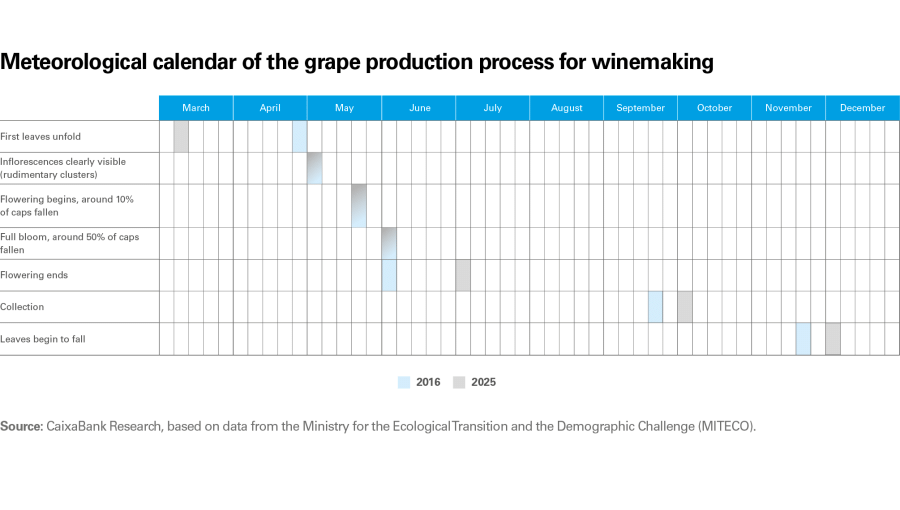
Climate change not only affects production, but also the wine’s profile and the ability to preserve the characteristics that identify each production area
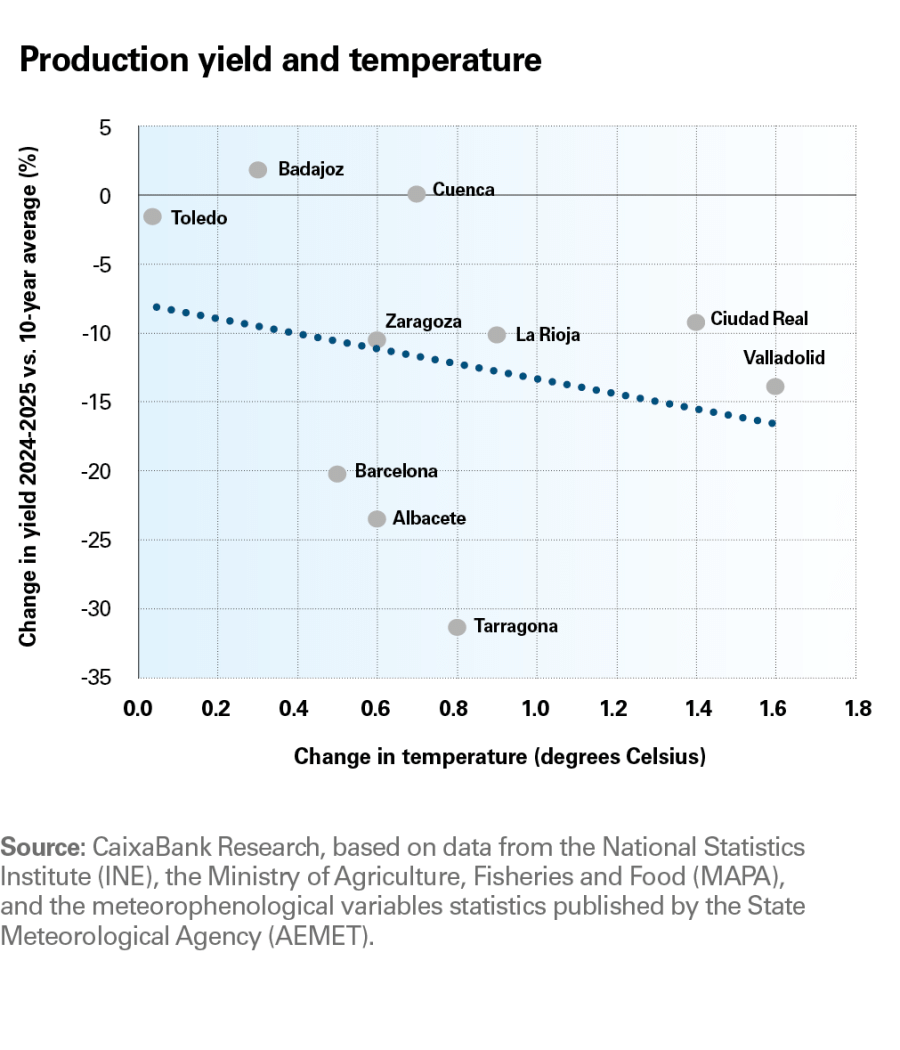
Data at the provincial level indicate that these effects are already visible in Spain. Between 2015 and 2025, the main producing provinces recorded widespread rises in peak temperatures, which were particularly intense in areas such as Valladolid, Ciudad Real, La Rioja and Tarragona. When correlating this pattern to yields observed in recent seasons, a negative relationship emerges: provinces that have experienced greater warming tend to show poorer productive performance compared to their historical average. Although this relationship is not uniform and also depends on factors such as water availability, soil type, altitude and the varieties being cultivated, evidence suggests that climate change is increasing harvest volatility and making it difficult to maintain the productivity levels that traditionally characterised some of Spain’s main producing areas.
Rising temperatures are affecting vineyard yields in the main producing regions
Not only is there less demand for wine, but it is also being consumed in a different way
Alongside the challenges posed by climate change and increasing international competition, the Spanish sector is facing a transformation in demand. Per capita wine consumption has been declining for decades in traditional European markets, and Spain is no exception. This trend is driven by demographic factors, changes in consumption habits and younger generations’ weaker connection to wine.
Between 2019 and 2025, wine consumption at home fell by 11.7%, compared to a 7.1% decline for all beverages, according to the Household Consumption Panel of the Ministry of Agriculture, Fisheries and Food. However, the trend has been uneven: consumption has decreased, but it has also changed in nature. While red wine and most traditional categories are losing ground, white and rosé wines are gaining market share, reflecting a growing preference for lighter products suited to consumption linked to leisure, gastronomy and experiences.12 These same trends are also observed outside the home, despite the boom Spain’s restaurant sector is currently enjoying, driven by the dynamism of the tourism sector.13
Meanwhile, sparkling and carbonated wines, along with traditional formats like the bottle, are the categories losing the most market share. In contrast, wines covered by a PDO (protected designation of origin) or a PGI (protected geographical indication) are showing greater resilience, indicating a growing demand for differentiated products with higher added value.
The generational dimension is particularly important. While consumption has barely changed among older households, it has fallen by nearly 45% among those under 35, especially among those who are young and independent and childless couples. These patterns reflect a decline in the role of wine in younger generations’ daily habits, within a context marked by a reduced inclination towards alcohol consumption, increased health concerns and an ever-expanding range of alternative beverages.
Overall, the evidence suggests that the main challenge for the sector is not just a reduction in the volume consumed, but a transformation of the demand itself. Frequent consumption is declining while more occasional consumption linked to leisure, gastronomy and experiences is gaining prevalence. Consumers are buying less wine, but they show a greater willingness to pay for products associated with origin, quality, sustainability or wine tourism. Simultaneously, new opportunities are emerging in segments such as low-alcohol or alcohol-free wines. The ability to respond to these new preferences will be one of the main determinants of the sector’s future growth.
- 12
The consumption of foreign non-sparkling wines has shown significant growth since 2019. However, given that in 2025 it accounts for just 0.10 litres per household, its impact on total consumption remains minimal.
- 13
Although the analysis in this article focuses on domestic consumption, the observed trends are also reflected in out-of-home consumption: between 2019 and 2025, per capita wine consumption at catering establishments fell by 35.5%, with particularly sharp declines recorded in rosé wine (–68%), cava (–48%), and red wine (–45%), among other categories.
Changes in beverage consumption patterns in Spanish households
Change from 2019 to 2025 (%)
How is the wine sector’s offering responding to the transformation?
The new context of climate change has forced the sector to go beyond temporary responses to each harvest. So far, two major complementary strategies have emerged:
i) the development and implementation of PIWI varieties,14 designed to enhance resistance to fungal diseases and significantly reduce the use of plant protection treatments, thereby contributing to more sustainable viticulture;
ii) the recovery and revival of grape varieties better suited to today’s climatic conditions.
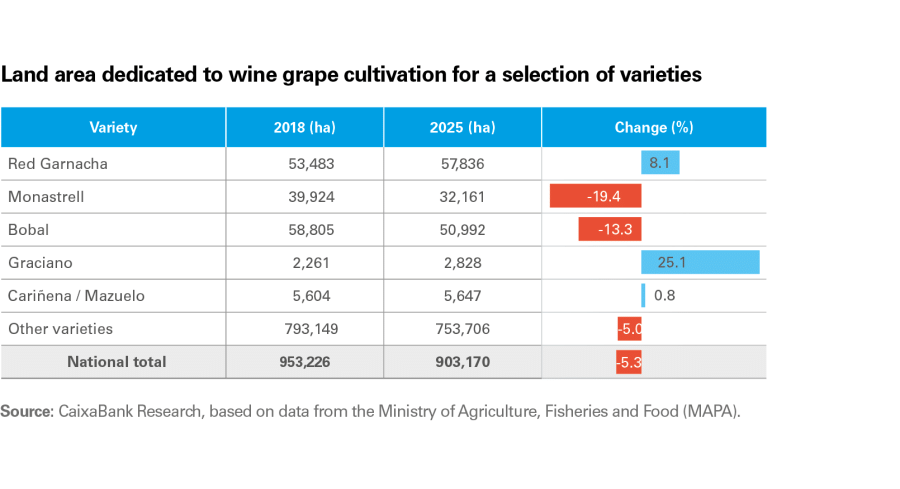
PIWI varieties allow for reduced costs and dependency on plant protection products, and are mainly used by Central European producers. As shown in the following table, the Spanish sector stands out for its use of native Mediterranean grape varieties, traditionally adapted to warm and dry conditions. Their hardiness and drought tolerance offer a competitive advantage in a climate change scenario.15
- 14
PIWI varieties (Pilzwiderstandsfähig or «fungus-resistant») are grapevine varieties developed through conventional genetic crossing and selection, which exhibit high resistance to certain cryptogamic diseases. Their main advantage is that they allow for a substantial reduction in the use of fungicides, which helps improve sustainability and the vineyard’s adaptation to new environmental demands.
- 15
In Spain, the native Mediterranean varieties best adapted to heat and water stress conditions include Garnacha, Monastrell, Cariñena or Mazuelo, and Bobal, as well as other local varieties such as Graciano, Sumoll, and Manto Negro.
On the other hand, the composition of production shows that Spain’s wine sector is also responding, albeit still gradually, to the changes in consumer preferences mentioned above. White and rosé wines are gaining ground (although reds still dominate), and there is a high presence of wines with PDO. Overall, while red and aged wines continue to hold a central position in the product range in Spain, there is also an increasing diversification towards whites, rosés and younger wines. In this way, the sector maintains its traditional offering for older consumers or those willing to pay more (a more traditional consumer profile), while gradually expanding its range to attract younger profiles and respond to new, more occasional and informal consumption patterns. All the indicators suggest that this shift will become much more evident in the coming decades.
The offering of wine products is gradually adapting to new consumer preferences
However, the adaptation of the Spanish supply is less evident in its export strategy. Although average export prices have risen across all major categories, the composition of foreign sales has barely changed: bulk wines still account for more than half of the export volume, and bottled wines have lost export share. Consequently, Spain remains a major exporter in terms of volume, but is making slower progress in terms of added value.
The most visible progress is concentrated in the higher quality and differentiated segments, where average prices have increased significantly. However, their limited gain in market share relative to total exports suggests that transforming the export model in favour of higher-value categories remains one of the sector’s main challenges.