
What has driven the global rise in long-term interest rates?
So far this year, sovereign yields have risen across the board in the main developed economies, with a particularly sharp increase at longer maturities. Synchronised trends in the US, Europe and Japan point to global forces that go beyond fiscal or institutional factors specific to each country. Although the conflict between the US and Iran has intensified the move, the trend has been evident since late 2024.

The nature of this rebound matters because the possible explanations for it have very different economic implications. One interpretation attributes it to higher inflation expectations or a loss of confidence in the sustainability of public finances. Another, particularly in the US, links higher real interest rates to stronger growth prospects stemming from the deployment of artificial intelligence (AI) and a possible rise in the neutral interest rate. A third explanation, which lies midway between the two, links greater public and private investment needs to a more price-sensitive investor base that demands higher returns to fund them. Although all three play some role, this latter explanation appears to be the most influential.
Real rates are driving the move
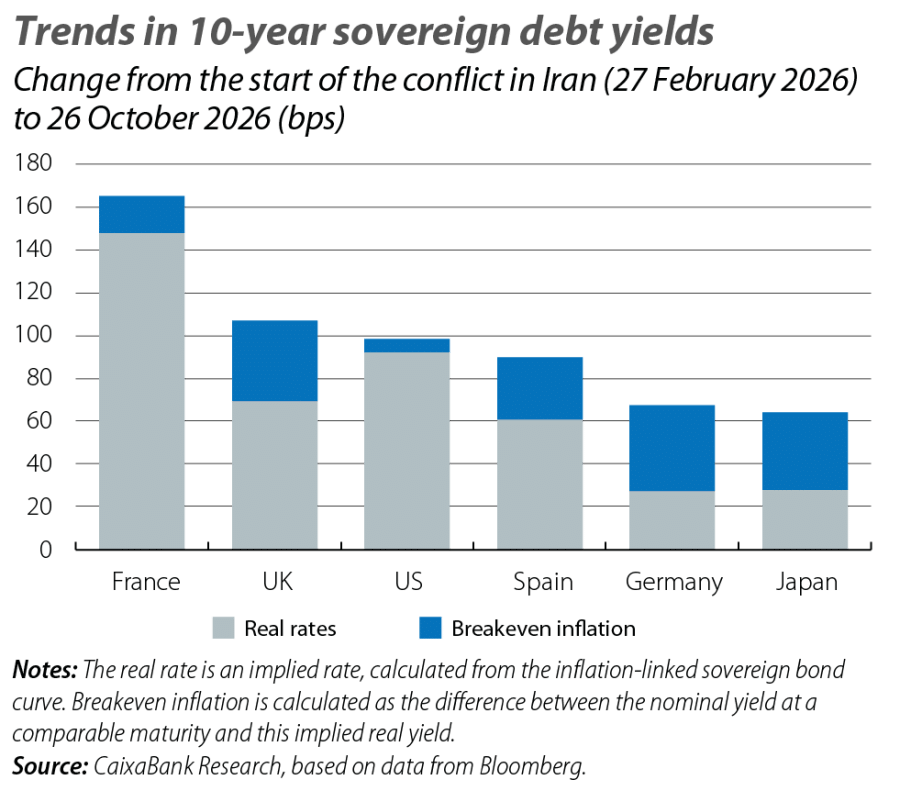
The rise in long-term interest rates is not primarily driven by higher inflation expectations, although their contribution varies across countries and stages of the conflict. Since the start, real rates have accounted for around 93 of the nearly 100-bp rise in the US 10-year interest rate. Germany and Japan have a more balanced composition, but compensating for inflation, despite gaining importance in recent weeks, is not the main driver of the trend either in the year to date or since the end of 2024.
More than a broad-based crisis of sovereign confidence
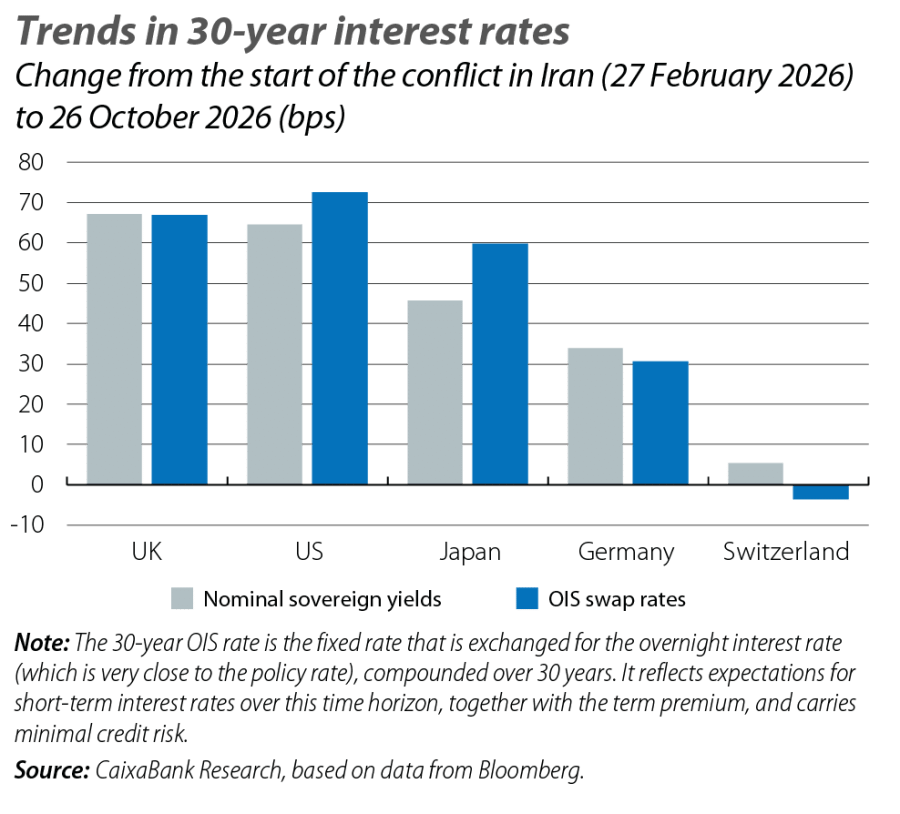
The rise also does not appear to be driven mainly by a widespread crisis of confidence in public finances. The broad-based move affects economies with widely differing fiscal positions and is not confined to those with the most worrying debt trajectories. Switzerland is a notable exception, with a much smaller rebound and a favourable fiscal position. Nevertheless, other economies with sound public finances and no significant deterioration expected, such as Denmark and Norway, have been similarly affected, as they are more exposed to common forces including the European monetary cycle and increased spending needs related to geopolitics and defence.
Trends in swap rates confirm that a substantial part of the shift reflects a general rise in the cost of long-term capital, rather than merely a higher sovereign risk premium. Since late February, the rate on the 30-year dollar Overnight Index Swap (OIS) has risen by around 70 bps, compared with around 65 bps for the equivalent Treasury. In the United Kingdom, OIS rates have risen by almost as much as the gilt, while in the euro area the OIS rate has increased by around 30 basis points, some 5 basis points less than the bund.
Country-specific fiscal risks do appear to explain differences in the scale of rate increases across countries. France is the clearest example. Alongside the broad rise in long-term interest rates, since early 2023 and amid QT, the spread on 10-year French sovereign debt over the European OIS rate has widened by around 170 bps, compared with some 115 bps against the bund. This reflects both a premium linked to France’s fiscal and political situation and the lower scarcity premium on German debt as the ECB reduces its sovereign bond holdings.
Why, then, have real interest rates risen?
Part of the increase reflects expectations that policy rates will remain higher for longer. Between September 2024 and early 2026, the rise in interest rates was relatively more concentrated at longer maturities, pointing to structural forces. However, the conflict in Iran and the energy shock have also prompted a sharp repricing at the short end. Whereas markets were pricing in rate cuts at the start of the year, they are now anticipating several further hikes, putting upward pressure on risk-free rates across the curve.
Even so, for the US, one of the Fed’s decompositions of the 10-year Treasury yield1 confirms that the revision of expected risk-free rates does not explain the entire move. Since the outbreak of the conflict in Iran in March, just over 40% of the rise in the 10-year Treasury yield can be explained by higher expected short-term real interest rates, while around 30% appears to reflect a higher real term premium. In other words, expectations about the path of monetary policy account for only slightly more than the higher compensation which investors are demanding for duration risk.
A second explanation for the rise in real interest rates is stronger global demand for investment capital. In the US, for example, the Bloomberg consensus forecasts real private investment growth of almost 5% in 2026 and 2027, up from 3.1% in 2025. The technology companies dominating the AI infrastructure boom, known as hyperscalers, are alone expected to invest around 800 billion dollars in 2026 and more than 1.1 trillion in 2027 (2.4% and 3.4% of expected nominal GDP in each year, respectively).
This substantial investment does not necessarily mean that the neutral rate has risen permanently. Expectations of high future returns may spur investment before the technology’s productivity effects become visible, increasing competition for savings and thereby raising real interest rates.2
In Europe, defence needs, energy security and infrastructure are also competing for savings, alongside growing issuance in European currencies by several AI companies.
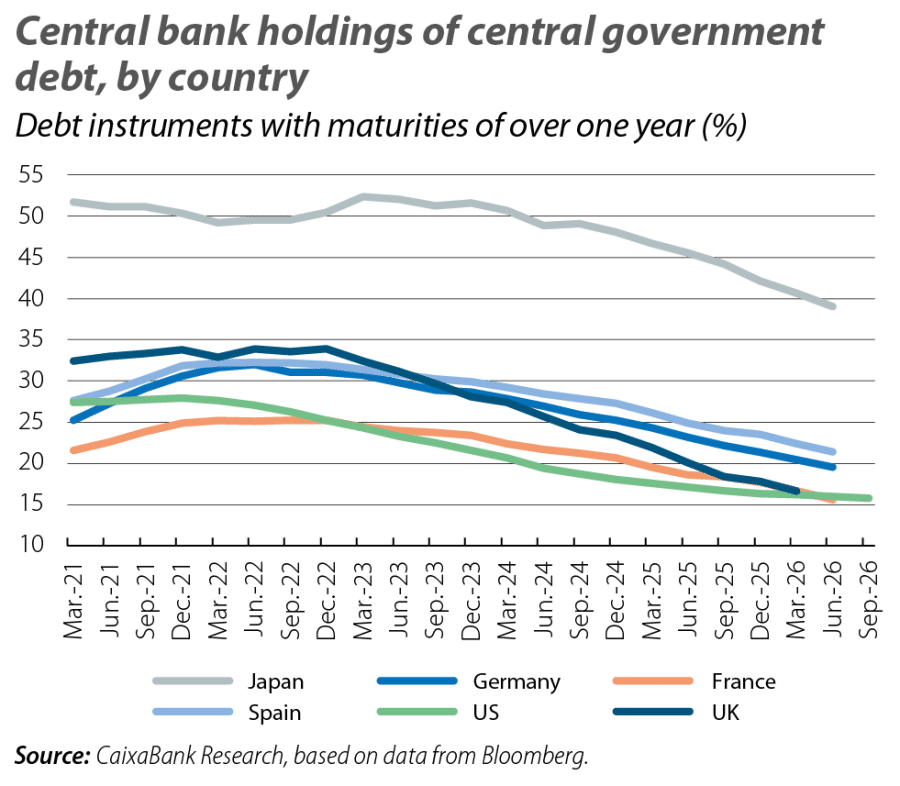
Finally, the shift in the investor base also helps explain why greater funding needs may require higher returns. During QE, central banks and other official buyers absorbed large volumes of debt with little regard for returns, reducing the amount available to the rest of the market. As their balance sheets normalise, more debt is held by price-sensitive private investors, and some of the scarcity or convenience premium that compressed sovereign yields during the QE era may dissipate.
A new price for capital
Ultimately, markets appear to be seeking higher returns to meet growing global funding needs. Inflation and policy rate expectations have contributed to the rebound, particularly since the outbreak of the conflict in Iran, but real rates have been the main driver. Higher investment demand, high debt stocks, a lower scarcity premium and a more price-sensitive investor base complete the explanation. Fiscal deterioration is therefore an important part of a broader story, not its sole cause.
Macrofinance
What factors will determine the evolution of interest rates, investment sentiment and macro-financial conditions in general?