
Global economic outlook and financial conditions: autumn 2026
Economic activity thus faces an outlook with higher energy prices, higher interest rates and higher inflation. At the same time, financial conditions as a whole are less restrictive than they might appear, thanks to the counterbalance provided by the strong performance of stock markets so far this year and the relative stability of exchange rates, while the AI-related investment boom is helping to offset the burden of the conflict in the Middle East.
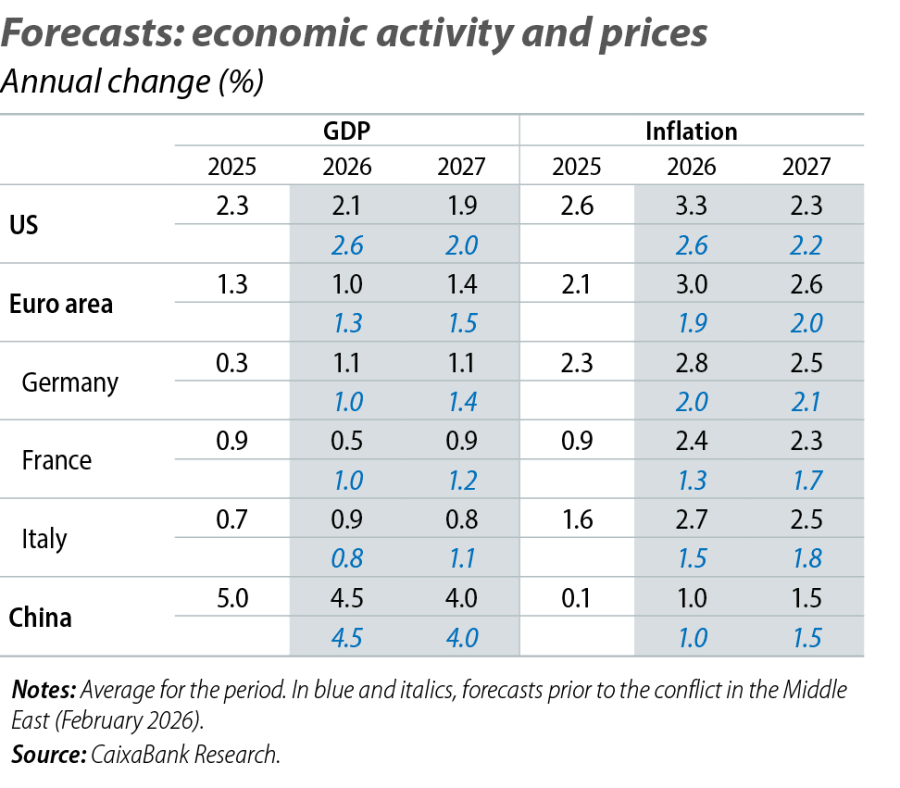
The conflict in the Middle East and the disruptions it is causing continue to set the pace for the global economy. To date, economic activity has remained resilient and inflationary pressures, although significant, have been confined to energy, with no signs of substantial indirect effects on other prices. However, the persistence of the conflict and its uncertainty have led central banks to shift gears and implement the first interest rate hikes.
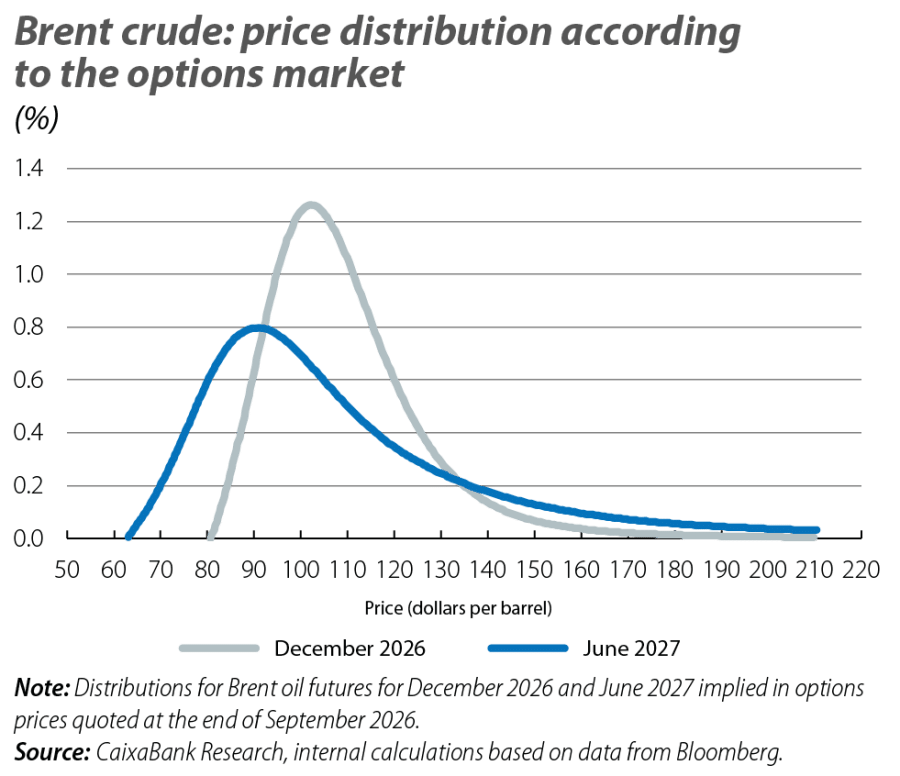
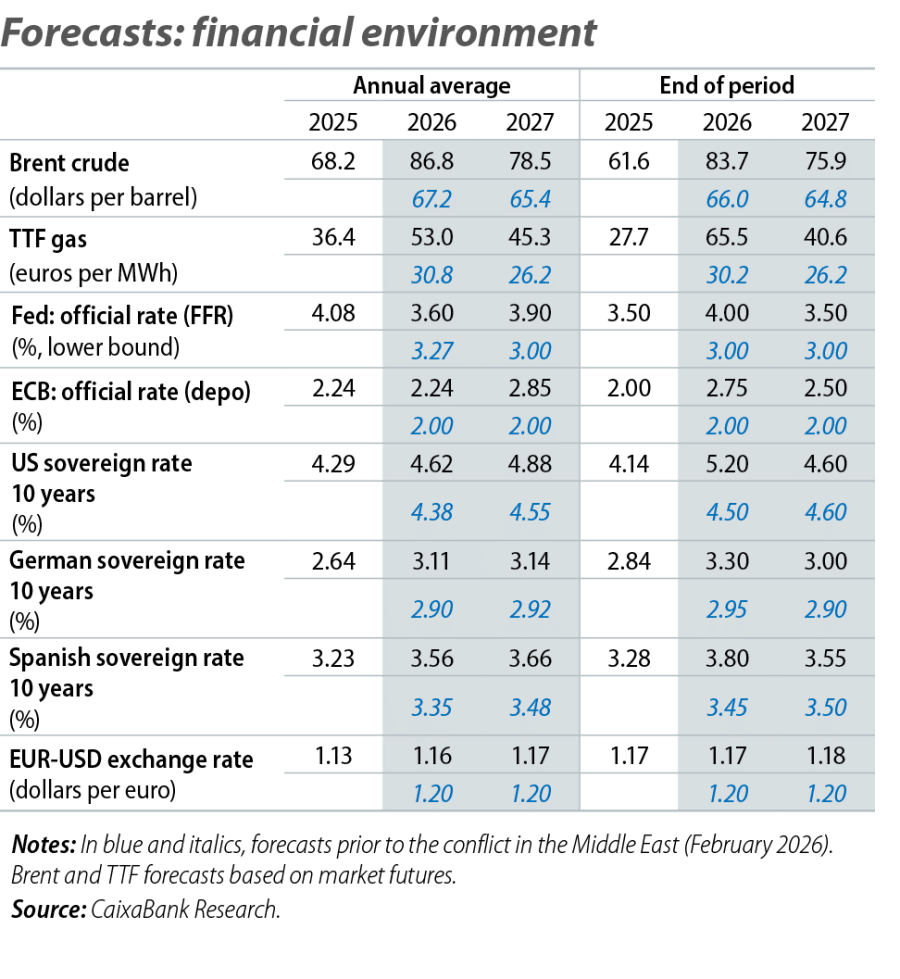
The starting point for our scenario is an environment of relatively demanding energy prices. Our forecasts are anchored in the oil and gas futures traded on financial markets, which as of the closing date of this article1 suggest a gradual, albeit incomplete, easing over the coming quarters. Specifically, a barrel of Brent is expected to reach between 80 and 90 dollars in the final quarter of the year and between 75 and 80 dollars in 2027, while TTF gas prices are forecast to lie slightly below 70 euros for the remainder of 2026, before falling towards 40 euros during the course of 2027. This starting point is also subject to significant risk. Energy prices have shown an ability to ease rapidly if the conflict in the Middle East is resolved. However, the closure of the Strait of Hormuz is depleting the reserves that have cushioned the disruption of flows,2 and the outlook has become more uncertain following the failure to reach a resolution over the summer. Thus, markets are pricing in a range of oil prices with a wide array of possibilities and a clear bias towards the persistence of disruptions (see first chart).
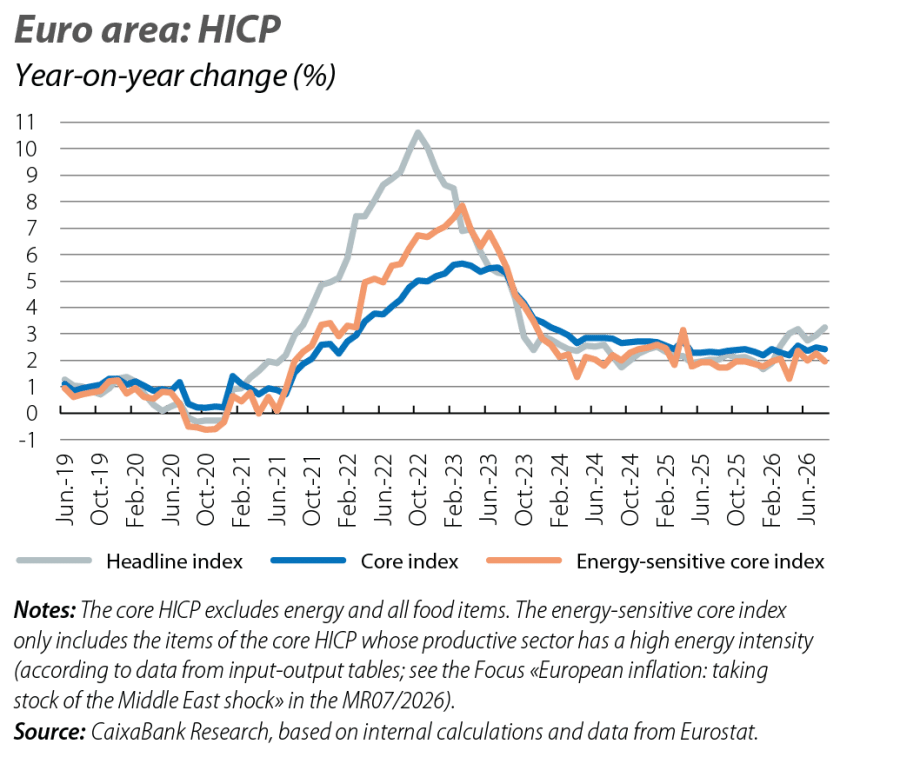
Based on the projected path for energy prices, economies such as the US and the euro area are likely to see inflation surpass 3.5% over the coming months, or even approach 4%, driven by energy and especially fuels.3From the spring of 2027, inflation should fall suddenly4 and return to levels closer to 2.5%. One of the key factors will be whether or not energy inflation has spread by then to other prices. For now, the indirect effects are limited, and there are several factors that suggest they can remain limited in the future: the restrictive monetary policy, the less accommodative fiscal policy than in the past, and the fact that activity remains resilient but is not booming. Nevertheless, three major sources of risk exist, stemming from refined oil products (such as diesel, the demand for which covers a variety of uses and which is further strained by the war in Ukraine and export restrictions), food (rising fertiliser costs, extreme weather events), and the threat of disruptions to global supply chains (e.g. attacks in the Red Sea).
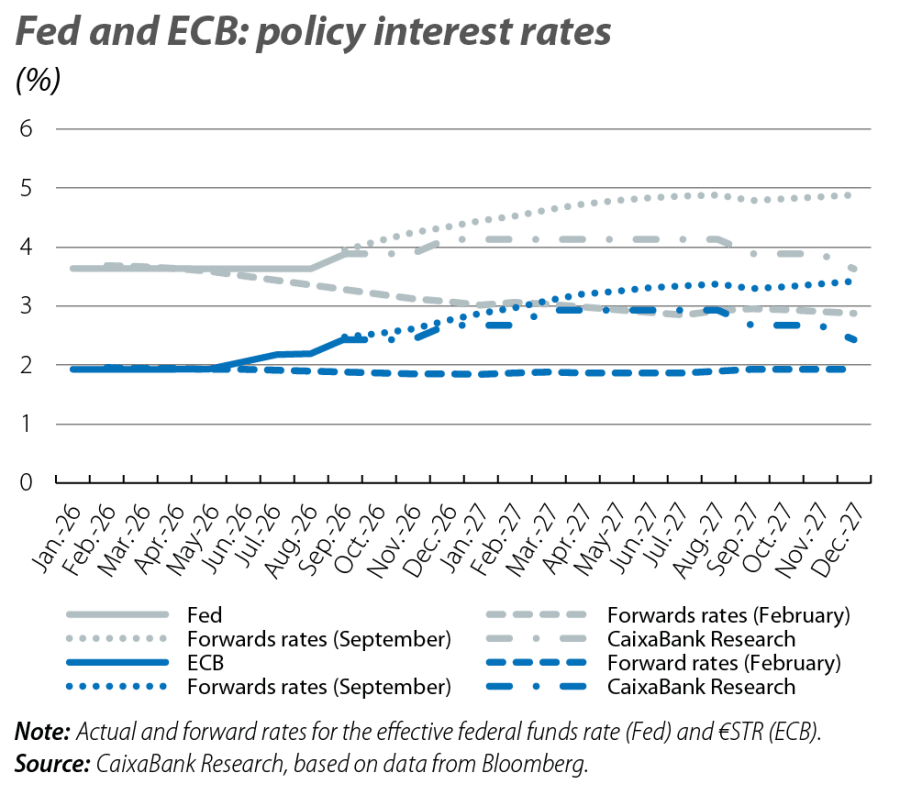
It is the intensification of inflationary risks, linked to a longer and more uncertain conflict, that has led central banks to raise rates. In the data themselves, underlying price pressures have remained virtually unchanged since the start of the conflict (see second chart). However, the longer the disruptions last, the greater the risk that these price pressures could spread to other components, causing inflation to gain momentum. This is why both the Fed and the ECB have started to raise rates. Furthermore, the resilience of economic activity gives both central banks room to tighten monetary policy a little more. All this leads us to anticipate that the Fed and the ECB will eventually raise rates to 4.00%-4.25% and to 3.00%, respectively. However, the improvement in inflation during the course of 2027 will likely allow for a relatively swift easing of monetary policy.5
- 3
The main components of energy inflation are fuels and electricity. So far, the shock has primarily impacted fuels, while transmission delays and greater production from renewables (which reduces the role of gas as a marginal producer) have mitigated the impact on electricity.
- 4
Due to base effects in energy, as the denominator for year-on-year inflation will include the initial months of the conflict.
- 5
Markets are pricing in a more aggressive tightening, with higher rates for longer.
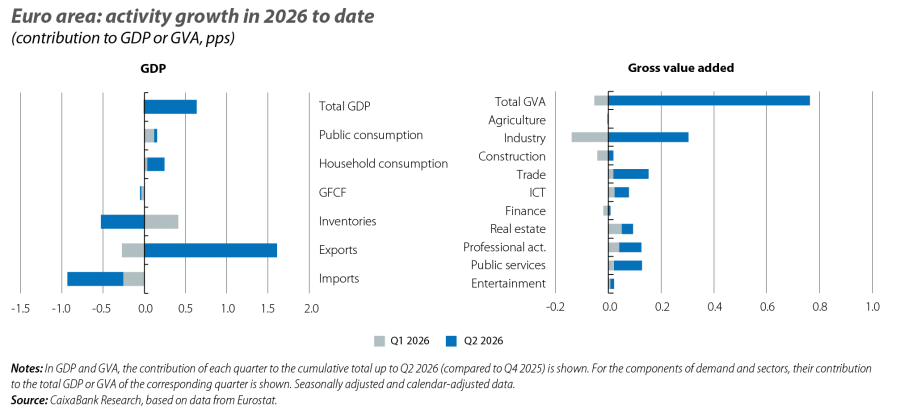
Economic activity thus faces an outlook with higher energy prices, higher interest rates and higher inflation. At the same time, financial conditions as a whole are less restrictive than they might appear, thanks to the counterbalance provided by the strong performance of stock markets so far this year and the relative stability of exchange rates. Moreover, the AI-related investment boom is helping to offset the burden of the conflict in the Middle East. So far, economic activity has shown resilience: euro area GDP grew at an annualised rate of just over 1% in the first half of 20266 and that of the US, at just under 2%, while China’s GDP remained within the 4.5%-5.0% year-on-year range targeted by the authorities. Furthermore, in recent months, indicators such as the PMIs reveal a recovery in sentiment to the highest levels this year, leading us to project a continuation of steady economic growth, supported by a strong labour market.
- 6
The euro area has grown at an average annualised quarter-on-quarter rate of 1.3% (1.2% excluding Ireland). Germany has done so at 1.6%, Spain at 2.7%, and Italy at 1.0%. France, on the other hand, has contracted at an annualised quarterly rate of 0.3%.
There are regional differences behind this picture. The euro area is relatively more exposed to the rise in energy costs due to its reliance on imported fossil fuels, but it benefits from momentum in investment and defence spending plans. Furthermore, the periphery’s dynamism and Germany’s renewed acceleration contrast with France’s stagnation. The greater energy autonomy of the US, on the other hand, reduces the direct impact of the shock, and US activity is also benefiting particularly from the AI boom. Nevertheless, persistent inflation and a restrictive monetary policy will also act as a brake on domestic demand. China’s economy combines weakness in its real estate sector and domestic demand with resilience provided by its extensive oil inventories and the boost of higher value-added goods exports (related to green technologies and AI).
All this lays the ground for a challenging, but not necessarily negative, outlook. The Middle East, energy disruptions and geopolitical tensions will continue to determine the economy’s course, so the outlook could change rapidly and in multiple directions. The AI investment cycle also presents double-edged risks: it could drive growth through increased demand and productivity, or it could hinder it if it triggers new episodes of financial turbulence.7 At the same time, we must not forget the environment of high public debt and higher interest rates, with increasing scrutiny from investors in economies such as France and the US. Finally, we must also not forget the trade tensions, despite the framework of US tariffs stabilising in the past year; after all, while their legal form may have changed, their basis has remained broadly similar, aiming for an average tariff with the rest of the world of around 10%.
- 7
Recent quarters have already provided some examples: the delicate balance between the high stock market valuations related to AI and the ambitious corporate earnings expectations, the risk of disruption in traditional sectors, and the competition for funding (which is contributing to higher sovereign interest rates).
Macrofinance
What factors will determine the evolution of interest rates, investment sentiment and macro-financial conditions in general?