Spain: 2027 macroeconomic outlook
Spain is facing the latest episode of international geopolitical tension from a position of strength, although rising energy costs, tighter financial conditions and a deteriorating international environment will keep inflation high and reduce economic dynamism. All this has led us to revise upwards our growth forecast for 2026 and to keep the forecast for 2027 unchanged.

The geopolitical conflict in the Middle East continues to shape the macroeconomic environment. In July, hostilities between the US and Iran resumed, triggering heightened tension in the energy markets ever since. Despite this challenging environment, Spain’s economy continues to grow steadily. In Q2, GDP grew by 0.7% quarter-on-quarter, driven by private consumption, investment, and service exports. This performance exceeded our forecast of 0.5%. Moreover, the available indicators for Q3 suggest that this positive trend is continuing: confidence remains high, the peak tourist season has yielded very positive results, and employment continues to enjoy rapid growth, partly thanks to the regularisation of undocumented migrants.
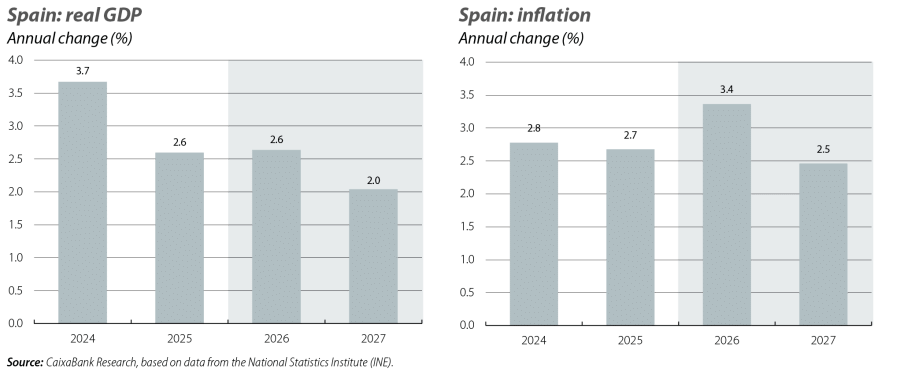
Although Spain is facing this new episode of international geopolitical tension from a position of strength, rising energy costs, tighter financial conditions and a deteriorating international environment will keep inflation high and reduce economic dynamism. Therefore, incorporating the latest data leads us to revise our GDP growth forecast for 2026 upwards by 0.2 pps, to 2.6%. However, we maintain the forecast for 2027 at 2.0% to account for these stronger headwinds.
The assumptions underlying the new scenario
Our baseline scenario anticipates that geopolitical tensions will gradually ease in the coming months, but we do not expect a definitive resolution to the ongoing conflicts over the next year. In fact, occasional episodes of heightened tension cannot be ruled out, although this scenario assumes they will be short-lived.
The international conflict is primarily impacting our economy through the energy channel. This results in higher inflation and, as a consequence of central banks’ response to this situation, a rise in interest rates.
We anticipate an average oil price of around 87 dollars per barrel in 2026, moderating to 78.5 dollars in 2027. This forecast for 2027 is approximately 20% higher than the market was anticipating back in February, before the outbreak of the conflict in the Gulf. This anticipated price trend is consistent with a scenario involving an easing of tensions, but without a definitive resolution to the conflict. Similarly, we expect gas prices will average 53 euros/MWh in 2026 and fall to 45 euros/MWh in 2027, approximately 70% above our pre-conflict forecast.1
The rise in the energy price curve has also raised interest rate expectations. The ECB has already raised the depo rate twice this year, bringing it to 2.5%, and the market expects between three and four additional hikes. This change has also been reflected in the Euribor, which has recently been fluctuating between 3.3% and 3.4%, 80-90 basis points above our forecast prior to the start of the conflict.
Overall, we are facing a more challenging scenario, with energy prices and interest rates that will be higher for longer.
- 1
The forecasts for Brent crude and gas prices were produced based on the average futures market prices from the second half of August.
Growth is moderating but remains high
Inflation is the main channel through which the conflict is affecting our economy. In Spain, it reached almost 5% in September and we expect it to remain high for the rest of the year. Inflationary shocks are transmitted in three stages. First, there is the direct impact of the rise in energy prices. Between six and twelve months later, indirect effects on other components of the consumer basket emerge, as higher production costs are passed on to prices of other goods and services. Finally, more than a year on, second-round effects may arise from demands for higher wages.
For now, we expect the indirect and second-round effects to be limited. In spite of everything, the current energy shock is much less severe than in 2022, the ECB is responding swiftly, and the starting point is very different. The end of the pandemic strained global supply chains and created inflationary pressures, which were later compounded by the energy shock. In this context, we anticipate that inflation will be 3.4% for 2026 as a whole, moderating to 2.5% in 2027. In any case, there is a high risk that this energy episode could end up being more persistent than expected.2
Fortunately, the Spanish economy has several factors that cushion the impact of the shock. Households and businesses are in a favourable financial situation, with debt-to-GDP ratios at historic lows, which mitigates the impact of rising interest rates.3 In the second quarter, the household savings rate stood at 11.5% of disposable income, well above the 7.3% average recorded between 2015 and 2019. This level of savings provides households with a cushion to absorb rising inflation without having to sharply cut back on consumption decisions. Finally, the data confirm the strong performance of the tourism sector. Despite occasional concerns about the availability of aviation fuel – a risk that did not materialise this summer – the sector has benefited from a redirection of tourist flows towards Spain, which is perceived as a safe destination amid the instability in the Middle East. This has led to excellent results both in Q2 and during the peak season.4
Beyond the headwinds from the conflict and these cushioning factors, the economy will continue to grow, driven by domestic demand, which is supported by consumption and investment. At the same time, exports of both tourism and non-tourism services will continue to perform well.
Population growth, driven by high levels of immigration, will continue to support private consumption. Investment, for its part, will continue to benefit from high confidence and the boost from European funds. Although their budget execution is almost complete, the impact on the real economy occurs with a certain delay, so they should still support investment growth this year and next.
In contrast, the weak growth of our main trading partners, the protectionist shift in the US and the conflict in the Middle East will continue to weigh on goods exports, which are expected to remain very subdued.
Overall, we have revised our GDP growth forecast for 2026 upwards by 0.2 pps, to 2.6%, after incorporating the better-than-expected figure for the second quarter. However, we have kept the forecast for 2027 unchanged at 2.0%. Although recent data indicate stronger growth momentum than expected, this effect is offset by higher interest rate and inflation expectations.
However, the risks to the scenario are skewed to the downside. The likelihood of the conflict in the Middle East becoming entrenched or escalating is higher now than it was just a few months ago. If these risks materialise, one could expect, among other things, higher inflation and interest rates, as well as a decline in confidence, all of which would further weigh on activity.
- 2
See the Focus «Global economic outlook and financial conditions: autumn 2026», in this same Monthly Report.
- 3
The debt of non-financial corporations stood at 81.8% of GDP in Q1 2026, a level not seen since 2002 and significantly lower than the euro area average of 103.3% of GDP. Household debt, meanwhile, stood at 42.5% of GDP in the same quarter, which is the lowest level in the historical series and also below the euro area figure of 50.2%.
- 4
For an assessment of the peak tourist season, see the Focus «The high season once again attracts international tourists to Spain», in this same Monthly Report.