The high season once again attracts international tourists to Spain
Spain’s tourism sector has accelerated once again. After several years of intense post-pandemic recovery, the pace of growth began to slow in 2025, but the high season data for 2026 confirms a new shift of gears.

Spain’s tourism sector has benefited from the redirection of tourist flows following the outbreak of the conflict in the Middle East, as tourists have found Spain to be a safe and equally attractive destination.1
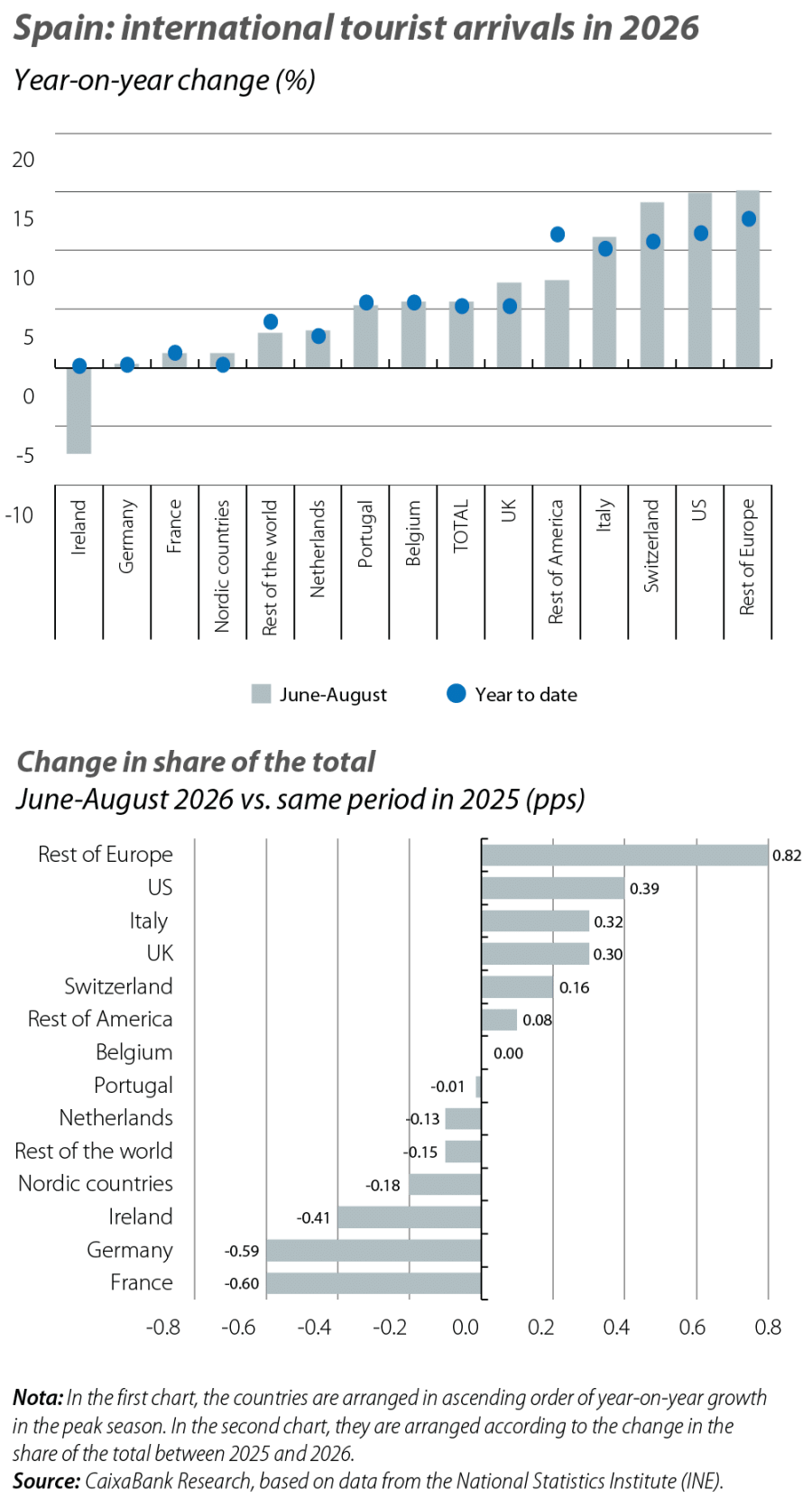
This high season, Spain received 1.8 million more international tourists than last year (+5.7% year-on-year between June and August), bringing the cumulative growth since January to 5.4%. The United Kingdom remains the main source market for tourists and in 2026 it showed significant growth, as part of a wider recovery following several years of very modest advances. Tourist flows from Eastern European countries, the US, Switzerland and Italy also recorded notable growth rates and their share of total international demand continues to increase. The Rest of America market, which includes Latin America, also stands out as the most dynamic so far in 2026, although its growth rate slowed during the summer months. In contrast, Germany and France, two of the main markets for the Spanish sector, experienced weaker-than-expected growth.
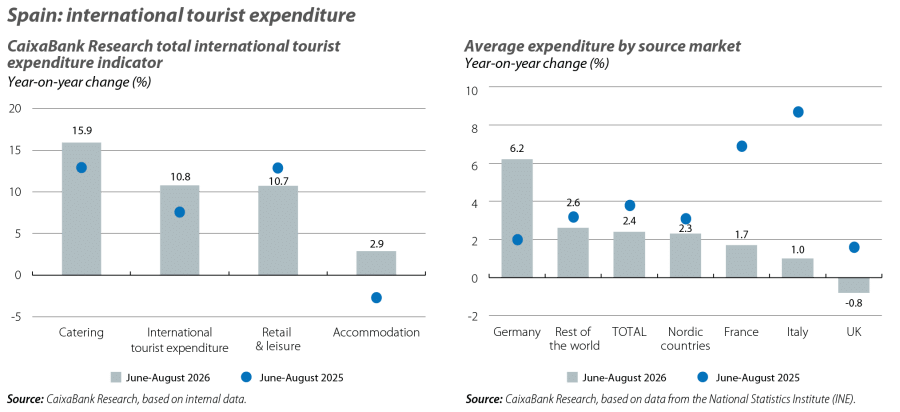
Foreign tourist spending also maintained momentum during the peak season, with an 8.3% year-on-year increase. This growth was supported both by the increase in arrivals and by high tourism inflation (around 4% in the same period). The average expenditure per tourist rose by 2.4% between June and August, below the rise in tourism prices and last year’s figure (3.8%). By source market, data published by the National Statistics Institute (INE) on average expenditure per tourist indicates a particularly positive trend among German tourists, which more than offset the weakness observed among British tourists. By category, our indicator of total expenditure by international tourists2 shows a particularly favourable pattern in catering, with a growth rate of 15.9%, while spending on retail and leisure advanced almost in line with the aggregate figure and accommodation recorded more moderate growth (see second chart).
- 1
In this article, all the indicators analysed refer to a peak season running from June to August.
- 2
The international tourist expenditure indicator in Spain includes in-person payments and cash withdrawals made by international tourists in Spain. International tourist expenditure is considered to include payments made in Spain on CaixaBank POS terminals using cards issued by foreign entities.
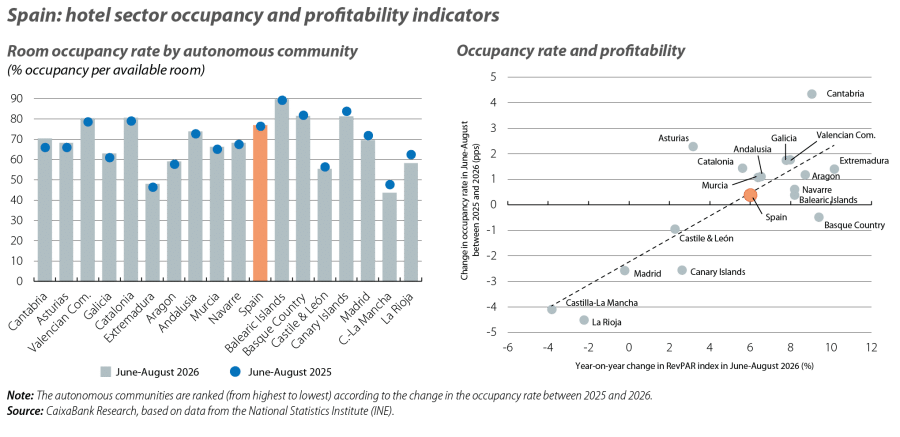
In this context of renewed dynamism in international demand, the hotel sector has once again enjoyed a strong high season, with the occupancy rate reaching 76.9% per available room compared to 76.5% a year earlier. This improvement has been accompanied by a solid increase in profitability, at 6.0% year-on-year.
Regional patterns also confirm the post-pandemic trend favouring destinations in northern Spain, which have traditionally been less attractive to tourists. Cantabria, Asturias and Galicia have once again improved their occupancy and profitability levels, although Asturias still has room for improvement in terms of revenue per available room.In contrast, Madrid and the Canary Islands stand out as having a less favourable trend, with declines in occupancy rates compared to 2025 and below average profitability growth.
Real-Time Economics
Follow the evolution of the Spanish economy with our real-time indicators and our published articles.