
Climate change and international tourist loyalty: new evidence for Spain
We analyse how tourists react to episodes of extreme heat in order to anticipate risks and opportunities for the tourism sector in the face of climate change, using anonymised internal data from foreign card payments on CaixaBank POS terminals.
International tourism has been one of the Spanish economy’s major strengths in recent years. Following the post-pandemic recovery, the sector has once again recorded very high figures for arrivals and spending, reinforcing its role as a driver of economic activity, employment and income generation across much of the region. However, this leadership position coexists with a profound structural challenge: climate change. Spain is a highly competitive tourist destination thanks to its rich and diverse tourism offering, high-quality infrastructure and long tourist season. However, much of its appeal still relies on climatic conditions that are changing rapidly. In this context, it is important to understand how tourists react to episodes of extreme heat in order to anticipate risks and opportunities in the sector.
In a previously published article,1 we used internal CaixaBank data on foreign card payments recorded on POS terminals, cross-referenced with climate information from the European Union’s Copernicus Land Monitoring Service Information, to analyse for the first time whether heatwaves affected the likelihood of an international tourist returning to Spain. In that analysis, we found that tourists who had experienced exceptionally high temperatures during their stay were less likely to return the following year. Specifically, when the deviation of the average temperature from its historical reference exceeded 8ºC – which we considered an extreme heatwave – the likelihood of a repeat visit decreased by 13.8%. The update of this analysis with data from 2024 and 2025 confirms that this was not an isolated pattern, but rather consistent behaviour that persists over time.
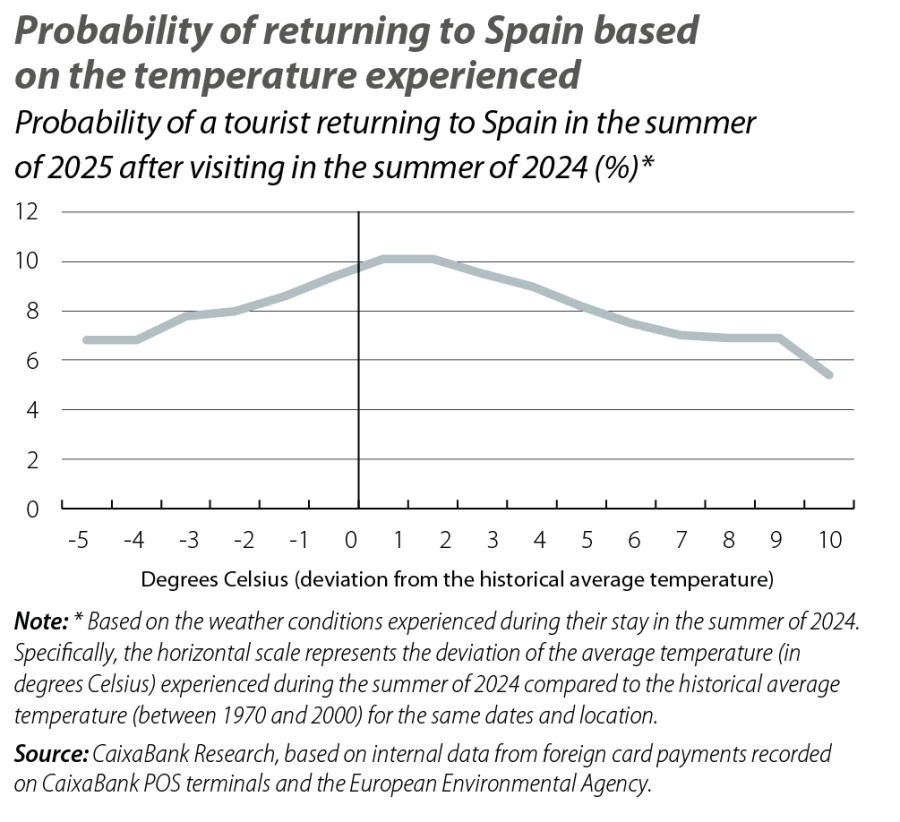
The first chart shows that the relationship between temperature and loyalty follows a very similar pattern to that observed previously. When the temperature experienced by a tourist is around its historical average, the propensity to return to Spain remains stable. However, as the temperature deviation exceeds four degrees above the average, the likelihood of returning decreases. In the most extreme cases, tourists who experienced exceptionally hot temperatures during their stay are around 15% less likely to return compared to those who experienced temperatures close to their historical norms. This result is particularly significant as it is obtained in a context in which international tourism to Spain remains highly dynamic, suggesting that the climate effect operates even during a period with high aggregate demand.
- 1
See the article «Tourist loyalty and climate change» in the Tourism Sector Report S2 2024.
The main innovation of this article is that we extend the analysis to study not only whether tourists return, but also how they adjust their decisions when they do so. The second chart shows that tourists who have experienced a heatwave during their stay tend to choose holiday destinations or dates with cooler expected temperatures the following year. Specifically, the likelihood of selecting a combination of a destination and dates in 2025 that offers a historical temperature at least 5ºC lower than what they experienced in 2024 increases in line with the proportion of days during the previous stay when the maximum temperature exceeded 32ºC. In other words, experiencing extreme heat reshapes preferences within the Spanish tourism market.
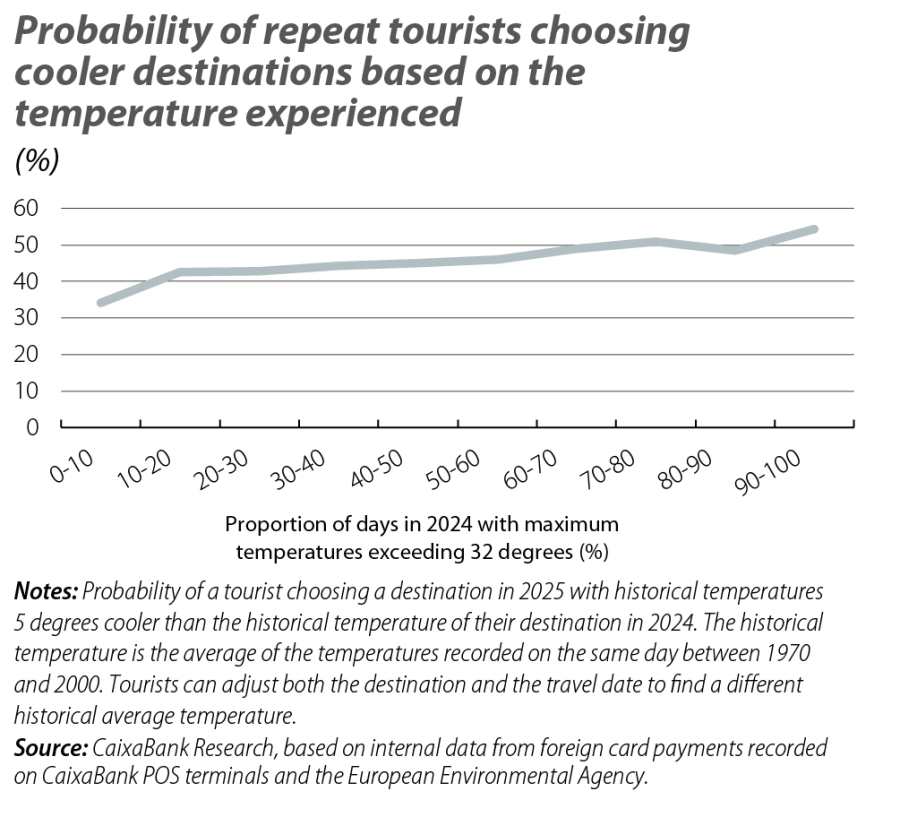
This adjustment of preferences in relation to Spain’s tourism market can occur through two main channels. The first is geographical substitution: a tourist generally keeps their holiday schedule unchanged but chooses a destination within Spain that offers more moderate expected temperatures. The second channel is temporal substitution: the tourist maintains a similar type of destination but shifts their holiday to cooler months of the year, either bringing their trip forward or delaying it.
Although tourists are adjusting their trips, they are doing so subtly. Repeat tourists tend to be loyal to their destinations. For instance, in Mediterranean destinations, which account for two-thirds of international arrivals, 85.2% of repeat tourists whose main destination in 2024 was in the Mediterranean returned to the same type of destination in 2025. Only 1.8% of international tourists who chose the Mediterranean in 2024 and returned to Spain opted to visit the Atlantic coast as their main destination in 2025. A regression analysis linking climatic experience with substitution by destination type suggests that this option is rarely used: tourists who have experienced a heatwave and still return to Spain do not generally change their type of destination. Furthermore, we observe that heatwaves are not associated with changes in the tendency to substitute seasons.
This limited mobility between destination types and seasons does not, however, mean a lack of adaptation. A tourist seeking a Mediterranean holiday can switch municipalities or coastal areas without leaving the general category of their preferred destination. Similarly, a visitor to the Canary Islands can choose a different island, a different coastal orientation, or different dates within a similar season. The specification of our regression, which links the experience of heatwaves with switching to a destination with historically lower temperatures while keeping the destination type and season fixed, shows positive and economically significant coefficients. Therefore, it seems that tourists who experience heatwaves manage to choose cooler destinations within the same season and geographical type.
The third chart shows how tourists who experienced more extreme temperatures in the Mediterranean in the summer of 2024, and who return to the Mediterranean in the summer of 2025, are more likely to choose destinations with historical temperatures 5 degrees below the historical temperature of their destination in 2025. This demonstrates that there is significant potential for climatic substitution without changing season or destination category. Another example of this type of substitution is that tourists who visited inland areas in the summer of 2024, experienced heatwaves and decided to return inland in 2025 tended to choose higher altitude destinations than those who did not experience heatwaves.
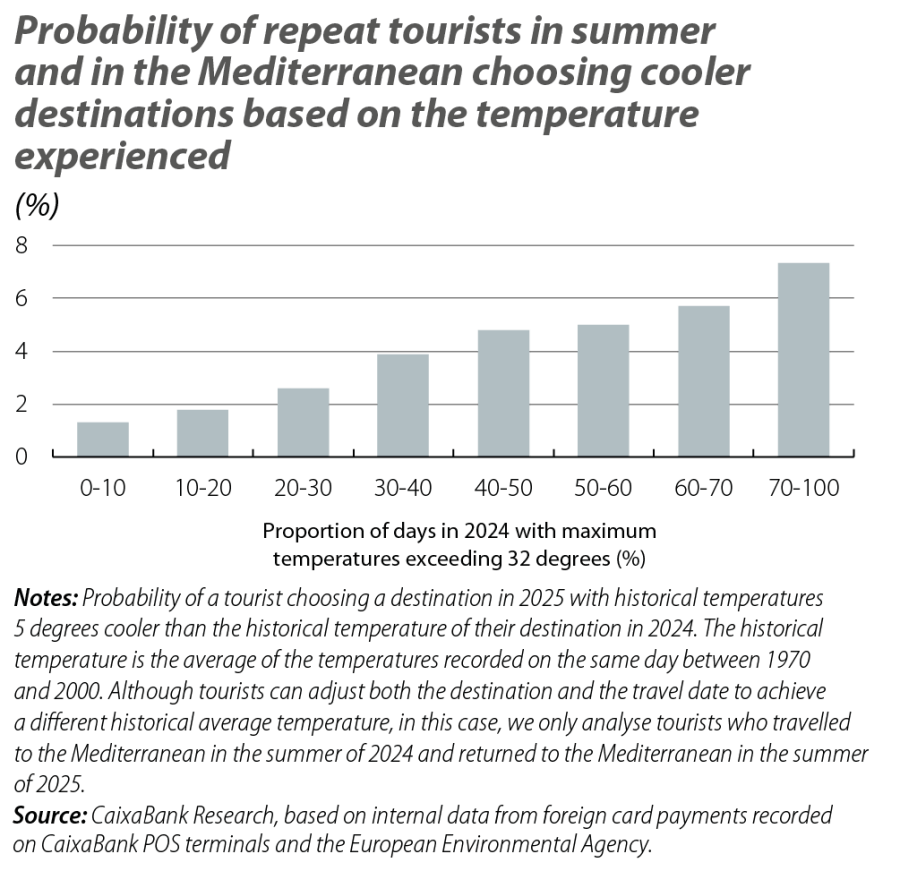
Overall, the results show that tourists respond to heatwaves in two ways. On one hand, they reduce their inclination to return to Spain. On the other hand, without changing the type of main destination or the travel season, they choose cooler destinations.
For Spain’s tourism sector, the implications are significant. Firstly, international tourists’ loyalty can be undermined by extreme heatwaves. Secondly, adapting the supply will be increasingly key for maintaining competitiveness. Making tourist accommodation and public spaces more comfortable during periods of extreme heat, providing more shaded areas, improving energy efficiency, adjusting opening hours and diversifying indoor and outdoor activities are all measures that can reduce the impact of heat on the tourist experience and maintain the loyalty levels of international tourists in Spain.
Climate change & green transition
What polices can be implemented to stop climate change? What are the implications of shifting towards a more sustainable economy?

Real-Time Economics
Follow the evolution of the Spanish economy with our real-time indicators and our published articles.