Economic situation in the Valencia province one year after the floods
One year after the floods, the data show a widespread recovery, albeit uneven between municipalities, businesses and socio-economic profiles.
This October marks one year since the floods that devastated the province of Valencia. Throughout these 12 months, at CaixaBank Research we have monitored the evolution of consumption in the area hardest hit by the floods1 and have published several studies2 based on the analysis of aggregated and anonymised CaixaBank data.3
- 1
The area most affected by the floods (ground zero) includes the following municipalities: Alaquàs, Albal, Aldaia, Alfafar, Algemesí, Benetússer, Beniparrell, Catarroja, Chiva, Llocnou de la Corona, Massanassa, Picanya, Paiporta, Sedaví and Utiel.
- 2
See the Focuses «Economic impact of the floods in the Valencia province» in the MR12/2024 and «Economic situation in the Valencia province six months after the floods» in the MR06/2025.
- 3
Including in-person and online card spending plus cash withdrawals.

Taking stock: the consumption tracker, one year on
During the first few months, the recovery of consumption in the area hardest hit by the floods took place at two different speeds. On the one hand, consumption among residents fell by 47% in the days immediately following the floods (from 30 October to 5 November), but the recovery was rapid: a month later, the growth of residents’ spending already exceeded the national average, probably due to the need to replenish goods. This trend has continued over the last year, although the difference with respect to the rest of Spain has gradually narrowed in recent months.
From the perspective of businesses in the area, the impact was even more severe. Between 30 October and 5 November, turnover plummeted 83% and spending in business establishments located in ground zero remained at negative levels for over six months. It was not until June that growth became positive again, thereafter matching the pace observed in the rest of the country.

The differential impact of the floods by municipality
The impact of the floods was not equal among the various municipalities affected, and nor is the recovery proving to be so. As can be seen in the attached table, which shows the change in inhabitants’ spending and in spending recorded in business establishments by municipality, an increase in residents’ consumption does not necessarily correspond to higher turnover in the local establishments. A clear case is that of Alfafar and Paiporta, where consumption by the inhabitants grew at a rate of over 20% year-on-year in September, while the turnover of its business establishments exceeded that of the previous year by only 10%.
This difference can be partly explained by the fact that some businesses had not resumed their activity. Today, the area hardest hit by the floods has more active business establishments as a whole than before the episode, although in towns such as Alfafar, Massanassa and Sedaví the previous level has not yet been fully recovered.

The differential impact of the floods on the inhabitants and businesses of ground zero
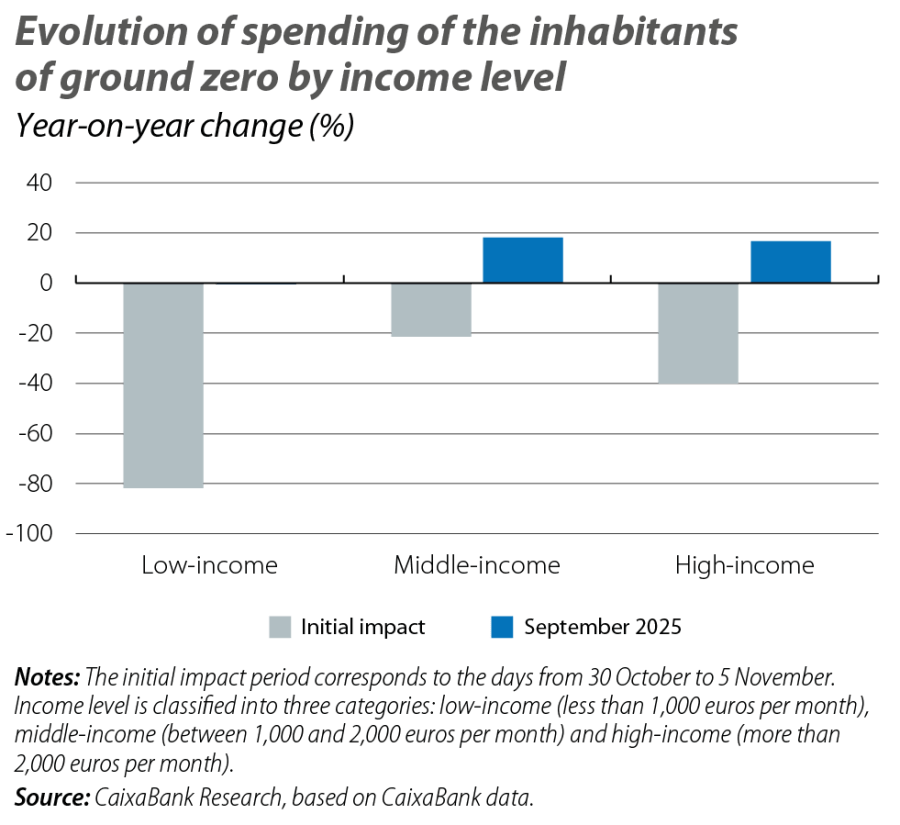
The internal CaixaBank data allow us to analyse the pattern of consumption and business turnover in greater detail according to the characteristics of those affected. Among residents, people with the lowest incomes suffered the greatest impact: their consumption fell by 82%, compared to 40% for the highest incomes. Moreover, in this case, the recovery has been uneven: between December and September, consumption among those on low incomes increased by 12% year-on-year on average, below the 16% recorded among high incomes, thus widening the consumption gap.
As for businesses, their size has been decisive. Big companies held up better: their turnover fell by 85% after the floods, but in September it had already recovered to the level of the previous year. In contrast, small businesses suffered a fall of 98% and, a year later, their turnover was still more than 10% below the same period last year.
In conclusion, one year after the floods, the data show a widespread recovery, albeit uneven between municipalities, businesses and socio-economic profiles.

Climate change & green transition
What polices can be implemented to stop climate change? What are the implications of shifting towards a more sustainable economy?