The upcoming budget takes over from NGEU in the European Semester
With an eye on the upcoming 2028-2034 EU budget, the European Semester is strengthening its role as a framework for identifying reform and investment needs. The priorities include achieving more tangible progress towards an effective integration of the Single Market, alongside strengthening the competitiveness agenda in strategic sectors and reconciling new spending needs with the European fiscal framework.

On 3 June, the so-called ‘Spring Package’ – the final stage of the EU’s annual cycle of economic, fiscal and cohesion policy coordination – was presented. Last year, the focus was on accelerating the execution of NGEU funds in their final phase and reflecting the guidance of the newly launched Competitiveness Compass. In 2026, the European Semester strengthens its role as a framework for identifying reform and investment needs ahead of the upcoming 2028-2034 EU budget. The priorities include: more tangible progress towards an effective integration of the Single Market, alongside strengthening the competitiveness agenda in strategic sectors and reconciling new spending needs with the European fiscal framework.
The geopolitical context exacerbates the EU’s structural weaknesses
The initial diagnosis is clear: there is no room for complacency in the face of external threats – such as security risks, climate change and supply tensions – and internal weaknesses – notably fragmentation of the internal market and low productivity growth. In line with the Competitiveness Compass, the three priorities are: closing the innovation gap, decarbonising the economy and reducing strategic dependencies.1 To achieve this, the focus is on effectively integrating the Single Market by reducing barriers, simplifying regulations, and developing the Savings and Investments Union (SIU), with recommendations to better channel European savings into productive investment.
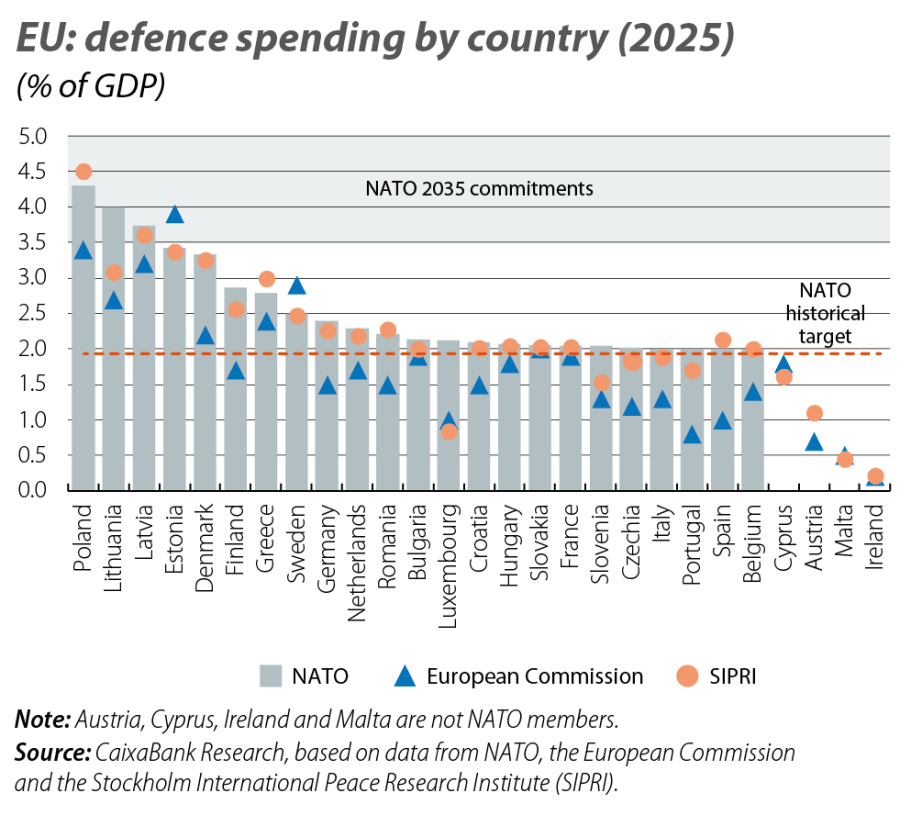
In terms of economic security and strategic autonomy, the central focus is on reducing dependencies in energy, critical raw materials and key technologies. Initiatives such as REPowerEU and AccelerateEU aim to accelerate the diversification of supplies, the deployment of renewables, electrification, and the strengthening of networks and interconnections, turning the energy transition into both a climate and geopolitical policy lever. In parallel, efforts are being made to bolster the industrial base in strategic sectors such as defence, focusing on joint procurement – supported by instruments like SAFE loans – and deeper coordination among Member States, which would allow for more efficient progress on NATO’s new commitments (see first chart).2
- 1
See the Focus «How far has the EU progressed on the Competitiveness Compass?» in the MR04/2026.
- 2
See the Focus «5% of GDP on defence: Why? What for? Is it feasible?» in the MR09/2025.
A broad set of challenges under the new strategic priorities
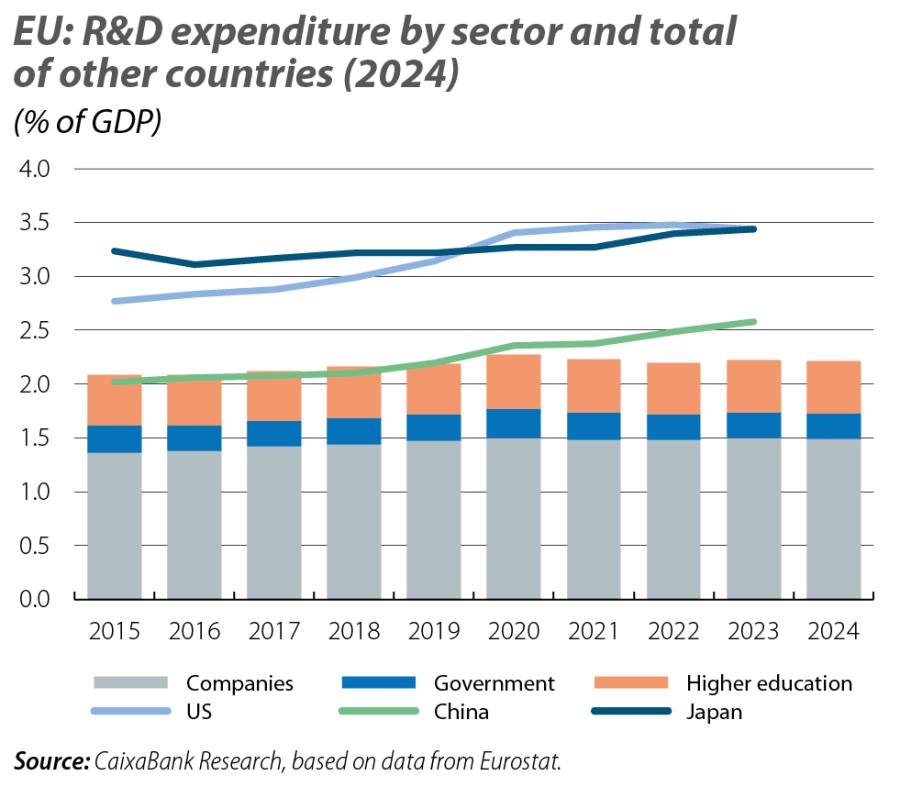
The country-specific recommendations reflect a more demanding agenda than in the past, centred around a common core linked to new strategic priorities. Thus, for the four largest economies, the emphasis combines competitiveness, the functioning of the internal market, and structural reforms. Boosting innovation is a shared priority, given the persistent gap with the US and other global competitors like China (see second chart). This includes recommendations to boost investment in R&D, improve the transfer of knowledge to the business sector, facilitate access to funding, and develop ecosystems that support the growth and scaling-up of start-ups. Reducing administrative bottlenecks that limit the ability to execute large-scale investments is also a priority in these countries. Recommendations in this area focus on improving efficiency, cutting red tape and expediting permits.
In Central and Eastern Europe, the focus remains on the energy transition in favour of renewable sources, given these regions’ current reliance on coal and gas, along with strengthening energy security. In the Baltic and Eastern European countries, security, defence, and civil preparedness are gaining prominence in the context of the war in Ukraine, while in Southern Europe the recommendations place greater emphasis on social cohesion, the labour market, and climate resilience.
A significant development this year is the increased prominence of housing on the European agenda.3 The Commission links the challenges in this area not only to social cohesion but also to competitiveness, due to their impact on labour mobility and the functioning of the labour market. The recommendations propose action on several fronts: simplifying and expediting permits and planning processes, mobilising public land and improving coordination between different levels of government, boosting the construction and renovation of affordable and energy-efficient housing, reviewing tax incentives that could distort demand, and encouraging the reuse of underutilised housing.
- 3
See the Focus «There are reasons why housing has become the top concern among European citizens» in the MR02/2026.
The fiscal governance framework: short-term flexibility, medium-term frictions
Together, these recommendations reflect a more ambitious investment and reform agenda, the pursuit of which is constrained by the state of European public finances.4 This year’s Spring Package represents the first comprehensive test of both the new fiscal framework adopted in 2024 and the national medium-term fiscal-structural plans submitted in 2025.5 The assessment combines the objective of ensuring the medium-term sustainability of public debt with adapting to an environment marked by rising structural spending needs (defence, energy, digital transformation and population ageing). The response has been to introduce limited and temporary flexibility into the fiscal framework, which, in some cases, allows the new spending pressures to be reconciled with the recommended fiscal path. However, compliance across Member States remains uneven, with risks of deviation concentrated in 2026.6
The main flexibility instrument is the national escape clause for defence expenditure, which was activated last year and allows for an additional spending margin of 1.5% of GDP through to 2028 without compromising medium-term fiscal sustainability. In 2026, its scope will be expanded, within this limit and time frame, to include certain energy-related measures linked to reducing external dependencies: up to 0.3% of annual GDP and a cumulative limit of 0.6% for investment in electrification, networks, storage, energy efficiency, or the clean energy transition.
This flexible design allows the energy and security shocks to be absorbed without formally altering the fiscal anchor. However, it does not eliminate underlying tensions: the margins are temporary, the additional expenditure will be incorporated into fiscal trajectories, and achieving sustainability will depend on these priorities being combined with higher potential growth or cuts to other budgetary items. In this context, the key will be how these new structural commitments are reflected in the spending paths of the medium-term plans. The risk, however, is that the EU may not have resolved the alignment of its strategic priorities with fiscal rules and a greater common budgetary capacity.
- 4
See the article «Europe’s medium-term fiscal dilemma» from the Dossier in the MR11/2025.
- 5
See the Focus «The new EU economic governance framework» in the MR01/2025.
- 6
Moderate risks of slippage emerge in 2026 for major economies such as France and Spain, although these are limited and compatible with compliance in cumulative terms. More strained situations are observed in a smaller group of countries with a risk of material non-compliance, such as Hungary, Croatia, Lithuania and Bulgaria; for the latter, the Commission is considering initiating an excessive deficit procedure.
The ball is in national governments’ court
With the publication of the Spring Package, the Commission is laying out the diagnosis and guiding the priorities, but it should not be forgotten that the final implementation lies with Member States. In the short term, they must finalise the execution of NGEU funds, apply the country-specific recommendations, and conclude negotiations for the 2028-2034 EU budget, which will determine the EU´s actual capacity to fund its ambitions in competitiveness, defence, energy and cohesion.7 In this context, the focus shifts from the European response to national execution, where factors such as administrative capacity, regulatory delays and territorial fragmentation can be decisive.
The debate, therefore, cannot be confined to the European dimension nor to what is discussed and agreed upon in Brussels. The conclusion of the NGEU programme marks the end of an exceptional instrument and necessitates the establishment of a more permanent framework for investment and reforms. The European Semester sets the direction, but the transition will not be automatic and will require deciding which part of this approach, along with the associated conditionality, is incorporated into the new financial instruments of the next budget (referred to as National and Regional Partnership Plans in the Commission’s initial proposal). Ultimately, it will be the ability – and the political willingness – of Member States to reach and implement ambitious agreements that will determine whether the EU has risen to the challenge.
- 7
See the Focus «The 2028-2034 EU budget: An impossible mission?» in the MR09/2025.
Geopolitics
We analyse the major geopolitical trends and thier effects on the financial markets and the economy.