The charitable response after the Valencia floods
In this fourth and last article of the Dossier “Solidarity in Spain: snapshot of a committed society”, we analyse, in collaboration with Pompeu Fabra University, the change in the aggregate volume and in the number of donations that were made after the floods in Valencia based on CaixaBank banking transactions in order to better understand the charitable response to this emergency.
On 29 October 2024, the Valencian Community suffered one of the worst natural disasters in its history. A high-altitude isolated low-pressure system – known as a «DANA» in Spanish – caused torrential rains, with burst river banks and severe floods, destroying homes, businesses, and claiming the lives of more than 200 people. Thousands of public servants mobilised to help in the face of the catastrophe, joining the extraordinary response from citizens and organisations.1 Undoubtedly, we all have images engraved in our minds of men and women crossing the Turia river, bailing the water out of houses, battling the mud with shovels and brooms, and supplying the volunteers with water and food.
From the outset, at CaixaBank Research we were able to analyse the impact of this disaster from an economic perspective. By monitoring consumption in the area hardest hit by the floods, we were able to track the recovery and note its inequality; today there are still areas and business establishments that have not fully returned to normal.2 With the passage of time, we have also been able to understand the charitable reaction of citizens to an emergency of this magnitude, based on their monetary contributions. In particular, in collaboration with Pompeu Fabra University, we have studied the change in the aggregate volume and in the number of donations that were made in the wake of the floods through CaixaBank banking operations, using duly anonymised data.3 To this end, in this analysis we will separate the change in donations made to NGOs that operate primarily within Spain, and who could mobilise resources in situ more expeditiously (usually larger and better-known organisations, and those which had the ability to implement campaigns to attract donations the quickest),4 from those which operate mainly outside Spain.5 We also compare the charitable reaction of donors according to the distance between their place of residence and the epicentre of the floods. This first descriptive analysis is complementary to another academic analysis currently underway, which is more focused on how people’s differing degree of altruism impacts their charitable reaction following a natural disaster, and which we will publish soon.6
- 1
See, for example, the response of the associative sector to the floods: «El papel de las fundaciones ante la DANA: solidaridad, reconstrucción y futuro», Spanish Foundations Association (Asociación Española de Fundaciones, AEF).
- 2
See the Focuses «Economic impact of the floods in the Valencia province» in the MR12/2024, «Economic situation in the Valencia province six months after the floods» in the MR06/2025 and «Economic situation in the Valencia province one year after the floods» in the MR11/2025.
- 3
See the article «Donations in Spain: how and to which causes Spaniards donate» in this same Dossier for further details on the characteristics of the data.
- 4
Among these campaigns, it is worth mentioning the one carried out by the Social Action teams at CaixaBank among the bank’s customers and employees.
- 5
The data do not allow us to analyse donations directed strictly to the floods, only to differentiate between entities that operate predominantly at the local or international level.
- 6
We will present the article «Universalist preferences and natural disasters: a view from bank accounts» at the American Economic Association conference to be held in Philadelphia in January 2026.
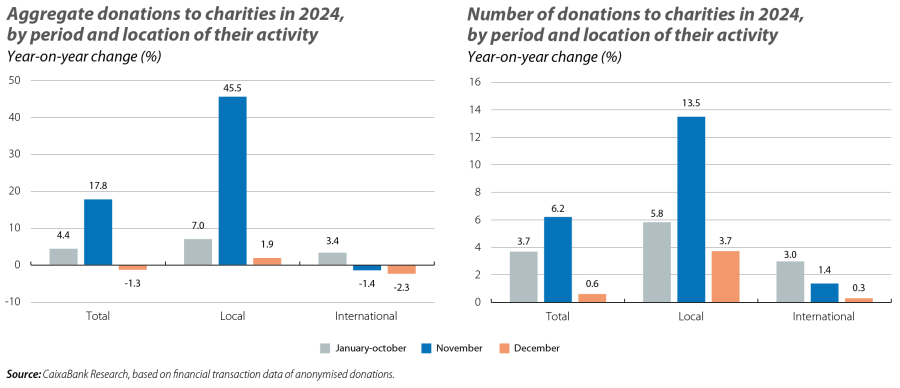
The first conclusion of the study is that Spaniards’ reaction to the disaster was highly supportive: charities saw the donations they receive increase by 18% year-on-year in November, compared to 4.4% recorded in the previous months. In particular, NGOs operating within Spain registered an increase of 45% in November. This figure is much higher than the +7% year-on-year that they received from January to October, and it stands out even more because of the fall recorded in donations made to NGOs operating in the international arena (–1.4% year-on-year in November vs. +3.4% from January to October). A similar phenomenon, albeit less pronounced, is observed when analysing the number of donations. This increase, concentrated in local NGOs, is the same one that we find using more sophisticated statistical techniques that allow us to identify the exceptional nature of the wave of solidarity that emerged as a result of the floods. Specifically, we estimate a differences-in-differences regression of the average donation at the census district level, controlling for socio-demographic variables (age, income, etc.), with treatment exposure determined by the distance from the epicentre of the floods and whether the area is prone to flooding.
The peak of solidarity observed in November, however, seems to rapidly fade. In December, donations collected for local causes increased even less than in the period from January to October, indicating that the increase in donations we normally see in the last month of the year was perhaps brought forward to November to support those affected by the floods. This phenomenon (the sharp increase in donations in the few weeks following the disaster and the rapid decline thereafter) suggests that the charitable response to an emergency is intense but brief.
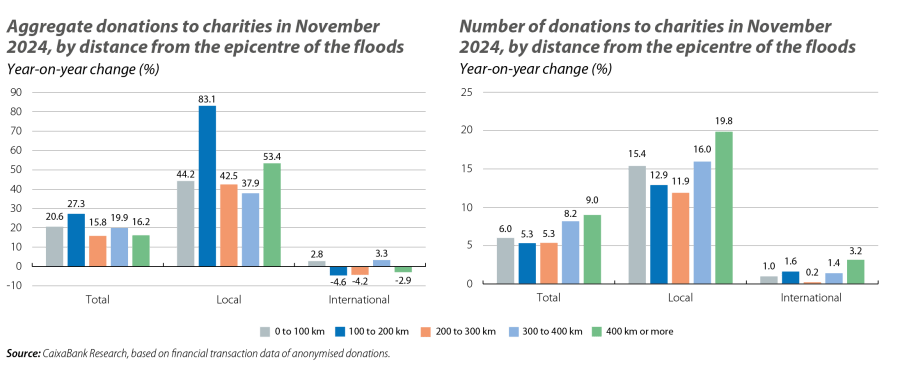
On the other hand, the geographical proximity to a disaster also has a significant influence on the charitable reaction. People residing closer to the flooded areas increased their donations to a greater extent than those living further away (excluding the very nearby areas, probably themselves affected by the disaster, albeit to a lesser extent). Residents in areas located between 100 and 200 kilometres from the epicentre, mostly within the Valencian Community, contributed 83% more to local causes than in November of the previous year, and they reduced their donations to NGOs operating mostly abroad by 4.6% year-on-year. The increase was significant, but minor, in areas more than 300 kilometres away, with increases of around 40% and 50%. This result shows how people’s altruism or empathy can be greater in the communities closest to the disaster, a phenomenon known in economic literature as «particularism» or «in-group bias».
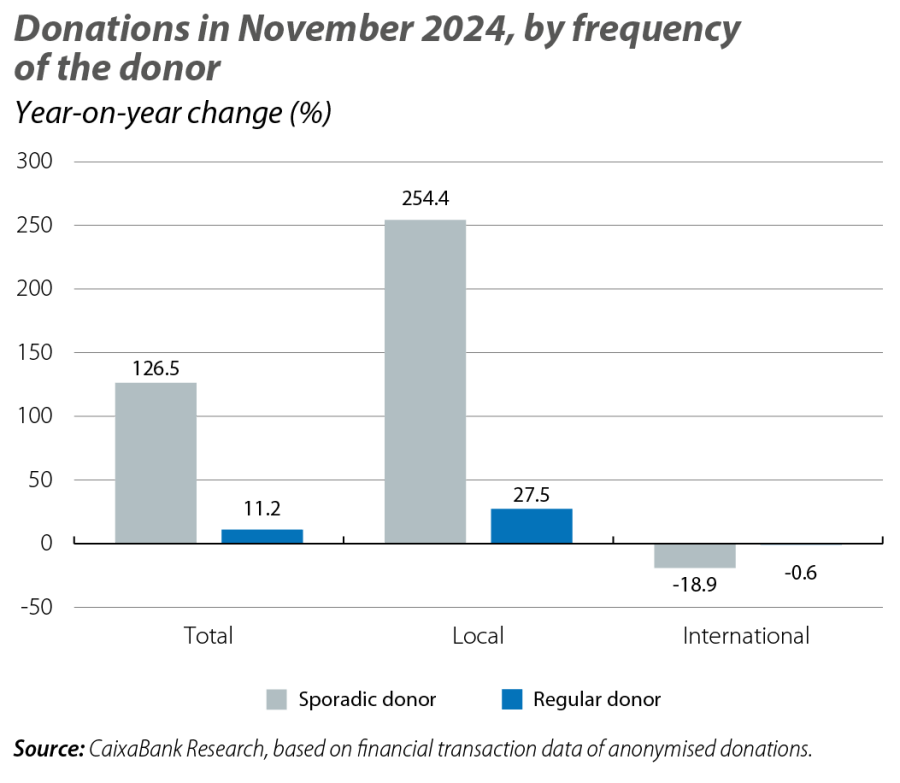
Finally, sporadic donors were the ones who reacted the most to the floods, with their donations to local causes surging by over 250% in November 2024. Regular donors (those who donate three or more times a year) also increased their contributions, albeit to a lesser extent (+27%). The most likely reason for this is that, as we explained in the previous article, their contributions were already higher, accounting for 55% of the increase in donations to local causes (compared to 45% for sporadic donors).
Climate change & green transition
What polices can be implemented to stop climate change? What are the implications of shifting towards a more sustainable economy?
Inequality & inclusive growth
We analyze the causes and consequences of inequality and what policies can foster inclusive economic growth that is distributed equitably in society.