
The profile of donors in Spain: a charitable majority and a key group of ‘superdonors’
After examining how philanthropy is perceived in Spain, and the main charitable causes that Spaniards support, in this third article of the Dossier "Solidarity in Spain: snapshot of a committed society" we address the socio-demographic characteristics of donors who collaborate financially with non-profit entities.
After examining how philanthropy is perceived in Spain, and the main charitable causes that Spaniards support, in this third article of the Dossier we address the socio-demographic characteristics of donors who collaborate financially with non-profit entities. To do this, we analyse the donations that individual CaixaBank customers made in 2024 through their banking transactions, using aggregate and duly anonymised data,1 which allows us to present a detailed profile of donors in Spain and, therefore, understand what they are like and how their help reaches the causes they support.
- 1
See the article «Philanthropy in Spain: social attitudes and behaviours» in this same Dossier for further details on the characteristics of the data.
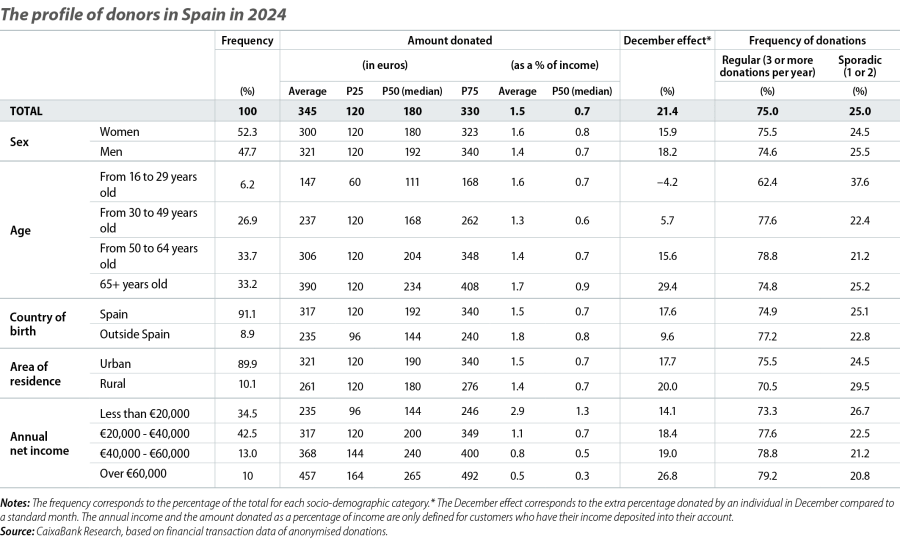
The profile of donors in Spain is diverse: it includes men and women of all ages and income levels, as shown in the first table. However, generally speaking, we note that the average donor is older (two thirds are over 50 years old, vs. 49% of the population), has higher incomes (two thirds earn more than 20,000 euros a year, vs. 48% of the population) and is more likely to reside in urban areas (90%, vs. 84% of the population). Most donors also collaborate on a regular basis, with 3 out of 4 donating at least three times a year, while the remaining quarter donates more sporadically (once or twice).
The average monthly amount donated to charities is almost 30 euros (345 euros per year), although there is significant dispersion among donors. If we divide them into four equal groups according to the amount donated, from lower to higher, we see that the first 25% of donors contribute 10 euros or less per month (120 euros per year); the second group, from 10 to 15 euros per month (from 120 to 180 euros per year); the third group, from 15 to 27.5 euros per month (from 180 to 330 per year), and the fourth, more than 27.5 euros per month (330 euros per year).
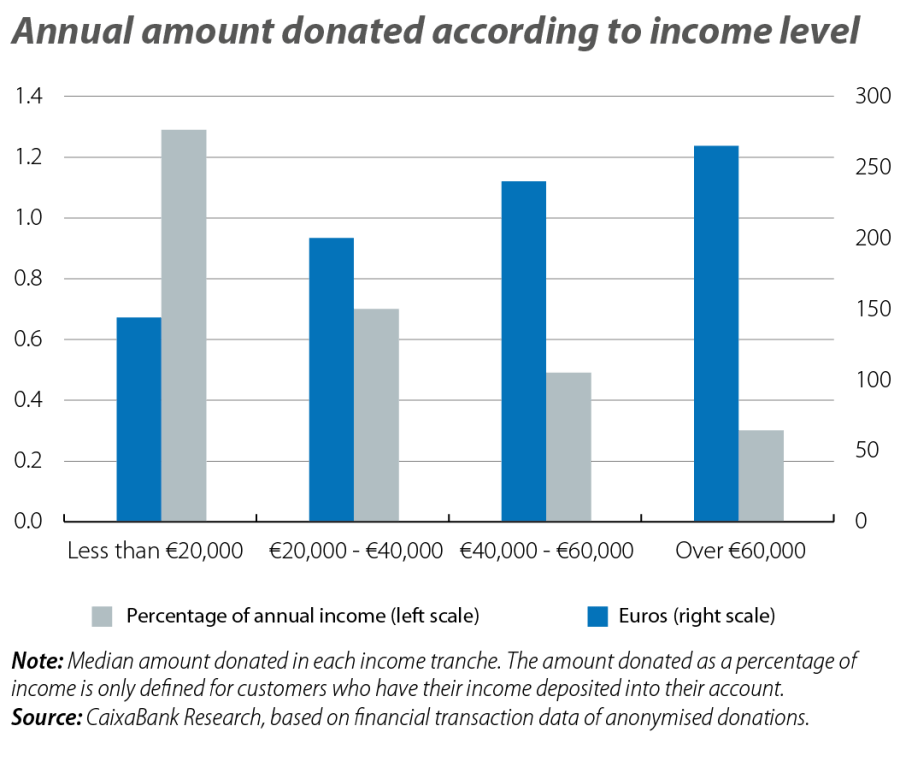
As seems logical, individuals with higher incomes make larger donations than those with lower incomes (see first chart). However, lower-income donors make a greater effort relative to their income: donors earning less than 20,000 euros per year contribute 1.3% of their income to charities on average, while this effort is less for higher income brackets, up to the minimum of 0.3% donated by the highest-income group.
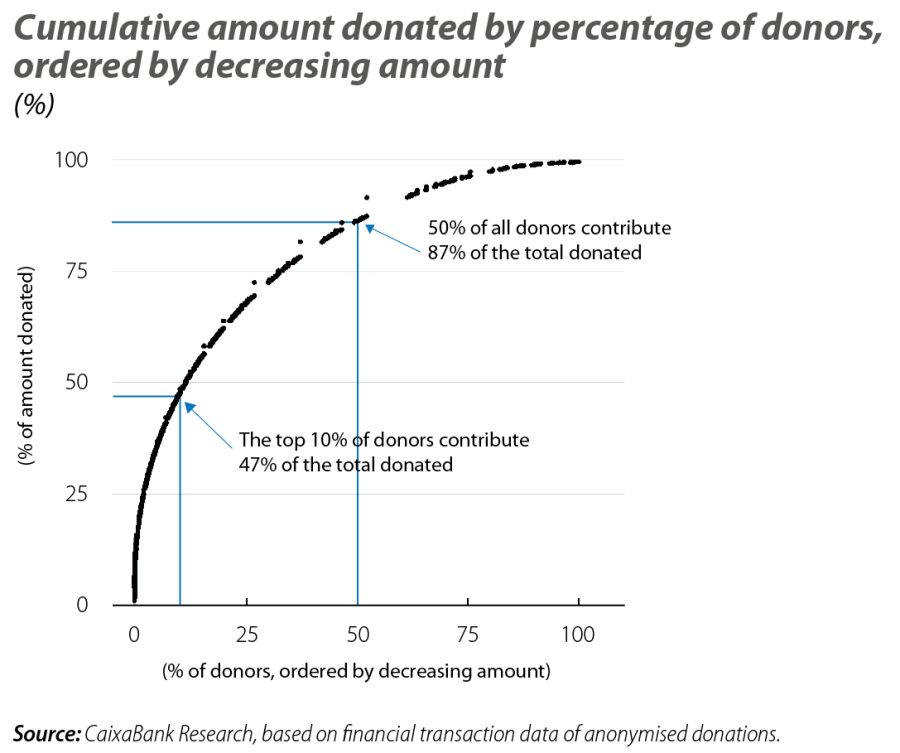
Most donors make small contributions. However, the half of donors who donate the highest amounts contribute 87% of the total amount raised. Moreover, a group of superdonors who make up the top 10% contribute 47% of the total alone, as can be seen in the second chart.
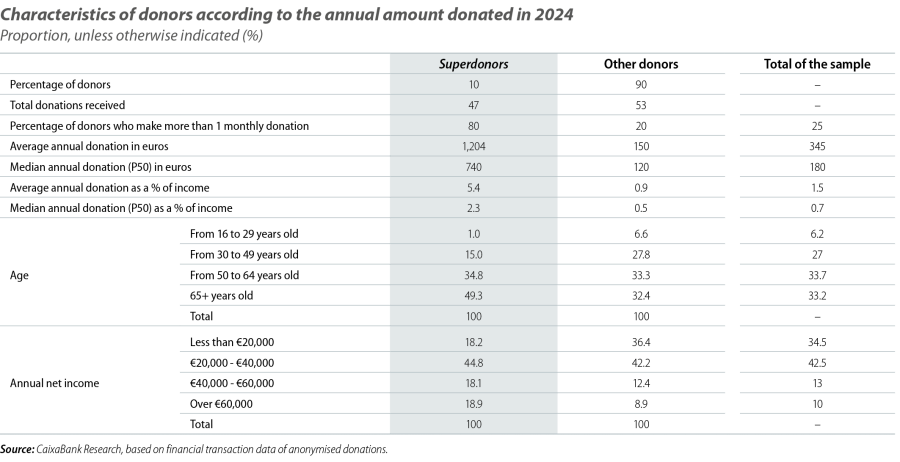
These superdonors are mostly older people (85% are over 50 years old) and are highly consistent in their contributions (8 in 10 donate more than 12 times a year). In general, superdonors donate around 740 euros a year, compared to 120 euros for other donors. In addition, their economic effort is proportionately greater: they allocate 2.3% of their income to charitable causes, compared to 0.5% in the case of other donors. Although they tend to have higher incomes, they are not necessarily millionaires: more than 4 in 10 superdonors earn between 20,000 and 40,000 euros a year. In short, superdonors not only contribute more, but they do so regularly and at the cost of greater effort.
In short, financial giving in Spain is supported by a broad base of donors who make modest contributions, complemented by a small group of superdonors who account for a large part of the total amount donated. This pattern reflects the importance of both mass participation and the intensive commitment of some individuals. What defines a superdonor? Becoming one does not mean donating exorbitant figures, but rather giving regularly and within your means. Every contribution counts, but commitment is what makes the difference.
Inequality & inclusive growth
We analyze the causes and consequences of inequality and what policies can foster inclusive economic growth that is distributed equitably in society.

Real-Time Economics
Follow the evolution of the Spanish economy with our real-time indicators and our published articles.