Philanthropy in Spain: social attitudes and behaviours
This first article in the Dossier “Solidarity in Spain: snapshot of a committed society” examines the social attitudes and philanthropic behaviour of the Spanish population through the representative survey commissioned by the Social Observatory of the ”la Caixa” Foundation in 2024.
Donating blood, making a donation or collaborating with NGOs are common forms of solidarity throughout the world. Even a gesture as simple as giving up one’s seat for an elderly person can be considered a selfless act of kindness towards others. Solidarity, in short, is expressed through multiple forms of social participation. And philanthropy – the etymological origin of which comes from the Greek φίλος (filos) and άνθρωπος (anthropos), literally «friend of man» or «person who is distinguished by love for their fellow men and by their work for the good of the community», according to the Royal Spanish Academy (Real Academia Española) – is a complement to the actions of the welfare state in addressing social needs. However, there is a lack of evidence on how often and in what way we help others. This Dossier, produced in collaboration with the ”la Caixa” Foundation, CaixaBank Research and Pompeu Fabra University, offers a comprehensive view of solidarity in Spain from a dual perspective: offering an overview of the various forms that altruism takes and of the donations made by Spaniards.
In this first article, we examine the social attitudes and philanthropic behaviour of the Spanish population through the representative survey commissioned by the Social Observatory of the ”la Caixa” Foundation in 2024.1 The survey gathers the various perceptions of solidarity and the different ways it is expressed by Spaniards, and it is complemented by the subsequent analysis of monetary donations, identified using anonymised transaction data from CaixaBank customers. This information source allows us to identify donations made by direct debit, transfers, Bizum payments and card payments, and to match it with socio-demographic and financial variables. Specifically, the other articles that make up this Dossier explore the financial contributions made to NGOs and the nature of the recipient entities;2 the socio-demographic characteristics of donors and the volumes and amounts of the donations,3 as well as the social response to emergencies, taking the floods that swept the Valencia province in October 2024 as a reference.4
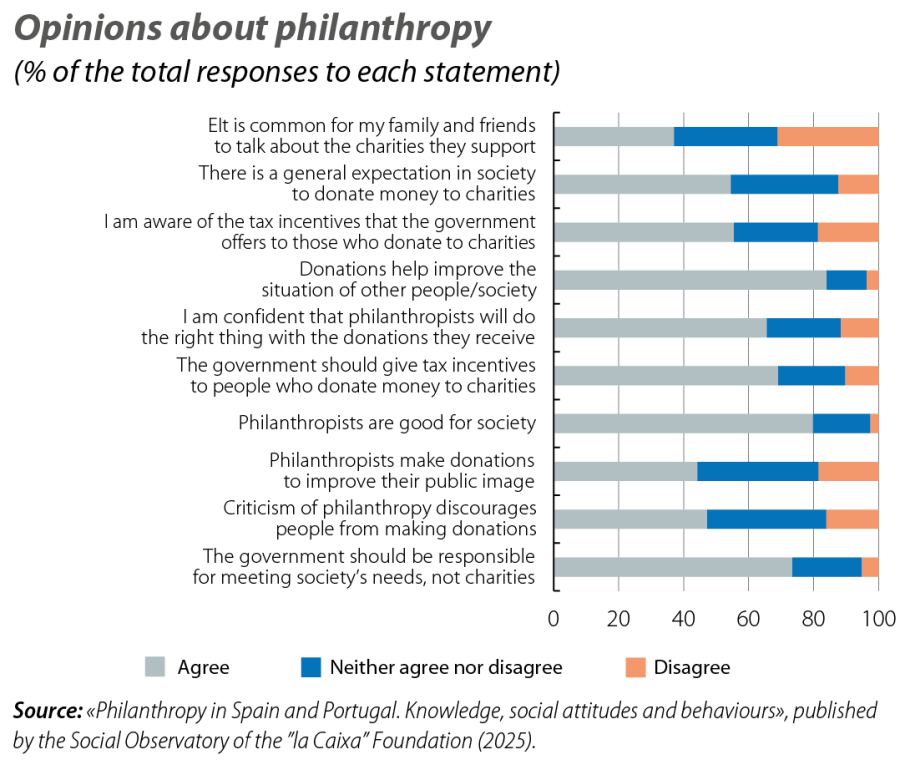
The survey data reveal first, how Spanish citizens perceive philanthropy and, secondly, what their philanthropic behaviours are. In response to the question «Do you know what philanthropy is?», 60% of the population claims to be familiar with the term, although in turn this also means that more than a third is not. Therefore, a first conclusion is that if philanthropic organisations were to improve their communication and explain more clearly t citizens what their activities involve and how they benefit society, it could increase awareness among the population about their function and scope. The perception of philanthropy among citizens, measured based on the degree of respondents’ agreement or disagreement with 10 related statements, suggests a fairly favourable overall results in Spain, as seen in the first chart. However, there is a certain distrust of the true motivation of philanthropists: almost 45% of respondents believe that the purpose of their donations is «charity washing». There is also a clear perception that it is the state, not philanthropy, that should assume the main role in «meeting society’s needs» (73%). However, it should be noted that in most cases the two perform complementary functions. Paradoxically, when asking respondents if they believe that donations help improve the situation of others or whether they believe that philanthropists are good for society, the percentage of affirmative responses is resounding: 84% and 80%, respectively.
- 1
See «Philanthropy in Spain and Portugal. Knowledge, social attitudes and behaviours», published by the Social Observatory of the ”la Caixa” Foundation (2025).
- 2
See the article «Donations in Spain: how and to which causes Spaniards donate» in this same Dossier.
- 3
See the article «The profile of donors in Spain: a charitable majority and a key group of superdonors» in this same Dossier.
- 4
See the article «The charitable response after the Valencia floods» in this same Dossier.
When asking respondents which issues should be addressed most urgently, health is by far the top priority: over three-quarters (76%) consider it to be the «most important» issue. This is followed by research (62%), human rights (55%), education and universities (51%), the environment and animals (46%), social action (38%), international cooperation (19%), culture, art and the humanities (17%), sport and leisure (10%), and religion (6%).
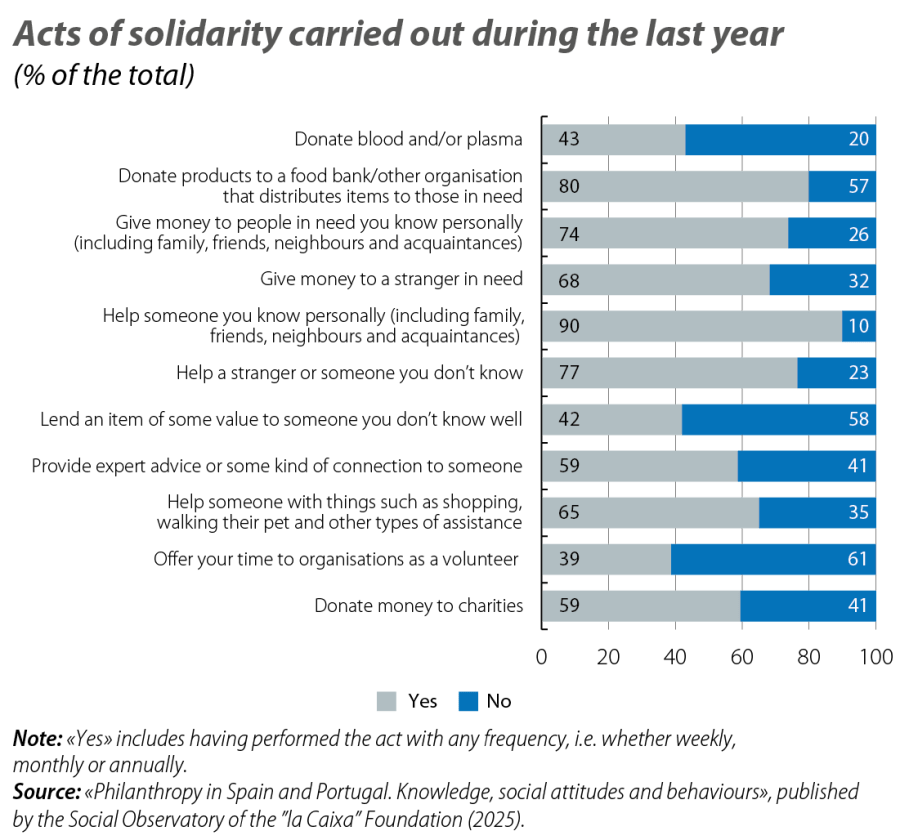
The survey also delves into real philanthropic behaviours in relation to a number of prosocial acts. The results show that Spaniards tend to be supportive and charitable in their daily lives. The majority of respondents have performed an act of solidarity at least once during the past year – and in some cases at least once a week or a month. Also, 77% of Spaniards helped a stranger and 74% gave money to an acquaintance. At the more formal end of philanthropic acts, involving the explicit dedication of time to volunteering activities, Spaniards also participate actively: 39% of respondents volunteer with charities, mainly in causes related to health, social action, and the environment and animals. However, despite these very tangible results, respondents are not fully aware that their participation in philanthropic activities is commonplace, nor do they perceive that the degree of altruism among their fellow citizens is relatively high. In fact, they state that the level of solidarity in society is not very high: on a scale from 0 to 10, the average of all the responses lies close to 6. In this context, it would be interesting, as a positive reinforcement, to remind society that philanthropy is a normalised and everyday practice, and that contributing to the collective well-being is part of many people’s daily lives.
As for economic support, donating money to charitable causes is quite common: 59% of the Spanish population declares that they have made at least one donation in the last year. The three causes cited above – health, social action, and the environment and animals – were not only the ones that had the most time allotted, but they were also the ones that received the most financial support according to the survey.
In short, Spaniards are more generous than they often realize, and collaborate with time or money on a recurring basis to support the work of charities. Health is the cause that we prioritise the most and to which we donate the most, both in terms of time dedicated to volunteering and in economic terms, but this does not stop us from helping other causes such as food banks (80%) or from helping someone with everyday activities for which they need assistance (65%). As in so many other facets of Spanish life, we just need to believe it a little more.
Inequality & inclusive growth
We analyze the causes and consequences of inequality and what policies can foster inclusive economic growth that is distributed equitably in society.