Donations in Spain: how and to which causes Spaniards donate
In this second article of the Dossier “Solidarity in Spain: snapshot of a committed society” we analyse how and to what causes Spaniards donate, based on an unprecedented data source: the donations made by CaixaBank customers through their banking transactions, duly anonymised.
Solidarity in Spain tends to surge during crises or in the face of crisis or in the face of major collective causes. During the Great Recession, intergenerational aid was a key pillar that helped many families to cope with economic hardship. In the pandemic, the dedication of thousands of essential workers, from both the public and private sectors, was key for society to move forward. Campaigns such as La Gran Recogida (the Great Collection) by Los Bancos de Alimentos (Food Banks), Rastrillo (Charity Bazar) by Nuevo Futuro (New Future) and La Marató (The Marathon) by TV3 show how citizens respond en masse to critical situations. However, solidarity is not limited to certain times of the year or to specific emergencies: every day, thousands of people discreetly support non-profit organisations through financial donations. These daily gestures, although less visible, allow thousands of NGOs to carry out vital work. In this article, we analyse how and to which causes Spaniards donate.
For this analysis, we draw on a unique dataset: the donations made by CaixaBank customers through their banking transactions, duly anonymised.1 While other survey-based analyses ask individuals about the amount donated, this database records the donations actually made to NGOs at some point of the year throughout the country.2 The sample analysed includes donations made by direct debit, transfers, Bizum payments and card payments.
This database contains the monetary donations made by Spaniards in 2024 and allows us to analyse them both from the perspective of the donors (which we analyse in the following article) and from that of the recipient entities, which we analyse here. To do this, we group them according to the main cause they support (international cooperation, health or social services, among others)3 and we use public information that helps us to determine the main purpose of each organisation, combining automatic classification processes with a subsequent manual review. In this way, we classify more than 2,000 NGOs into categories that reflect the predominant cause they support.4
- 1
Due to the nature of data on financial transactions, cash contributions are not included.
- 2
This analysis focuses on donations made by individuals, and excludes corporate philanthropic work carried out by companies, foundations or other entities.
- 3
The causes were included according to the classification used in «Philanthropy in Spain and Portugal. Knowledge, social attitudes and behaviours», published by the Social Observatory of the ”la Caixa” Foundation (2025).
- 4
In order to classify the main cause that the recipient entities support, we use information collected from the entity’s name, tax ID number (NIF) or CNAE (National Classification of Economic Activities) code, or other publicly available information, first classifying the NGOs automatically before subsequently performing a manual review. For example, the first letter of an NGO’s NIF allows us to identify the legal nature of the entity (G corresponds to associations, F identifies foundations and R is used for religious institutions) and the CNAE code identifies the economic activity carried out by the entity, so an NGO engaged in social action would fall under social services (e.g. 8899 «Other social services without accommodation») and one that provides health services would fall under health activities (e.g. 8690 «Other health activities»).
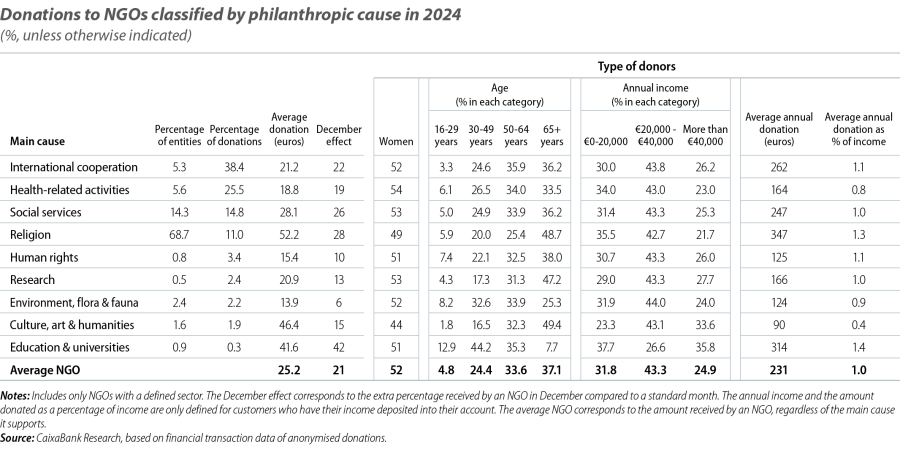
In 2024, around 90% of the donations made were concentrated in four major causes: international cooperation (38.4%), health (25.5%), social services (14.8%) and religion (11%). The other five causes identified (human rights; research; environment, flora and fauna; culture, art and humanities; and education and universities) received the remaining 10% of the amount donated (see table for further details). Most of the entities that received donations in 2024 are of a religious nature (68.7%), which shows the extent to which they are spread throughout the country – an advantage for responding better in times of crisis – although they received 11% of the total amount donated (based on financial transactions).5
The average donation is 25 euros, although some causes typically receive smaller donations, such as those for human rights and those that support health-related activities. In addition, a given entity receives an average of 230 euros annually from the same donor (although they may donate to multiple NGOs). Religious NGOs receive higher amounts on average (347 euros), followed by educational entities (314 euros) and those dedicated to international cooperation (262 euros), while for those linked to culture and the environment it is around 90-120 euros.
The month of December is the month in which the most donations to NGOs are registered. The December effect (i.e. the increase in donations compared to a typical month) is as high as 21% for an average NGO, indicating a strong seasonality in all cases, although there are differences between them and the effect is more pronounced in education (+42%) and religion (+28%).
Causes which support the environment and education have a higher proportion of young donors than average, while culture, religion and research have a higher proportion of older donors. In terms of income level, culture has a higher proportion of high-income donors, while health-related activities and religion have a higher proportion of low-income donors.
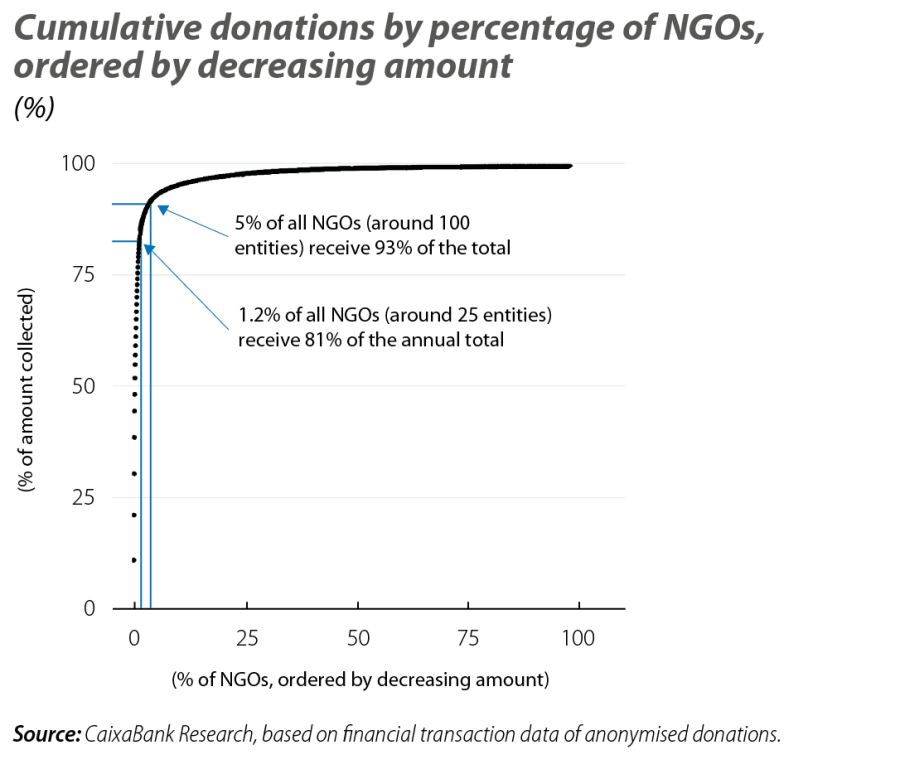
What stands out is the heavy concentration of donations among a handful of organisations. As can be seen in the chart, which shows the cumulative sum of donations according to the percentage of NGOs by decreasing amount, a small number of organisations capture the majority of donations. More specifically, 1.2% of all NGOs (around 25 entities) receive 81% of the annual sum of all donations.
In conclusion, our analysis shows that just a handful of causes and entities receive most of the charitable donations made in Spain, with strong seasonality in December and different patterns according to donors’ age and income level. The richness of this first analysis opens the door to further research on the patterns of solidarity in Spain that allow non-profit organisations to carry out their work.
- 5
It should be recalled that, due to the nature of the data, cash contributions are not included, which may result in an underestimate of the percentage of donations to a greater extent than in other non-profit entities.
Inequality & inclusive growth
We analyze the causes and consequences of inequality and what policies can foster inclusive economic growth that is distributed equitably in society.

Real-Time Economics
Follow the evolution of the Spanish economy with our real-time indicators and our published articles.