
Migration and migration policy: a global overview
More than 300 million people, almost 4% of the world's population, now live outside their country of origin. In this article we examine the main global migration trends and how public policy is evolving to address this challenge.

Migration flows have historically reflected human needs: escaping armed conflict, violence against specific groups and natural disasters or, in most cases, simply seeking better opportunities. By moving from less developed regions or countries to more prosperous ones, migrants can improve their living standards and put their time and talents to more productive use, benefiting from better institutions, markets and technologies, as well as from a less uncertain environment.1 Migration not only benefits individuals and host regions but also creates considerable development opportunities in countries of origin, for example through remittances to family members, investment and knowledge transfer. However, as with trade in goods and services or capital mobility, the movement of people has distributional effects and poses significant challenges for public policy.
- 1
Around 70% of migrant workers worldwide are in advanced economies.
Recent trends and geographical patterns
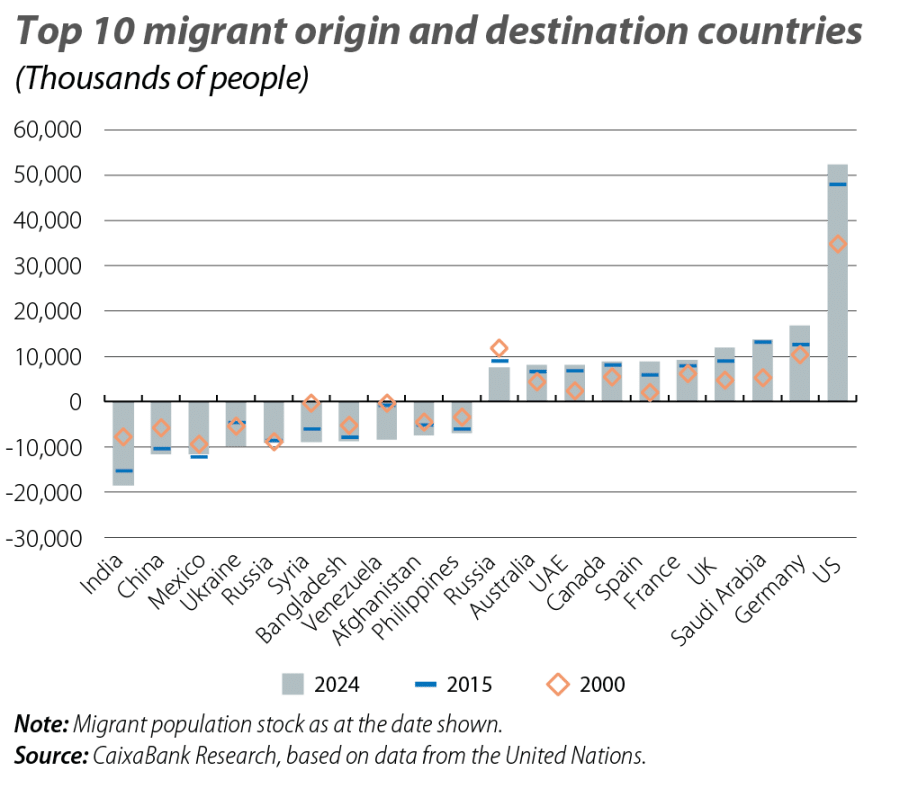
So far this century, global migration flows have continued to grow. More than 300 million people now live outside their country of origin (2024 data, the latest available).2 Although the main origin and destination countries for migration flows have not substantially changed, there are several notable features worth highlighting (see first chart). The US has been the world’s leading destination for migration flows, with more than 50 million migrants in 2024. Destinations such as Saudi Arabia, the United Arab Emirates, the United Kingdom and Spain have also experienced substantial growth. Also notable are India’s rise as the world’s leading country of origin for international migrants and the resurgence in migration flows from countries affected by conflict or humanitarian crises, such as Ukraine, Syria and Venezuela.3 This global picture masks a strong geographical dimension, as illustrated by major migration routes such as the Mexico-US and Syria-Turkey corridors, and those between Central Asian countries and the Gulf region. Most migrants and displaced people move to nearby countries because they are easier to reach, more familiar and offer a quicker route to safety.4
- 2
According to the «World Migration Report 2026» published by the International Organization for Migration (IOM), this represented almost 4% of the world’s population in 2024, compared with 175 million migrants in 2000 (just under 3% of the population).
- 3
United Nations data indicate that around 2.5 million refugees will need resettlement this year, up from fewer than 1 million in 2015.
- 4
IOM (2026), op. cit., chapter three.
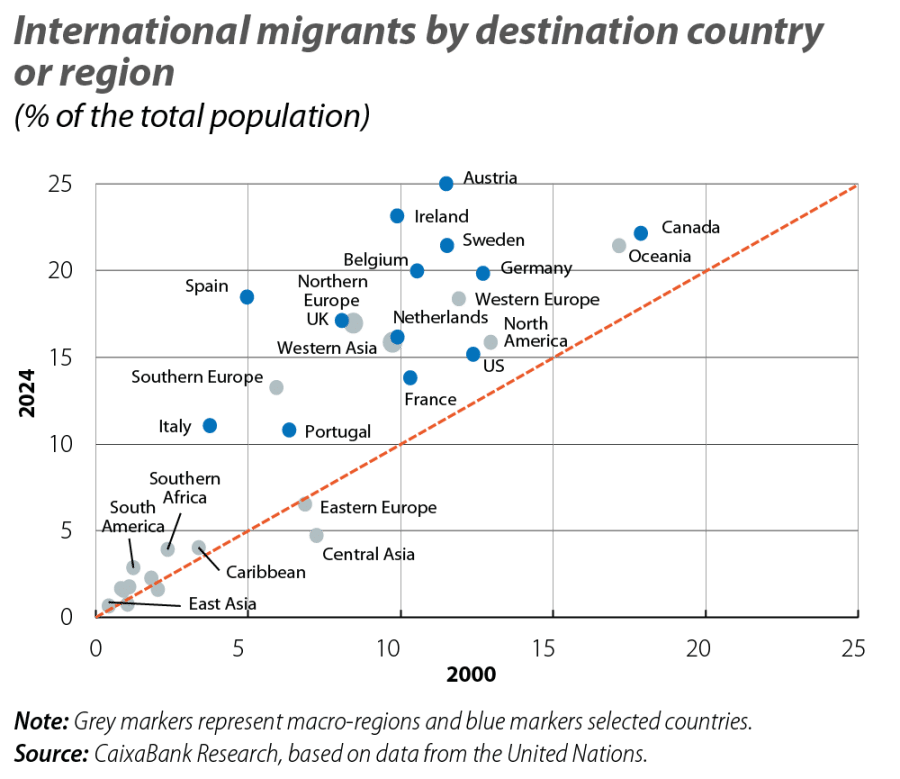
High migration flows over the past 25 years, coupled with population ageing in developed economies,5 have significantly increased the share of foreign-born people in these countries (see second chart). Across advanced economies, the average increase between 2000 and 2024 was 6 percentage points. Europe, North America and Oceania remain among the top destinations for international migrants, who account for more than 15% of the population in these regions. By country, the largest increases since the turn of the century have been concentrated in several European countries, including Austria, Spain, Switzerland, Sweden, Belgium and the United Kingdom. All have recorded rises of around 10 percentage points or more in the share of international migrants in the population.
- 5
See the Dossier «Challenges and policies in the age of longevity», in the MR09/2025.
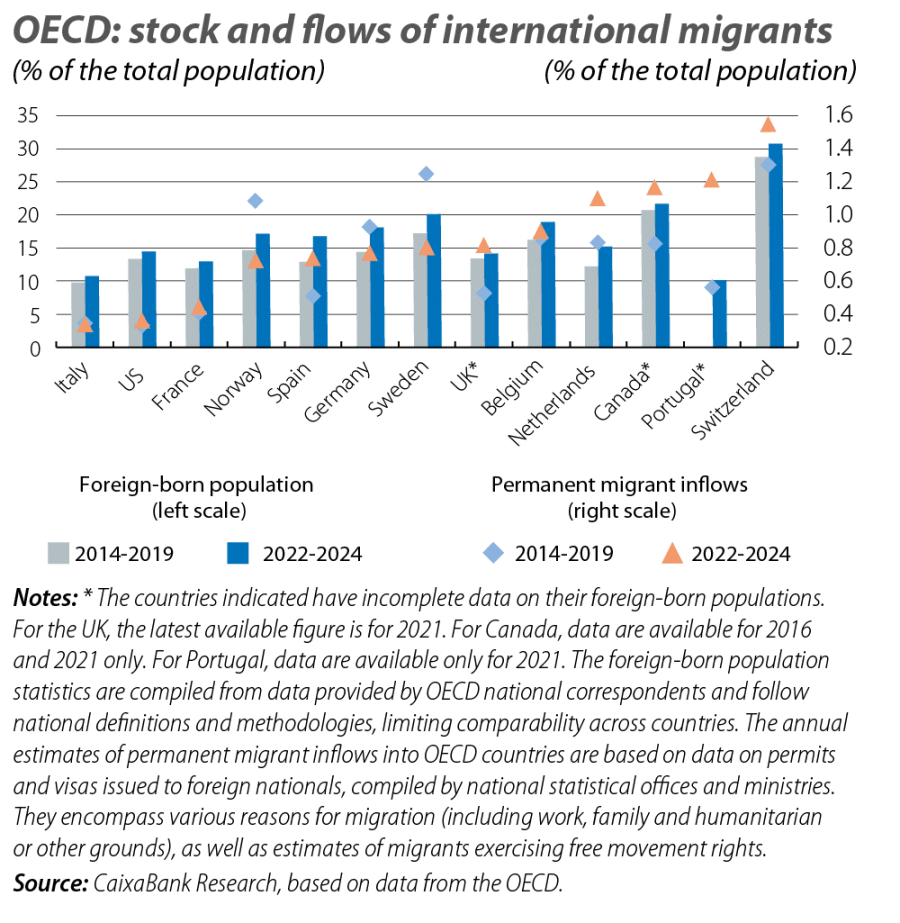
Across the OECD, despite a slight slowdown in 2024, migration flows have reached record highs in recent years, at close to 6 million arrivals a year. While work-related entries have almost doubled since the pre-pandemic period to more than one million, family reasons have remained the main route of entry, while entries on humanitarian grounds have risen steadily.6 These migration trends accelerated in 2022-24 in countries such as Spain, Portugal, the Netherlands, the United Kingdom and Canada, while in Germany, Sweden and Norway they slowed from their 2014-19 peaks (see third chart).7
- 6
In 2024, the number of new asylum applications lodged in OECD countries reached 3 million, more than double the 2019 figure. This increase was driven mainly by the US (1.7 million), but also by Canada and the UK, while the number of applications fell across the EU.
- 7
If the trends observed between 2019 and 2024 continue, the foreign-born population will exceed 20% before 2030 in some OECD countries, including Germany, Spain and Canada, while it would approach 15% in France, Italy, the UK and the US. According to OECD data, in 2024 Spain had 8.8 million foreign-born residents, accounting for 18.1% of the population. According to data from Spain’s National Statistics Institute (INE), the country had 9.5 million foreign-born residents at the end of 2024, accounting for 19.3% of the population. The latest available data (July 2026) indicate that around 10.3 million people living in Spain were born abroad, equivalent to 20.7% of the population (provisional data, Continuous Population Statistics, INE).
Public policy and the migration challenge: future implications
Against this backdrop, OECD countries have made significant changes to their migration policies. Some have set explicit targets to reduce immigration flows and significantly tightened conditions for asylum seekers and family reunification, while also restricting access to social benefits.8 At the same time, labour-related migration routes have become more selective and increasingly geared towards individual countries’ economic needs. Tight labour markets have also prompted a rapid expansion of quota systems in recent years, alongside the introduction of lists of shortage occupations.9
On integration, the prevailing trend is increasingly to link reception policies to labour market participation. Several countries have strengthened mechanisms for recognising qualifications obtained abroad and have expanded training and labour market integration programmes for more vulnerable groups, such as migrant women. While some countries are expanding their integration frameworks, others have tightened requirements for newcomers, reflecting a broader shift towards more restrictive systems with a stronger focus on economic outcomes.
The main destination countries for global migration are also seeking a new balance between their structural need for immigration and growing political pressure
to control these flows. Although labour shortages, population ageing and global competition for talent continue to drive structural demand, more selective policies are being adopted, resulting in tighter entry requirements and immigration being increasingly aligned with market needs. Integration policies are also shifting from an approach focused on reception in favour of models that prioritise newcomers’ economic contribution.
This trend reflects a deeper transformation in global migration. Migration has historically been driven by humanitarian factors or income disparities between regions. Today, it is increasingly central to debates on economic growth, population ageing and the sustainability of welfare systems. In this new environment, managing migration flows at the national level will remain crucial, but will require both the adaptation of a broad range of public policies and stronger international cooperation. More restrictive policies may alter migration patterns, but they are unlikely to eliminate the structural factors driving international mobility and the challenges it creates.
- 8
See, for example, Elcano Royal Institute (2026), «La aplicación del Pacto Europeo de Migración y Asilo: hacia políticas más restrictivas»
and the Focus «Trump 2.0 immigration policies: the end of the American Dream?», in the MR10/2026. - 9
There has also been a focus on developing temporary migration schemes targeting highly skilled workers. See OECD (2025), «International Migration Outlook 2025».
Demographics
How does demographics affect economic growth, the reallocation of the model of production, the labour market and productivity?