Trump 2.0 immigration policies: the end of the American Dream?
Restrictive immigration policies are not a new development in US history, nor are they the defining feature of the second Trump administration compared to its predecessors. What is new lies in the breadth and speed of their application, as well as their potential impact on constitutional principles, from birthright citizenship to basic procedural guarantees. Some significant economic effects are already evident.

The 250th anniversary of the US Declaration of Independence comes at a time when, more than at almost any point in its recent history, the country is debating the scope of one of its founding ideals: the equality of all people, their freedom to forge their own path in life and their right to pursue a better future. This is a vision that has helped define the country as a nation of immigrants and a land of opportunity. Restrictive immigration policies are not a new development in US history, nor are they the defining feature of the second Trump administration compared with its predecessors. What is new is the breadth and speed of their application, as well as their potential impact on constitutional principles, from birthright citizenship to basic procedural guarantees. Although their medium-term socio-political consequences remain uncertain, some significant economic effects are already evident: lower demographic momentum, tensions in specific segments of the labour market, and a potential erosion of the US ability to attract international talent.
Broad-based restrictions: from managing migration flows to reducing the migrant stock
Trump 2.0’s shift on migration began on the very day of his inauguration. On 20 January 2025, the president signed several executive orders aimed at strengthening border control, restricting access to asylum, expanding detention and deportation powers, and reviewing various pathways for legal and humanitarian immigration. Among other measures, electronically processed appointments for asylum applications were cancelled; the Remain in Mexico programme was reactivated, requiring asylum seekers to await the outcome of their application on Mexican soil; the use of expedited removal procedures was expanded; and various refugee admission programmes, temporary authorisations (parole), and temporary protection mechanisms against deportation for certain nationalities were suspended or limited. New travel bans were introduced for citizens of 19 countries (later expanded to 39 countries), along with stricter visa control requirements, and measures aimed at encouraging «self-deportation» and reducing the incentives to remain in the country without legal status.
Although many of these policy instruments have been used by previous administrations, what is new under Trump 2.0 is their simultaneous application across the entire migration cycle: from entry into the country and access to asylum to legal residence, regularisation and removal. Obama combined high levels of deportation with administrative relief mechanisms such as DACA, which temporarily protected undocumented immigrants who arrived in the country as minors from deportation; Trump 1.0 introduced travel bans, the border wall and Remain in Mexico; and Biden attempted to channel flows through legal and humanitarian routes, although he progressively tightened border controls. Trump 2.0 goes a step further by attempting to reduce both new arrivals and the stock of immigrants already present in the country.
The change is particularly evident in the legal sphere. The current administration attempted to restrict automatic birthright citizenship recognised by the 14th Amendment of the Constitution through an executive order, but the Supreme Court invalidated the measure in June 2026. Subsequently, an order with a more limited scope has also been provisionally blocked by a federal court. The administration has also promoted the wider use of expedited removals and administrative detention, which has reopened the debate on the scope of procedural safeguards applicable to non-citizens and the constitutional limits of immigration policy, including the role of federal courts in overseeing executive decisions in this area.
Economic impact: reduced demographic momentum and tensions in the labour market
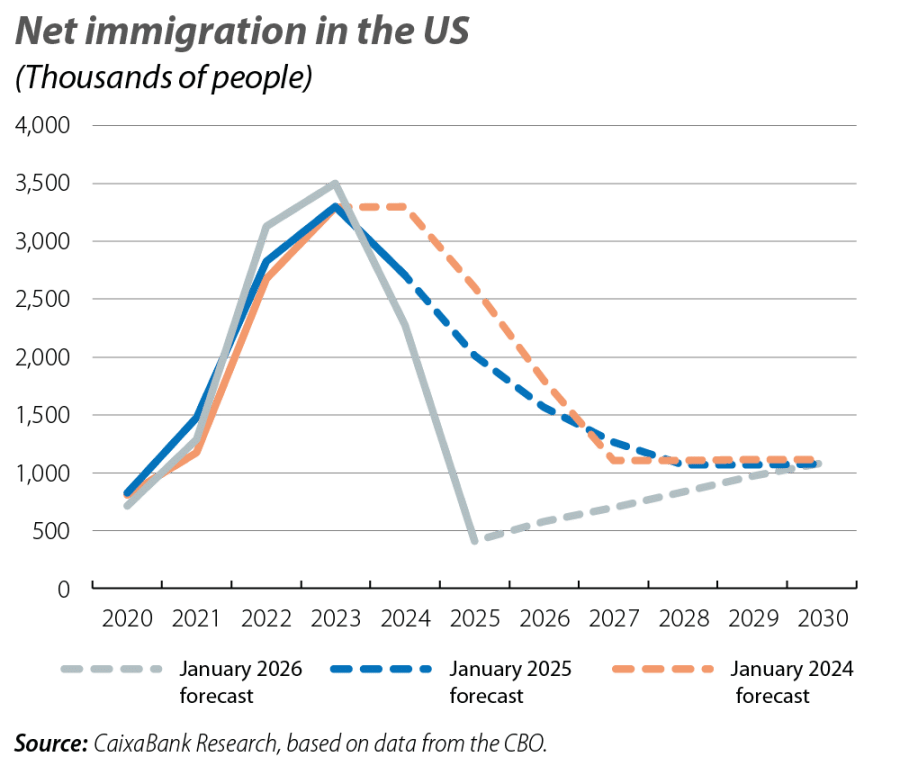
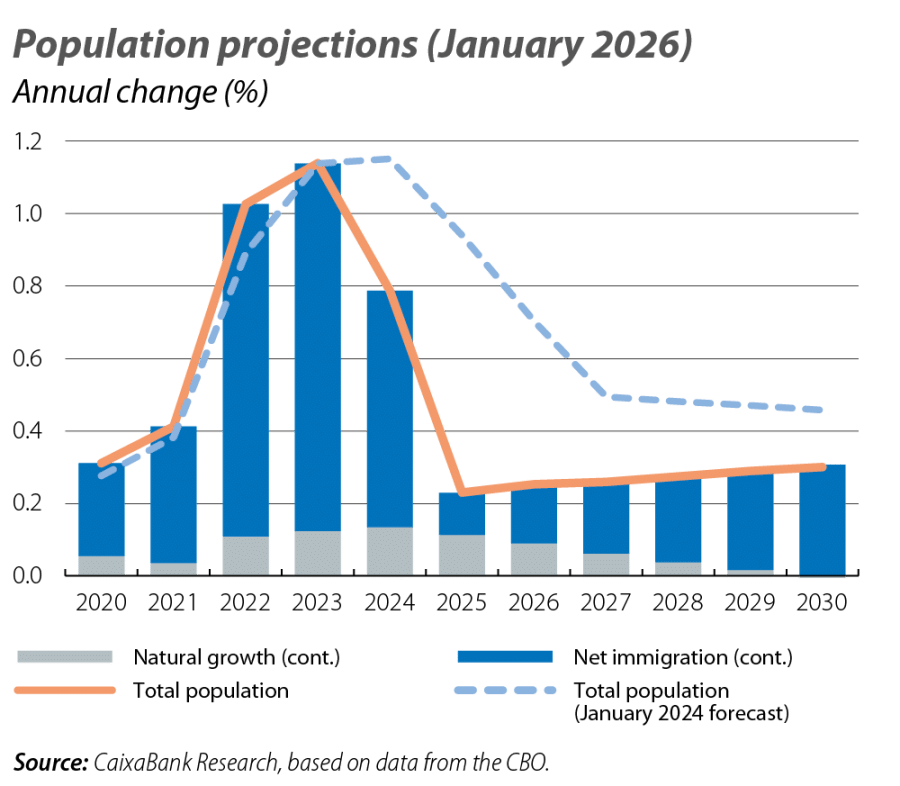
The effects of the measures described in the previous section have already begun to be reflected in US demographic and labour dynamics. Using the latest population projections by the Congressional Budget Office (CBO) as a reference, the advent of the second Trump administration has led to a significant reduction in projected net immigration flows for the coming years (see first chart). Although the CBO had already anticipated a normalisation of flows following the high levels of previous years, in September 2025 it lowered its net immigration forecast for that year by 1.6 million compared to the figure published in January. Overall, cumulative net immigration between 2025 and 2030 is expected to be approximately 3.5 million lower than anticipated prior to the current administration.1 This revision is particularly relevant because the country is currently in a phase in which immigration is crucial for sustaining population growth. Indeed, this dependency will intensify from 2030, when, according to the CBO itself, deaths will outnumber births and the natural balance will become negative (see second chart).
- 1
Estimate based on Congressional Budget Office (2025), «The Demographic Outlook: 2025 to 2055» and Congressional Budget Office (2026), «The Demographic Outlook: 2026 to 2056».
The implications of this shift go beyond the demographic dimension and directly affect the labour market. Immigrants account for around one-fifth of the US labour force (19.1% in 2025) and they played a crucial role in the post-pandemic employment growth.2 However, the growth of the foreign-born workforce has moderated sharply since 2025, in line with the slowdown in migration flows. Some estimates attribute between 40% and 60% of the slowdown in non-farm job creation observed during 2025 to reduced immigration, although the broader weakening of the demand for labour also played a significant role.3 While there is currently no widespread labour shortage or any significant impact on overall wages, the effects are already visible in certain sectors and regions where the percentage of foreign labour is higher. The Federal Reserve’s Beige Book from October 2025 already identified labour supply tensions in agriculture, construction, hospitality and manufacturing associated with changes in migration policy, with explicit mentions of hiring difficulties, delays in certain projects and wage pressures in specific regional markets. These developments have also been documented in subsequent reports.4
An additional channel affects the US’ ability to attract international talent. Migration restrictions have not been limited to lower-skilled jobs: they also affect students, researchers and highly educated workers. In the university sector, new international enrolments fell by 17% in autumn 2025, with surveyed institutions citing difficulties obtaining visas and travel restrictions as key factors.5 This setback is particularly significant because universities are one of the main gateways to the job market for international talent and represent an essential source of human capital for knowledge-intensive sectors.6 In addition, new restrictions and increased bureaucratic requirements for certain academic and professional visas have led to heightened uncertainty in fields such as technology, finance, scientific research and advanced innovation. It is still too early to conclude that talent is shifting towards other destinations. However, if this trend consolidates, it could limit the availability of the human capital needed to fully leverage the current investment cycle in AI and translate it into productivity gains.7
- 2
Bureau of Labor Statistics (2026), «Labor Force Characteristics of Foreign-Born Workers: 2025».
- 3
S. Mongey (2025), «Immigration Can’t Explain Declining Employment Growth».
- 4
Federal Reserve System (2025), «Beige Book, October 2025».
- 5
J. Baer and S. Ekin (2025), «Fall 2025 Snapshot on International Student Enrollment».
- 6
According to data from the National Science Foundation, around three-quarters of international graduates who earned a doctorate in science and engineering in the US between 2017 and 2019 on a temporary visa were still residing in the country in 2023.
- 7
See the Dossier «The present and futures of the new AIconomy», in the MR05/2026.
Measures against history…
Experience suggests that migration restrictions rarely eliminate the economic needs that drive population movements. In the US, both the Chinese Exclusion Act of 1882 and the termination of the Bracero programme in 1964 were partly justified by the expectation of improving job opportunities for the native population.8 However, subsequent evidence indicates limited effects on wages and employment, while the main adjustments occurred through technological changes, the reorganisation of production or reduced economic activity in the most affected areas.9 Although it pertains to a different institutional context, Britain’s experience after Brexit points in a similar direction. The end of the free movement of European workers in January 2021 led to a sharp drop in immigration from the EU and labour supply tensions in certain sectors, especially those most reliant on EU workers.10 However, part of this decline was later offset by an increase in non-EU immigrants, with no available evidence indicating widespread improvements in employment or wages for the native population attributable to stricter migration policies.
The main lesson is that an effective migration policy requires more than just entry restrictions. It also requires credible mechanisms for enforcing legislation, legal certainty for workers and businesses, and cooperation with neighbouring countries to manage flows that are driven by long-term economic and demographic forces. Furthermore, the loss of competitiveness relative to China in some US industrial sectors can hardly be explained by immigration. Innovative capacity, infrastructure, institutional quality, the availability of suitable human capital, and the strength of technological and industrial ecosystems appear to be much more decisive factors in explaining an economy’s competitive position. In this regard, migration policy can complement a competitiveness strategy, but it cannot replace it.
In a context of an ageing population,11 the question is not so much whether the US will remain a nation of immigrants, but whether it will retain the ability to attract and retain the talent and workforce that have historically contributed to its economic dynamism and competitiveness, and thereby, its status as a land of opportunities.12 The EU could seize this opportunity to advance its ambitious – and necessary – competitiveness agenda,13 perhaps laying the foundations for a European Dream.
- 8
The Chinese Exclusion Act suspended the entry of Chinese workers into the US from 1882, while the Bracero programme channelled the temporary hiring of Mexican workers, mainly for agriculture, between 1942 and 1964.
- 9
M. Clemens, E. Lewis and H. Postel (2018), «Immigration Restrictions as Active Labor Market Policy: Evidence from the Mexican Bracero Exclusion», and J. Long, C. Medici, N. Qian and M. Tabellini (2024), «The Impact of the Chinese Exclusion Act on the Economic Development of the Western US».
- 10
J. Portes and J. Springford (2023), «Early Impacts of the Post-Brexit Immigration System on the UK Labour Market, Centre for European Reform».
- 11
See the Dossier «Challenges and policies in the age of longevity», in the MR09/2025.
- 12
National Academies of Sciences, Engineering, and Medicine (2017), «The Economic and Fiscal Consequences of Immigration».
- 13
See the Focus «How far has the EU progressed on the Competitiveness Compass?», in the MR04/2026.
Geopolitics
We analyse the major geopolitical trends and thier effects on the financial markets and the economy.

Demographics
How does demographics affect economic growth, the reallocation of the model of production, the labour market and productivity?