The new US tariff landscape (2026 back-to-school edition)
Few economic topics have experienced as many twists and turns in such a short time as the tariff saga of Trump 2.0. In just 18 months, analysts (not to mention firms involved in international trade) have experienced a true roller-coaster: the iconic Liberation Day; the unprecedented escalation with China, with tariffs exceeding 100%; and the Greenland episode, amidst the usual threats to the EU.

In contrast to these maximalist positions, the agreements reached with key trading partners moderated the previously announced tariffs, while the reconfiguration of imports reduced their effective impact. In 2026, this de-escalation took a further step when the Supreme Court ruled against the general tariffs implemented through the use of emergency economic legislation. With the temporary tariff that replaced them now expired, the new measures outlined in section 301 of the Trade Act and the various sectoral tariffs create a scenario that alters the nature of the instruments more than it does the average duty.
Effective tariffs: stability after de-escalation
The executive orders adopted between February and April 2025 entailed a complete overhaul of the tariff regime that the US applies to its imports.1 According to customs and import revenue data, the average effective tariff rose from just over 2% at the beginning of 2025 to around 7% in April, reaching a peak close to 11% in October. By then, the measures were already fully in place, the anticipation effect that had driven imports of products that were initially exempt, such as pharmaceuticals and electronics, had dissipated, and some of the tariffs announced on Liberation Day had been revised upwards, especially those imposed on Brazil and India (see first chart).
- 1
See the Focus «US tariffs: where do we stand and what comes next?» in the MR06/2025.
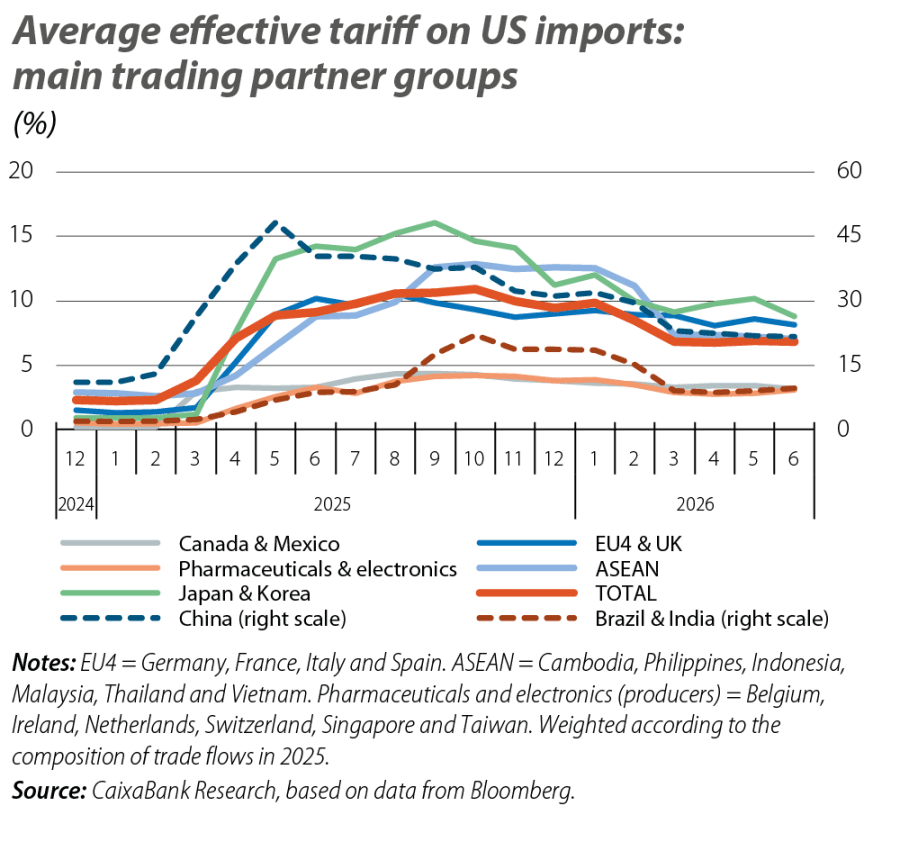
Since then, we have witnessed a gradual de-escalation, driven by three factors of a very different nature and scope: bilateral trade negotiations, the reconfiguration of US imports and the Supreme Court ruling. Firstly, the agreements reached last year resulted in significantly lower tariffs than those introduced on Liberation Day. This was particularly the case for Southeast Asian countries, but also for China following the truce in November 2025, as well as for the EU compared to previous protectionist threats.2 Secondly, changes in the relative level of tariffs by product and trading partner have led to major changes in the composition of imports, with some purchases from China shifting to other Asian suppliers, such as Vietnam for certain labour-intensive manufactures, and Taiwan for technological products.3 Mexico has also gained market share in the US, aided by the increase in the proportion of imports that comply with the rules of origin under the United States-Mexico-Canada Agreement (USMCA), which has also cushioned part of the tariff increase.4 This has been compounded by the strong demand for electronic products in the US, linked to the AI investment cycle.
Thirdly, the Supreme Court ruling on 20 February 2026 determined that invoking the International Emergency Economic Powers Act (IEEPA) was not the appropriate legal avenue for establishing general tariffs and that, being a tax measure, it required Congressional authorisation.5 Thus, tariffs that accounted for some two-thirds of the increase in the average levy since early 2025 were rendered invalid, paving the way for the amounts previously collected from importing companies to be refunded.6 On the same day as the ruling, a presidential proclamation activated section 122 of the Trade Act – intended to address fundamental balance of payments issues – and established a temporary general tariff of 10% for 150 days.
This set of factors has decisively contributed to reducing the average effective tariff by 4 pps, and since March 2026 it has stood slightly below 7%, its lowest level since last spring.
- 2
See the Brief Note «Acuerdo comercial entre EE. UU. y la Unión Europea» of 29 July 2025.
- 3
See the Focus «The new map of US goods imports» in the MR01/2026.
- 4
E. Martínez-García and R. Mau (2026), «How USMCA compliance cushioned the 2025 tariff shock».
- 5
See the Focus «10 questions on the US Supreme Court’s tariff ruling» in the MR03/2026.
- 6
According to information from US Customs and Border Protection cited by The Conference Board, as of 31 July, refunds had been completed amounting to approximately 100 billion dollars (including interest); the applications accepted for processing totalled 128.7 billion, compared to a total of around 166 billion collected under the IEEPA.
Announced policies: everything changes so that tariffs can stay as they are
The expiration of the temporary tariff under section 122 on 24 July has not marked a return to the pre-Trump 2.0 scenario. On the same day, the new tariffs approved under section 301 came into effect, following investigations opened in March regarding the bans adopted by the US main trading partners on the import of goods produced wholly or partly using forced labour and their effective enforcement.
The measures affect 60 economies, which account for almost all US imports. Canada, Mexico, the United Kingdom and India are subject to a general additional surcharge of 10%, which rises to 12.5% in the case of China. For other trading partners, the new levy complements the most-favoured-nation (MFN) tariff applied to each product when it falls below a threshold: up to a total rate of 10% for the EU and Taiwan, and 12.5% for Japan, South Korea, and Switzerland. All of these rates lie below the 15% set in the trade agreements reached since the summer of 2025. Exemptions also remain in place for certain products, including goods from Canada and Mexico that comply with USMCA requirements and those already subject to sectoral measures under section 232 of the Trade Expansion Act. The new regime also exempts certain raw materials and critical inputs in cases where imposing tariffs on them could cause supply issues, such as critical minerals and fertilisers. Moreover, it gives preferential treatment to Central American and Dominican textiles that meet the conditions of the CAFTA-DR agreement, while also planning future quotas for imports of these products from certain Asian partners, linked to the purchase of US cotton and textile goods.
Sectoral measures make up the second major pillar of the new framework. Section 232 allows tariffs to be imposed for national security reasons and already covers steel, aluminium and motor vehicles, among others. In the pharmaceutical sector, the US administration implemented in April the measure announced in September 2025: a tariff of up to 100% on certain patented medicines and their ingredients. The scheme includes lower rates or exemptions depending on the country of origin, as well as corporate commitments to investment and production in the US, while generic medicines are exempt, for now. In commercial aviation, a negotiation period began in July, lasting until the end of the year, before a decision will be made on possible additional measures.
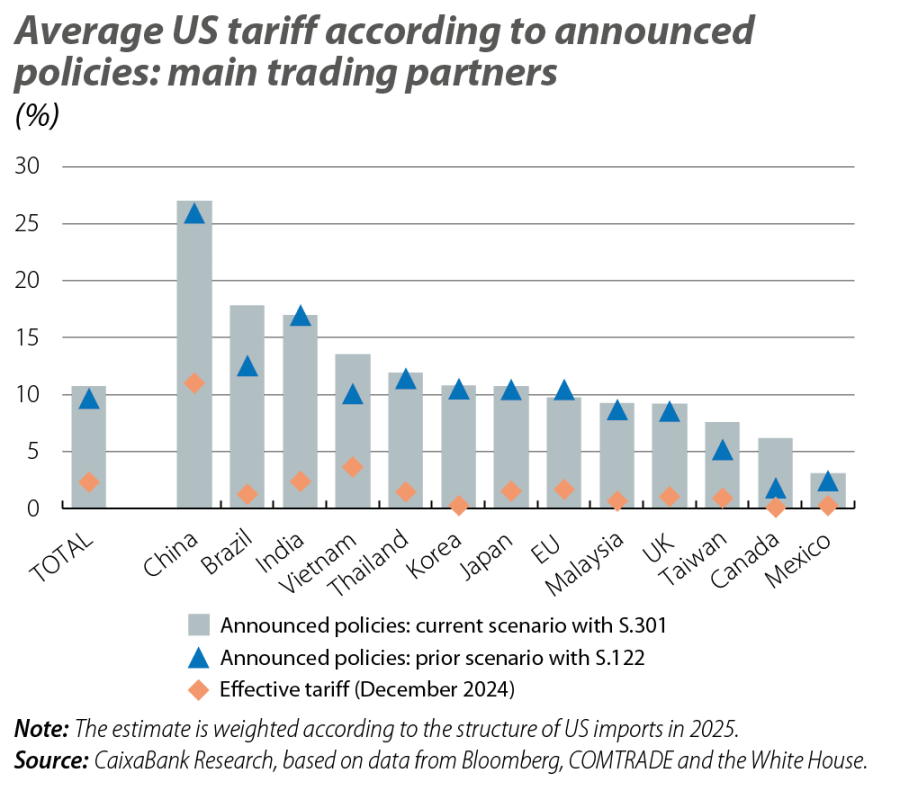
Considering this overlap of instruments and making reasonable assumptions about the scope of the current exemptions, we estimate that the average tariff implied by the policies announced would be around 11%, just 1 percentage point higher than the previous estimate under the temporary section 122 tariffs. The ranking of the US main trading partners does not change substantially either (see second chart). Mexico and Canada remain among the partners with the lowest tariff burden thanks to exemptions under the USMCA, while the EU remains slightly below average. In contrast, China, Brazil and India are at the upper end of the distribution, with a particularly significant leap in Brazil’s case due to the imposition of an additional 25% levy resulting from another bilateral investigation under section 301, this time concerning a wide range of trade practices. For several Asian partners, the new scheme replaces the general rates agreed bilaterally in 2025 with surcharges that are added on top of the MFN tariff, with differing outcomes depending on the composition of their exports.
The final chapter of the saga?
In the end, everything changes... so that (most) things can stay as they are: similar levels of protection, but supported by a more specific and procedural legal framework. This does not shield it from further legal claims, nor does it prevent tariffs from continuing to be used for a wide range of objectives. This includes their use as a tool for applying commercial pressure, as demonstrated by the additional 50% levies in force since August on a wide range of Canadian products and the threat of their extension to cars and components in 2027, to which Canada has already responded with equivalent measures. It also includes their use as a geopolitical and regulatory lever, with the recent initiation of an investigation against the EU following the multi-million dollar fine on Google. They also continue to serve national security and industrial policy purposes, as in the case of the new tariffs on drones and their components. For the coming months, the key uncertainties are concentrated along several fronts. The ongoing investigations under section 301 into structural manufacturing overcapacity in 16 economies could lead to new tariff measures, as could the growing crackdown on the illegal transshipment of goods through third countries.7 Moreover, the US decision not to extend the USMCA under its current terms paves the way for a process of annual reviews and prolongs the uncertainty about its future configuration. There is also ongoing concern about the stability of the truce with China, which rests on a fragile balance of dependencies in semiconductors, advanced technology, and critical minerals, against the backdrop of the AI race.8
- 7
White House (2026), «The great transshipment scam».
- 8
See the Dossier «The present and futures of the new AIconomy» in the MR05/2026.
Geopolitics
We analyse the major geopolitical trends and thier effects on the financial markets and the economy.