Ireland, the country that skews Europe’s statistics
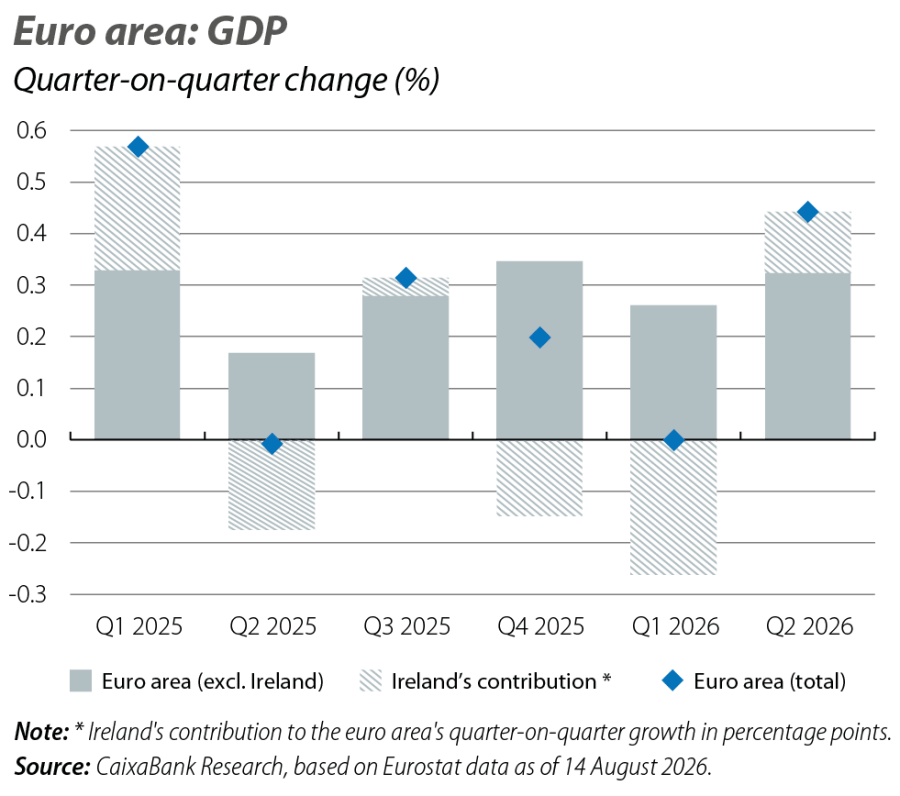
When Eurostat publishes GDP growth for the euro area, Germany, France, Italy and Spain are the main drivers of the final result. However, in recent years, Ireland has been responsible for the largest revisions and distortions of the euro area’s figures, both upwards and downwards. How can a country with just 5 million inhabitants have the capacity to alter the statistics of a region with over 350 million people?

The answer does not lie in the size of the country, but rather in how a significant portion of global economic activity is recorded within its borders. Ireland has become a global operations hub for some of the world’s largest multinationals, particularly in pharmaceuticals, technology, intellectual property and aircraft leasing. In other words, a small number of firms conducting high-volume operations cause the national accounting data to behave differently from those of a typical economy.
Ireland’s fiscal and legal framework has been a magnet for multinationals
Ireland was already an attractive European platform for multinationals before 2015, thanks to a combination of a low corporate tax rate, a favourable legal environment, and a particularly appealing regime for the location of intangible assets (patents, software, trademarks or exploitation rights). However, 2015 marked a turning point.
On one hand, the tightening of the international framework against certain «tax engineering» strategies led many multinationals to reorganise the location of their intangible assets and some of their corporate operations. On the other hand, the Irish tax regime allowed for the fiscal amortisation of intangible assets under particularly favourable conditions. The result was that Ireland emerged bolstered as a destination for intangible assets and certain functions of many companies, particularly in the technology and pharmaceutical sectors, as it offered a stable institutional environment, legal certainty and full access to Europe’s single market. And therein lies the key to Ireland’s uniqueness: in a small economy, the relocation of high-value assets can significantly alter its investment, export, value-added and GDP statistics.
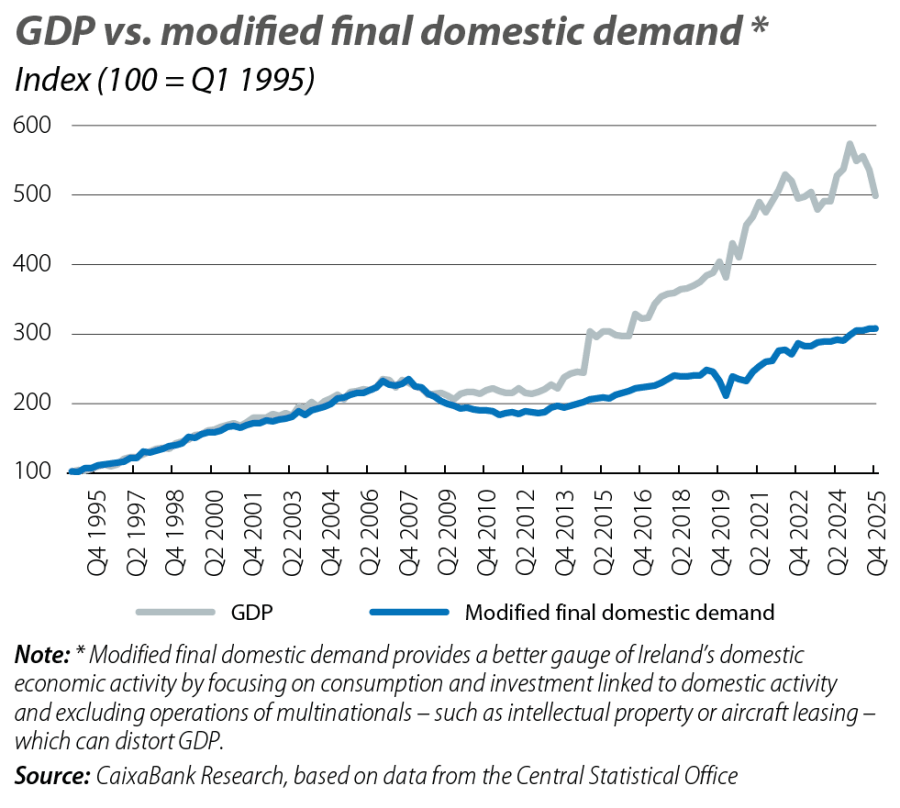
Ireland’s GDP may present a distorted picture of its economic development
The initial effect of this transfer of intangible assets may come as a surprise. When a multinational decides to transfer the ownership of a patent, software, or a trademark to Ireland, it is treated as being equivalent to the country acquiring an asset, which is recorded as an investment. However, as this asset (a patent, for example) is located abroad, it must simultaneously be accounted for as an import of services (R&D or intellectual property).1 Therefore, in the quarter in which the transaction is carried out, the impact on GDP is practically neutral. However, once these intangibles are integrated into the economy’s capital stock, they begin to generate service export flows, for instance in the form of licences, thus persistently contributing to GDP growth in subsequent years.2
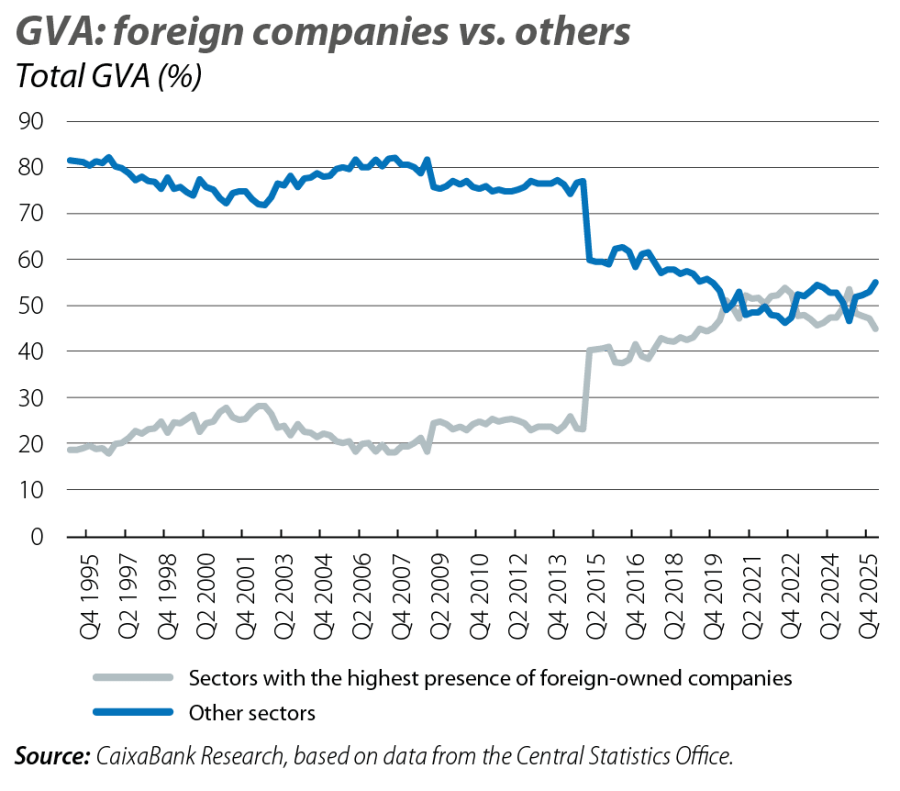
These practices explain the significant fluctuations in Ireland’s gross fixed capital formation (GFCF), exports and value added. They also explain the significant role of intangible assets within Irish investment: in recent years, it accounts for over 50% of all GFCF in Ireland, more than double the level in the main euro area economies. Ireland’s overexposure to these assets is confirmed by the fact that, since 2015, Ireland’s share of euro area GDP has been less than 4.0% on average, yet it accounts for more than 10% of the region’s investment in intangible assets. The contribution of other major economies to the euro area’s investment in intangible assets is much more consistent with the size of their economies.
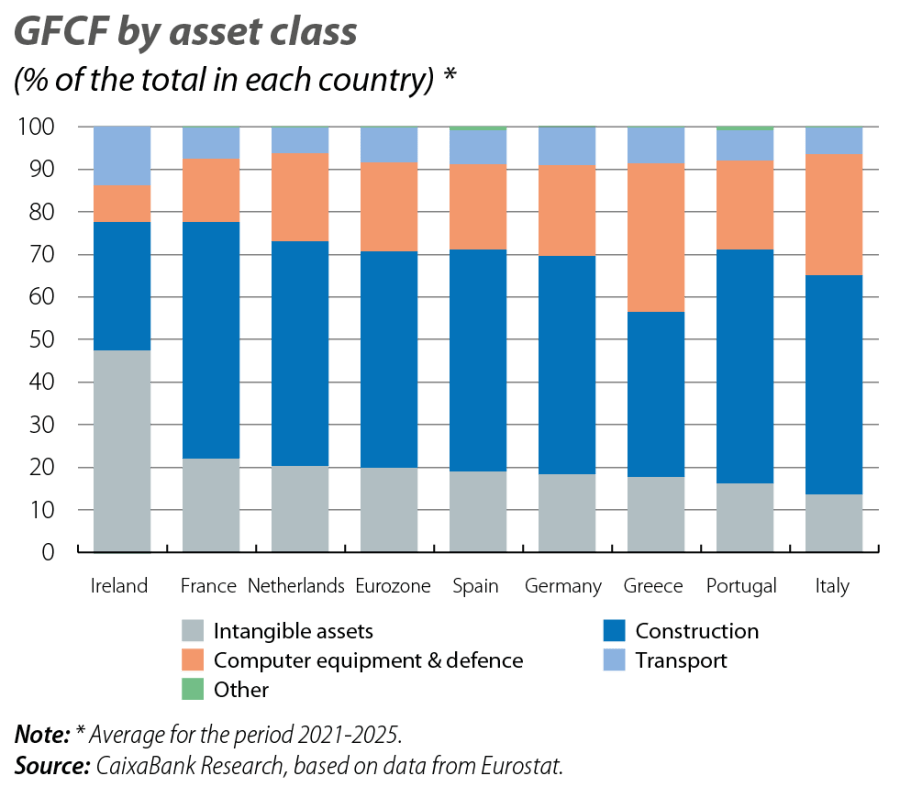
As a result, it is possible for Ireland’s GDP to grow significantly based on decisions made by a handful of multinationals whose actual business is conducted outside its borders, even in a context of weak household consumption, public spending, or investment related to the domestic economy. Conversely, Ireland’s GDP can fall sharply even if its domestic growth remains strong.
For this reason, the Central Statistics Office of Ireland is developing indicators that aim to separate domestic activity from the more volatile items associated with multinationals. These include modified final domestic demand (MFDD), which provides a better approximation of the country’s domestic economic activity by including household and general government consumption and investment in activities linked to the national economy. This measure excludes purchases of intellectual property, aircraft intended for leasing, and other components more closely linked to decisions of multinationals, which are counted within GDP.3 The data confirm this stability of MFDD compared to GDP. For example, in
Q3 2024, GDP grew by 7.6% quarter-on-quarter, but MFDD recorded an increase of 1.1%. In contrast, in Q1 2026, GDP fell by 7.6% quarter-on-quarter, but MFDD recorded a modest increase of 0.3%. Furthermore, MFDD has grown by more than 25% since Q4 2019, compared to an increase of just over 6.0% recorded by the euro area excluding Ireland.
Ireland is proof that size isn’t always what matters
The influence of multinationals and intangible assets has made Ireland a significant player in the euro area’s aggregate statistics. So much so that, in some quarters, we must ask ourselves which part of the euro area’s economic performance is due to the cyclical behaviour of the major economies and which part reflects the impact of operations concentrated in Ireland. This distinction is significant enough for the ECB itself to include in its forecast table a calculation of euro area GDP based on Ireland’s GDP and another based on MFDD.
Ireland does not distort the statistics because it has a major share of the euro area economy; it distorts them because it is the country in which a significant portion of the global intangible economy is recorded. GDP remains an essential variable for analysing an economy, but the case of Ireland reminds us that sometimes we need to look beyond the headline in order to understand this economy’s progress, as well as to gauge that of the euro area more reliably.