
The key ingredients for Spain’s regions to boost productivity
We conclude the Dossier «An analysis of European productivity» by identifying the factors that hinder productivity growth in the Spanish economy, and those that could drive it, focusing on the evolution of productivity in the various autonomous community regions and on their defining traits relative to other European regions.
Studying productivity is essential for assessing the state and growth potential of any economy, but it is particularly relevant in the case of Spain. Our economy has long been characterised by relatively low productivity growth, and it is still unclear whether this has changed in recent years.
For instance, GDP growth per employee has increased by 0% between Q4 2019 and Q3 2025, a figure that falls short of the 0.3% shown between Q4 2014 and Q4 2019. GDP growth per hour worked has shown slightly more dynamism, averaging 0.4% between Q4 2019 and Q3 2025, a rate similar to the 0.5% observed in the period Q4 2014-Q4 2019. However, this result has been driven by the decline in the number of hours worked per employee –1 a source of improvement with limited scope.
In order to identify the factors that hinder productivity growth in the Spanish economy, and those that could drive it, we focus on the evolution of productivity in the various autonomous community regions and on their defining traits relative to other European regions.
- 1
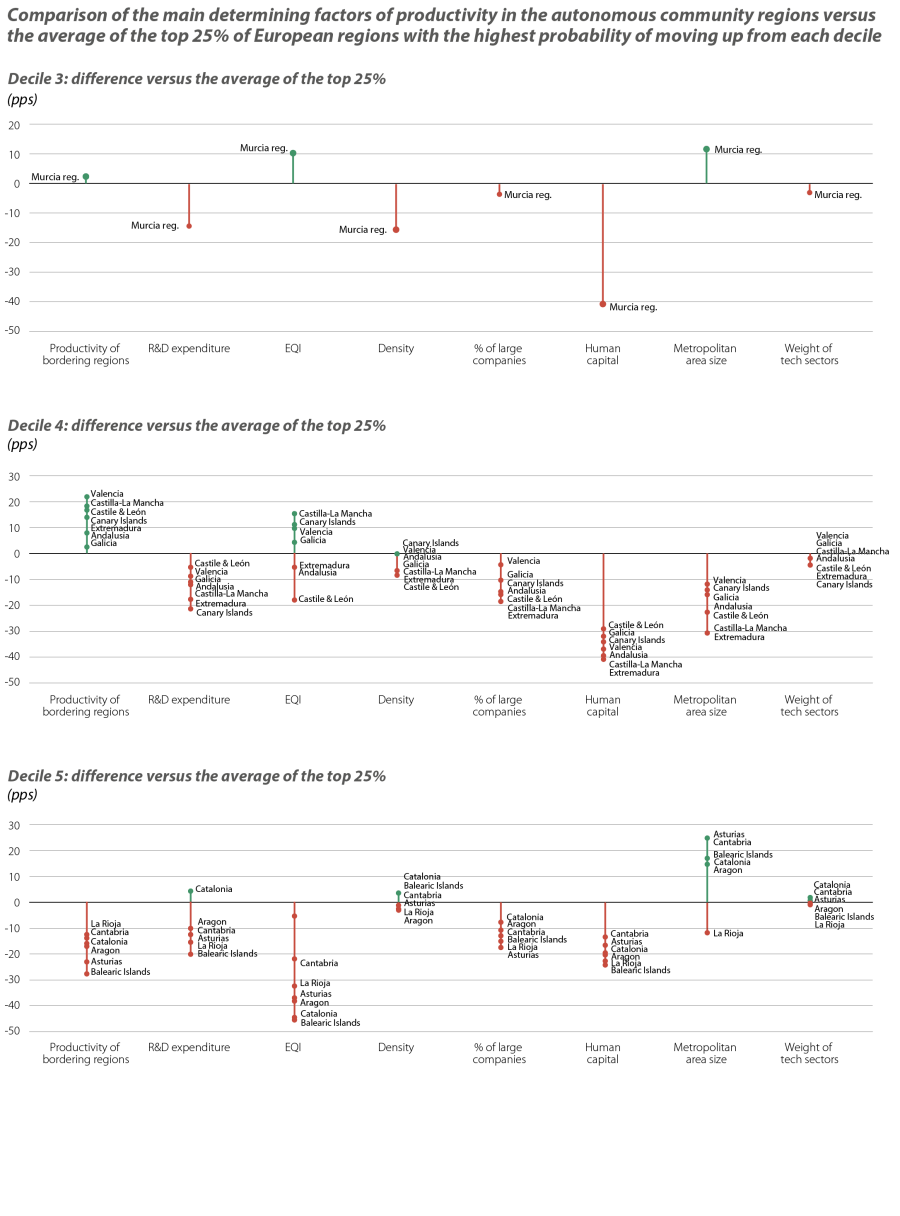
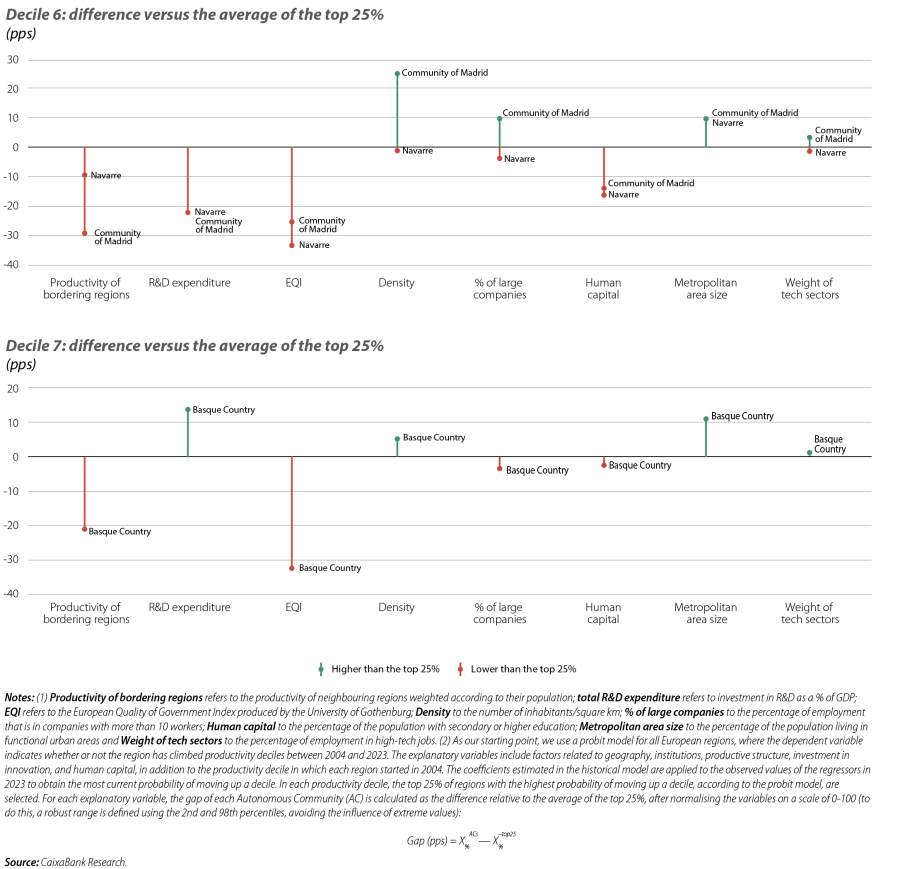
Comparison of the main determining factors of productivity in the autonomous community regions versus the average of the top 25% of European regions with the highest probability of moving up from each decile.
Relative position of Spain’s autonomous communities in the European productivity ranking
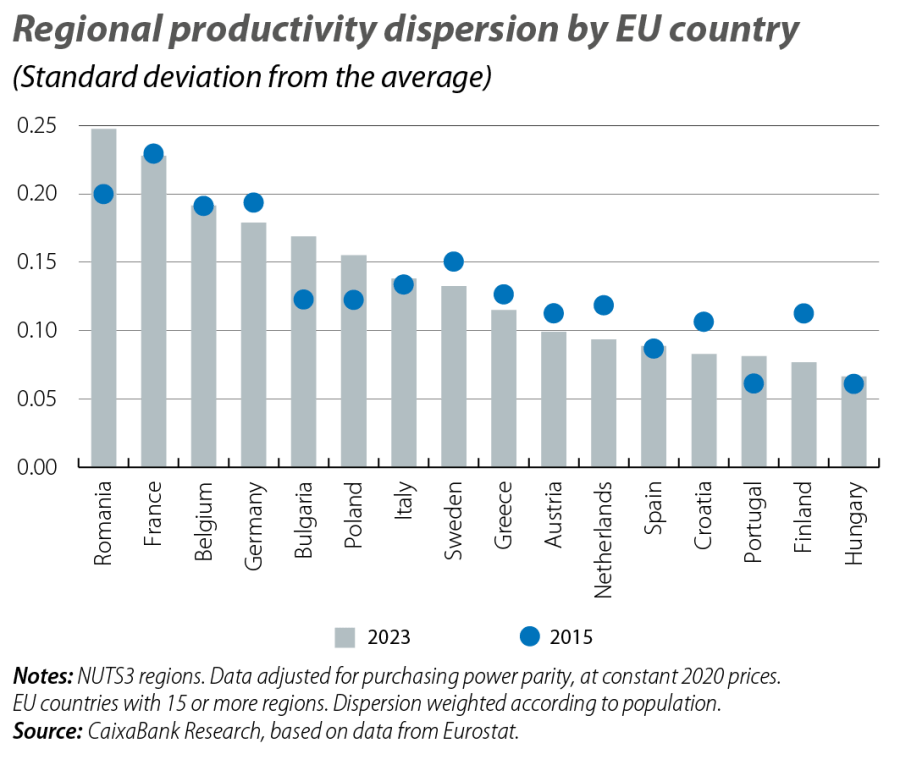
In general, Spain’s autonomous communities have a productivity level close to the European median.2 In the ranking of European regional productivity, Spain’s autonomous communities are predominantly found between deciles 4 and 6.3 The Region of Murcia was the only one positioned a step below, in decile 3, while the Basque Country is slightly higher, in decile 7, closer to Europe's leading regions.4 The disparity in productivity levels among Spain’s various autonomous communities has slightly increased in recent decades. However, if we compare the dispersion of regional productivity in Spain with that of other EU countries, we observe that it is relatively low, clearly below that recorded by leading economies such as Germany, France and Italy (see first chart).
- 2
Following the methodology used in the rest of the articles of this Dossier, the measure of productivity used is GDP per hour actually worked.
- 3
Data referring to 2022-2024, the latest data available for comparing between European regions. As in the other articles of this Dossier, three representative periods of relative normality are analysed: pre-Great Recession (2003-2005), pre-COVID (2014-2016) and the recent period (2022-2024). For each one, the average of the available years is taken, which for simplicity we will refer to as 2004, 2015 and 2023, respectively, in the remainder of this article.
- 4
Refer to the charts at the end of the article to see in detail in which decile each autonomous community lies.
The relative position of the various autonomous communities in the European productivity ranking is quite similar to that of two decades ago, without significant changes. Only Cantabria, the Autonomous Community of Navarre, the Community of Madrid, and the Basque Country have moved up one position; conversely, the Region of Murcia has dropped one position. This stability contrasts with the dynamics observed in most European countries. In some countries − such as Germany, Austria and Denmark − their regions have recorded widespread rises in the ranking, while in others − such as France, Greece and Italy − a large number of regions have experienced a decline.
In order to assess each autonomous community’s current situation and evaluate to what extent it can improve its position, we analyse in more detail the main factors determining their productivity. For this, we rely on the factors already mentioned in the other articles of the Dossier: geographical and institutional factors, the productive structure, and the capacity to innovate of each region. Specifically, we developed a statistical model to estimate the probability of each autonomous community changing its productivity decile, given the state of these determining factors.5 Our model shows good predictive capability: we find that 50% of the European regions that were in the medium-high and high probability quartiles of moving up the deciles in 2004 have indeed climbed declines over these 20 years. Similarly, 90% of the European regions that have moved up at least one decile were situated 20 years ago in the two quartiles with medium-high and high probabilities of doing so.
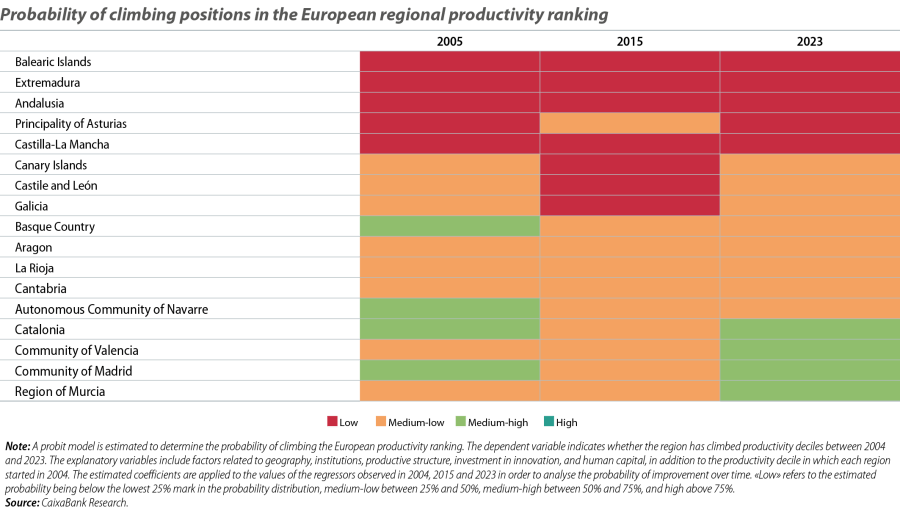
As the table below shows, most Spanish regions have a relatively low probability of moving up the deciles.6 Only four of them present a high probability: Catalonia, the Community of Madrid, the Community of Valencia and the Region of Murcia. In the past, this group also included the Autonomous Community of Navarre and the Basque Country, but both have moved up a position in recent decades and today are in a productivity decile more in line with the state of their determining variables.
- 5
Specifically, we estimate a probit model for all European regions, where the dependent variable indicates whether or not the region has climbed productivity deciles between 2004 and 2023. The explanatory variables include factors related to geography, institutions, productive structure, investment in innovation and human capital, in addition to the initial productivity decile from which each region started in 2004.
- 6
According to the distribution of probabilities predicted by the probit model, most of Spain’s autonomous communities are in quartiles 1 and 2.
What should the autonomous communities do to improve their position in the European productivity ranking?
Finally, in order to better understand in which spheres each autonomous community excels and which factors hinder its progress in the European productivity ranking, we compare the state of the various determining variables of productivity with that of the top 25% of European regions that are most likely to move up a decile. For example, let us take the autonomous communities positioned in the 4th productivity decile and compare them with equivalent European regions within that decile, such as the regions of Zagreb (Croatia), Vilnius (Lithuania) or Wrocław (Poland). In this case, the Community of Valencia and Castilla-La Mancha benefit from being located close to other more productive regions, such as Catalonia and Madrid, respectively. On the contrary, the main elements hindering progress in the European productivity ranking are those related to the productive structure (for example, the small average size of companies), certain geographical factors (such as the percentage of the population residing in metropolitan areas) and the level of human capital (particularly, the percentage of the population with secondary or higher education).
Similarly, the autonomous communities located in the 5th decile are compared with equivalent regions such as Mecklenburg-Vorpommern (Germany), Chemnitz (Germany) and Friesland (Netherlands). For many of the autonomous communities within this decile, their geographical factors stand out as being particularly positive, such as the size of their metropolitan area and their population density. These aspects, as observed in previous articles of this Dossier, are closely correlated with the progress of the most productive regions. Catalonia stands out in this group for having R&D expenditure greater than the top 25% of the European regions most likely to move up a decile. However, the institutional quality of all the autonomous communities within this decile is clearly inferior compared to the regions of reference. This factor also weighs down those positioned higher up the ranking, in deciles 6 and 7, such as the Autonomous Community of Navarre, the Community of Madrid and the Basque Country. In the case of the Community of Madrid, the high population density and the extent of its metropolitan area stand out as particularly positive factors, along with the fact that it has a relatively large business network. In the Basque Country, meanwhile, investment in R&D stands out.
Ultimately, all of Spain’s autonomous communities have certain elements they can rely on to continue improving their productivity, and some areas where they face a certain disadvantage. None of them are insurmountable. If corrected, the growth capacity of their economy will improve. The study also highlights the importance of geographical factors. Therefore, if the effort is shared among all the autonomous communities, then the probability of success will be even greater.