
What can we expect from labour force participation rates in the US and EU?
Trends over the past 25 years suggest there is still some scope for labour force participation to contribute to supporting the labour supply, but not all contributions of the past will continue to have the same effect in the future.

Population ageing poses significant challenges to economic growth, but there are policy tools that can at least partly mitigate its effects.1 Chief among these are boosting productivity and increasing the working-age population through immigration.2 Another such tool related to the labour market is to make greater use of labour by increasing workforce participation among groups that remain under-represented. To assess the potential of this approach, we analyse the factors that have driven its evolution in the US and the EU’s four largest economies over the past 25 years. The results show that demographic trends, education and changes in labour-market behaviour have operated with varying degrees of intensity on both sides of the Atlantic, and that some of the forces that drove participation in the past are beginning to lose momentum.
- 1
See the article «The effects of ageing on growth and policy tools to mitigate them», in the Dossier of the MR09/2025.
- 2
On immigration, see the Focus «Migration and migration policy: a global overview», in this same Monthly Report.
A breakdown of its structural factors
The labour force participation rate measures the proportion of the population that is either employed or actively seeking work. In order to identify the factors that drive its evolution, we have statistically broken down its change over time into three components: shifts in the population’s age distribution, changes in education level within each age group and changes in participation among people of the same sex, age and education level.3 This final component captures changes in labour market behaviour within each group and may include cohort effects shaped by factors such as labour market policies, pension reforms, measures related to work-life balance and shifts in labour demand. The analysis uses OECD data for men and women aged 25-64 in the US, Germany, France, Italy and Spain. Within each sex, we distinguish four ten-year age groups and three levels of education (basic, medium and higher), and we compare how they have evolved over the past 25 years.
- 3
We follow the methodology used in C. Fernández-Vidaurreta and D. Martínez-Turégano (2018) «Evolución y perspectivas de la tasa de participación en el área del euro: una visión de largo plazo». Boletín Económico, 1/2018, Bank of Spain.
Convergence, but driven by different forces
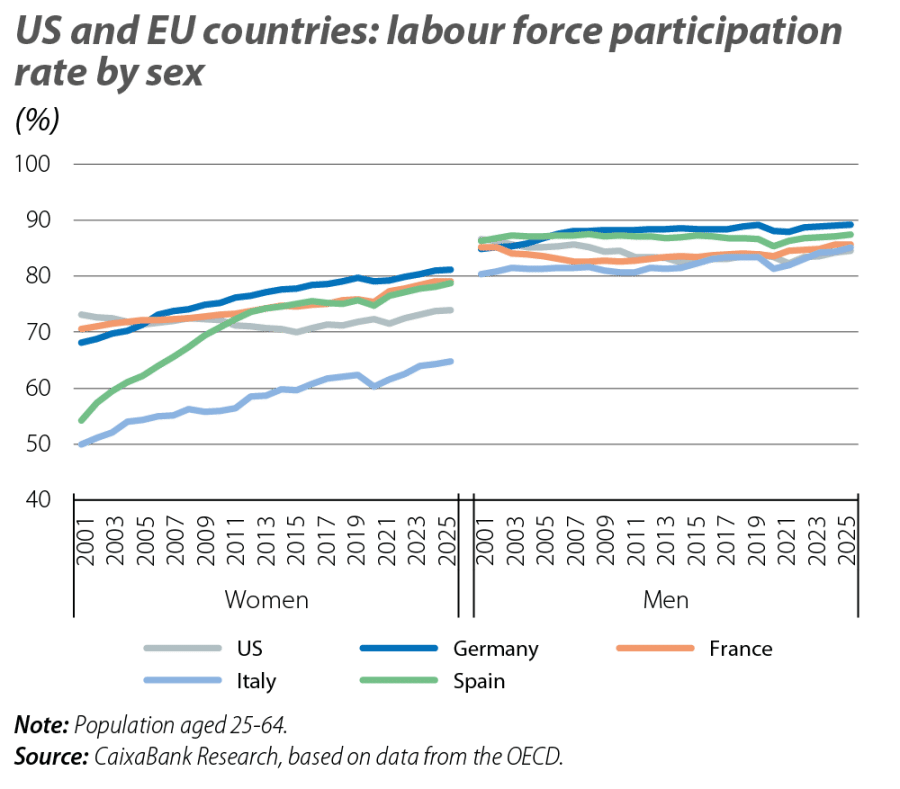
Since the start of the century, there has been a clear convergence in labour force participation rates between the US and the EU’s four largest economies, but through very different channels and with varying degrees of intensity over time. Between 2001 and 2013, the labour force participation rate among 25-64 year-olds fell for both sexes in the US, while it rose in European countries – particularly in Spain, followed by Germany and Italy – driven decisively by women (see first chart). This extended the convergence between the two areas that had begun decades earlier.4 Possible explanations for the US trend highlighted in the literature include weaker demand for workers with certain qualifications and the resulting skills mismatch, changes in the sectoral composition of employment and a higher prevalence of health problems or disabilities among some groups.5
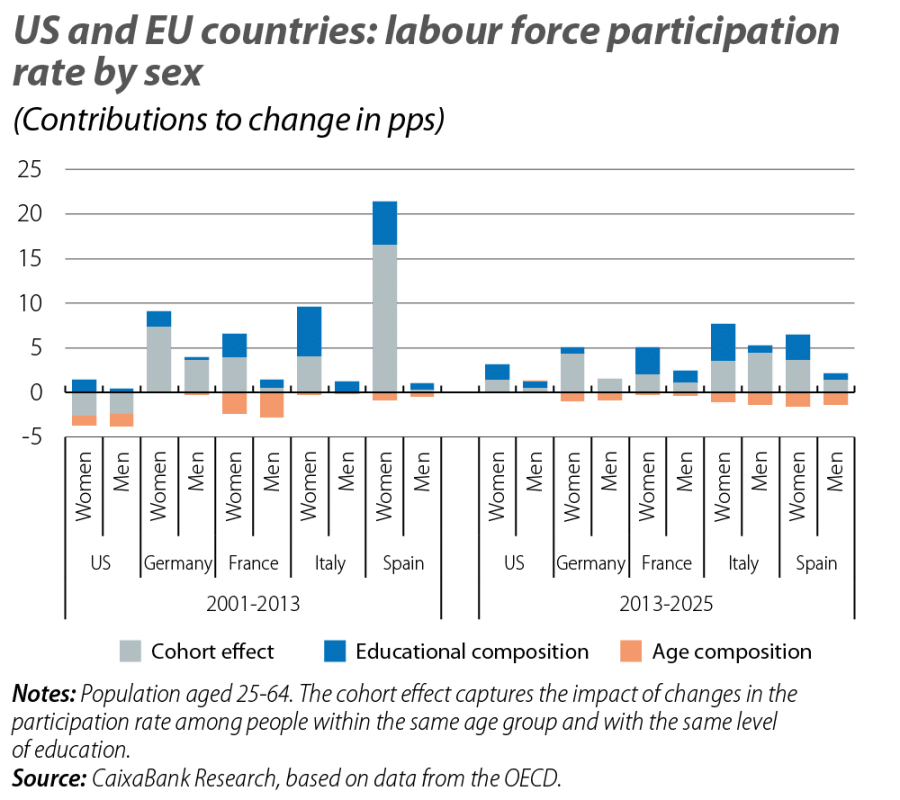
The structural breakdown allows us to identify the drivers of these trends more precisely (see second chart). For example, between 2001 and 2013, changes in participation within similar age and education groups accounted for around 17 of the 20 percentage-point rise in Spain’s overall female participation rate. This component also accounted for most of the increase among women in Germany and France. In the US, however, changes within similar groups made a negative contribution for both sexes. In Europe, the higher labour force participation among younger female cohorts was associated, among other factors, with changing fertility decisions and improved opportunities to balance professional and family life. Among older women, it also reflected the fact that cohorts which had entered the labour market in large numbers in previous decades were approaching retirement age. Improved education levels made a positive contribution in all countries, particularly among women in Italy, where it was the main driver, and in Spain. In contrast, changes in the age structure had a negative impact across the board, especially in France and the US.
Since 2013, the pattern has shifted. The US has seen a rebound after decades of decline, while trends in Europe have been more mixed: increases slowed in Germany and Spain, accelerated in France and remained strong in Italy. The improvement was broad-based among women, with increases of 3-6 percentage points. Among men, Italy stood out, recording a rise on a par with that for women, while increases were more moderate in the other countries. The US recovery suggests that the earlier decline was not driven solely by irreversible forces, although the data do not allow the shift to be attributed to any single factor.
The mix of factors also changed. In the US, the recovery was driven both by higher participation within age and education groups and by rising education levels, while the effect of the composition by age was broadly neutral. In Europe, participation across the various groups continued to make a positive contribution, particularly among women, as well as among men in the case of Italy, while population ageing continued to have a moderate but persistent negative effect. Thus, up until 2013, the convergence reflected rising participation in Europe and a decline in the US, while thereafter, participation improved on both sides of the Atlantic, albeit modestly and driven by different groups and factors.
Fewer tailwinds ahead and a need for more targeted policies
Trends over the past 25 years suggest there is still some scope for labour force participation to help sustain the labour supply, but not all the factors that contributed in the past can continue to do so to the same extent. The first constraint is demographic. Between 2013 and 2025, changes in the age structure reduced labour force participation in all four European countries, and this pressure is expected to intensify as the proportion of the population aged 55-64 increases. This effect could be partly offset by migration flows that lower the population’s age profile, as well as by higher participation rates among older workers, although the latter would need to rise significantly to counter the growing share of this age group in the population.6
The second constraint concerns education. Given that people with higher education levels have a closer connection to the labour market, their growing share of the population has raised the aggregate participation rate. However, this tailwind will dissipate as high education levels become the norm across the various cohorts. For the same reason, the impact of generational turnover among women will also diminish as cohorts entering the labour market increasingly resemble their predecessors in their behaviour.
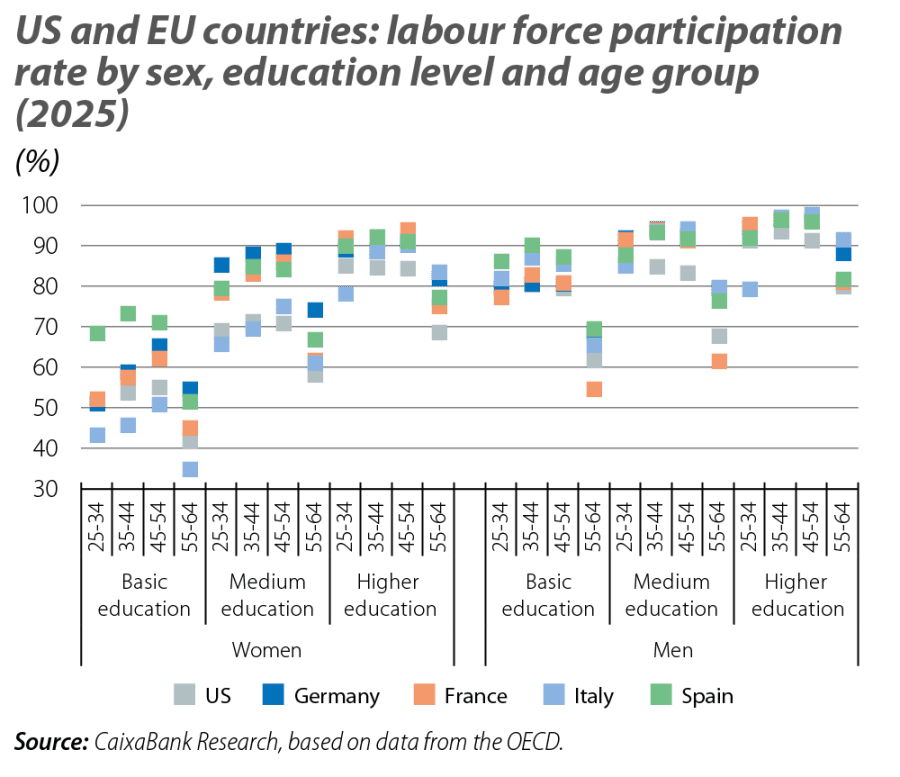
The remaining scope is therefore concentrated among specific groups (see third chart). In 2025, the gap in the labour force participation rate between men and women aged 25–64 still exceeded 20 percentage points in Italy and stood at around 10 pps in the US and Spain. There is also scope to raise participation among 55-64 year-olds, particularly in France and the US, where average participation rates were more than 10 pps below Germany’s. Policies should address the specific barriers facing each group through measures addressing work-life balance, incentives to bring the effective retirement age closer to the statutory age, more flexible forms of employment and training tailored to the different stages of working life.
- 6
See a detailed analysis for Spain in the Focus, «The ageing of the workforce: a challenge for Spain and Europe», in this same Monthly Report.
In the US, the recovery under way since 2013 may also face constraints in the coming years. Projections by the Bureau of Labor Statistics point to a slight decline in labour force participation among 25-54 year-olds between 2024 and 2034, but further increases among those aged 55 to 64, particularly women.7 This is compounded by the tightening of immigration policy under the second Trump administration. In line with the slowdown in inflows, growth in the foreign-born working-age population, which accounts for nearly a fifth of the US labour force, has moderated since 2025.8 For now, the aggregate participation rate among prime-age workers remains stable, but this masks signs of weakness in some segments, including a lower propensity to participate among the foreign-born population.9 Even so, it is too early to separate the effects of immigration restrictions from those arising from the annual update to population estimates and underlying population ageing.10
In sum, there is scope to increase participation on both sides of the Atlantic, but it will be more limited and concentrated than in recent decades. Progress will increasingly depend less on major socio-educational shifts and more on policies targeting women in countries with wide gaps, people with lower levels of education and workers nearing retirement. Even if successful, these policies will only partially cushion the impact of ageing. They will therefore need to be complemented by measures aimed at boosting productivity and managing migration flows in ways that help sustain the growth of the working-age population.
- 7
Bureau of Labor Statistics (2025). «Civilian Labor Force Participation Rates by Age, Sex, Race, and Ethnicity, 2004, 2014, 2024 and Projected 2034».
- 8
See the Focus «Trump 2.0 immigration policies: the end of the American Dream?», in the MR10/2026.
- 9
L. Bengali, I. Chen, A. New-Schmidt and N. Petrosky-Nadeau (2026), «The Recent Slowdown in Labor Supply and Demand». FRBSF Economic Letter, 2026-02, Federal Reserve Bank of San Francisco.
- 10
A. Bick (2026), «What’s Behind the Sharp Drop in Labor Force Participation?». Federal Reserve Bank of St. Louis.
Demographics
How does demographics affect economic growth, the reallocation of the model of production, the labour market and productivity?