NGEU: execution is progressing, but we are approaching the moment of truth
Execution of the Next Generation EU (NGEU) funds through the Recovery and Resilience Plan continues to gain traction, although the schedule is tight and the final stretch will require increased efforts. Indeed, by the deadline of 31 August, all investments funded with grants and loans need to have been allocated through the resolution of the relevant calls and tenders, and compliance with all milestones must be demonstrated to the European Commission. Also, Spain must submit payment requests before 30 September, while the Commission will have a deadline of 31 December to make the disbursements, as it will only have until then to certify the investments, that is, to verify that the money has been allocated to the committed projects.

The state of the matter and a tight schedule
According to data from the Recovery and Resilience Facility Scoreboard maintained by the European Commission itself, Spain has completed 54% of the milestones set out in the Plan, including the most structural ones – labour and pension reforms –; however, there are still 224 milestones yet to be achieved, associated with 24.8 billion euros in transfers and 6.5 billion in loans. Many of these milestones require complex investments: the deployment of renewables, the digitalisation of SMEs, charging infrastructure for electric vehicles, the modernisation of irrigation systems, energy-efficiency upgrades to homes and water management initiatives. Among the most challenging pending milestones are the digitalisation of regional and local administrations and the part of the committed tax reform concerning increased taxation of diesel.
Regarding transfers, Spain has received disbursements from the European Commission amounting to 55.09 billion euros, out of an allocated total of 79.8 billion. Furthermore, following the approval of the Addendum by the European Commission, at the end of 2025 Spain decided not to request almost all of the NGEU loans, such that it will ultimately only use 22.8 billion euros, compared to the initially planned 83.2 billion euros. This decision was explained by the fact that, at the end of last year, the cost of NGEU financing was very similar to that of market financing. Of the 22.8 billion in loans, the European Commission has already transferred 16.27 billion to date.
At the beginning of March, Spain submitted the sixth payment request under the Recovery Plan. The amount requested totals 7.256 billion euros – 6.205 billion in grants and 1.051 billion in loans. Once the Commission has validated this request, the percentage of the milestones met by Spain will increase from 54% to 70%, placing it among the top European countries in terms of compliance.1
The impact of NGEU on GDP growth in 2026 is estimated to be between 0.4 and 0.6 pps. This boost comes from two distinct but complementary vectors. On the one hand, by 2026 all pending funds in the form of grants must be executed: 15 billion, according to the Ministry of Economy’s ELISA tool, and more than 20 billion, according to the AIReF, although 2.8 billion have already been allocated to the Spain Grows (España Crece) fund, which will invest beyond 2026. This figure aligns with the rate of execution of previous years, but the challenge lies in concentrating all this activity before 31 August, the deadline set by the European mechanism. On the other hand, greater dynamism is expected in the projects financed with loans, given that in 2025 they were still in the early stages of deployment. By November 2025, operations financed with these loans amounting to around 7 billion euros had been approved, and there was also a pipeline of projects in the identification and evaluation phase for a further 5 billion.
In this context, 2026 will be a decisive year. Beyond this year, investments will continue to be deployed without a cliff effect, supported by the creation of the sovereign Spain Grows (España Crece) fund, which is financed with 10.5 billion euros in unused Next Generation loans and an additional 2.8 billion in non-repayable transfers, raising the initial capital associated with this initiative to 13.3 billion. The fund will be managed by the ICO, which will co-invest with the private sector in strategic projects to boost potential growth.
Having reviewed the schedule, in the following section we analyse how the execution is progressing in practice.
- 1
Among the main European countries, Germany has achieved 61% of its milestones, Italy 64%, Poland 45%, Portugal 60% and France 83%.
Execution up to 2025: more good news than bad
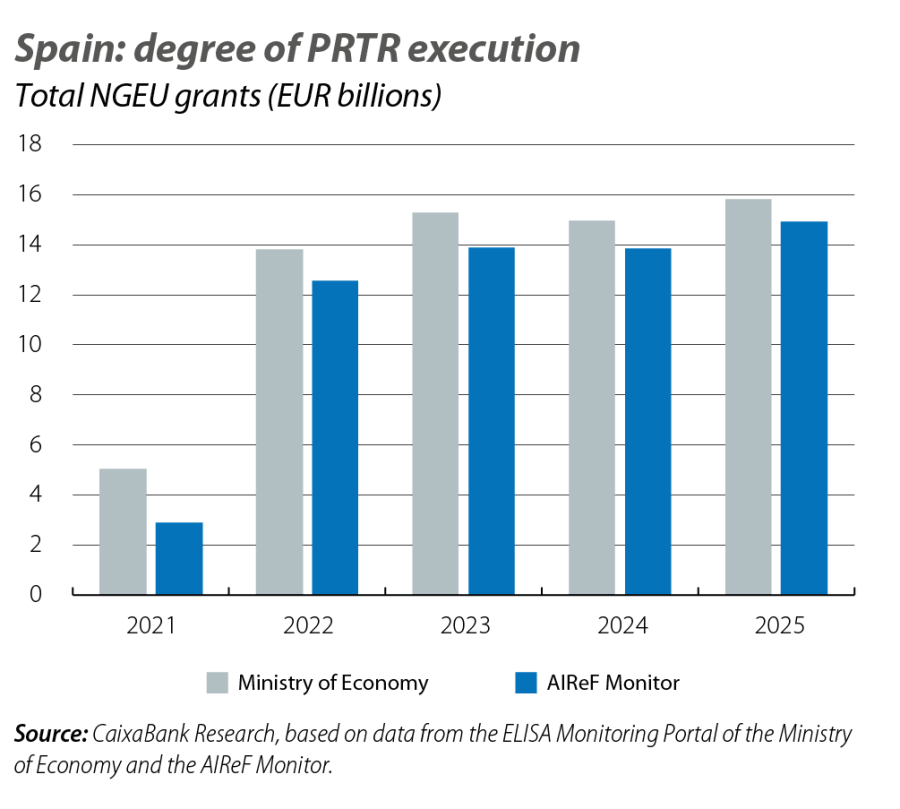
Between 2021 and December 2025, the sum of NGEU grants that had been «executed» – i.e. calls and tenders completed by the various public administrations – amounted to 59 billion and 64.9 billion euros according to the AIReF Monitor and the Ministry of Economy’s ELISA tool, respectively, which is equivalent to between 74% and 81% of the programme’s total (79.8 billion euros).2 The annual execution rate in 2025 was slightly higher than in 2024: around 15 billion euros were executed in 2025,3 which is about 1 billion more than in 2024, an increase on which both metrics agree.
If we look at the final phase of execution, that is, the funds that have reached the productive fabric of the economy, the figures are lower than those awarded in calls and tenders, as there is a delay before payments are made and, on occasions, beneficiaries must submit additional documentation, which delays their receipt. According to Eurostat, the effective public expenditure financed by NGEU European funds amounted to 31 billion between 2021 and 2024. Also, between 2021 and November 2025, the central government made payments amounting to 46 billion euros, a sum that includes transfers to other administrations and public entities or companies.
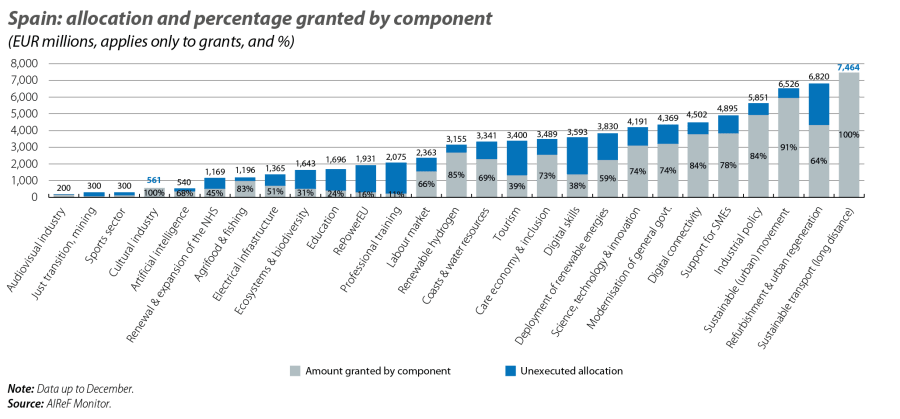
The analysis by component up to December 2025 performed by AIReF shows a mixed picture. The second chart reveals that the areas with the highest degree of relative execution in relation to the total allocation are sustainable mobility – both urban and long-distance – digital connectivity and industrial policy. In contrast, the most significant delays are concentrated in energy refurbishment and urban regeneration (which includes energy-efficiency upgrades to the existing housing stock and the construction and refurbishment of more than 20,000 social rental homes), renewable energies, water resources, vocational training and education, tourism, and science and technologies. It should be noted that nearly 2.5 billion euros in refurbishment and regeneration and around 2 billion euros in tourism, vocational training, and digital skills remain yet to be executed.
- 2
It is normal for the numbers not to match exactly; the key methodological difference lies in the recording criterion. ELISA considers a call to be «resolved» when final awardees are identified, even if there has been no signing of contracts nor, in some programmes, an individualised grant in the strict sense. In contrast, the AIReF Observatory only includes contracts once they are signed, and grants when there is a formal awarding with a specific beneficiary and amount, so its monitoring takes place at a later stage in the administrative process.
- 3
Specifically, 15.8 billion according to ELISA and 14.9 billion according to AIReF.
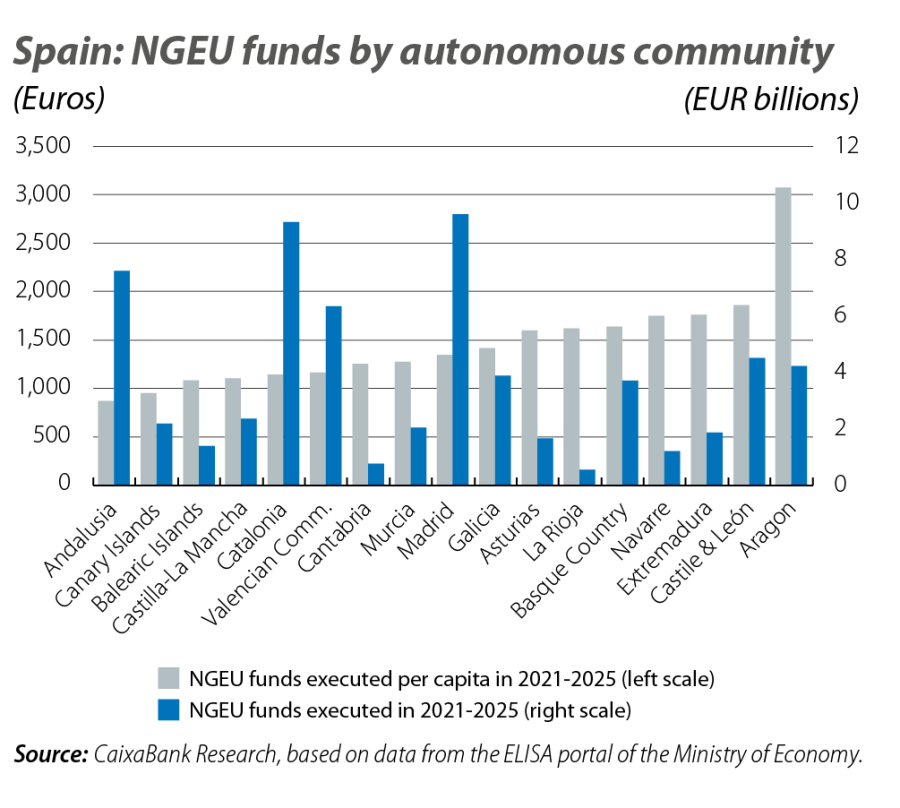
The regional analysis shows that the largest communities in terms of population and GDP are leading the total volume of funds executed.4 However, this advantage diminishes when the data is adjusted per capita. In per capita terms, regions with smaller populations but large industrial projects stand out. These include Aragon, the dynamism of which is explained by investments linked to the strategic PERTE project for electric vehicles – including the battery plant, the expansion of Stellantis and other associated projects. Other regions, such as Asturias and La Rioja, also reflect this pattern, with a high per capita execution.
The overall balance, therefore, is relatively positive, but we must avoid complacency: execution is progressing, the macro impact is being consolidated, and the most significant reforms are already underway, but the moment of truth is just around the corner. The ability to mobilise, prioritise and absorb the bulk of the pending investments will determine whether the Plan fully delivers on its transformative promise.
- 4
All calls and tenders are included in each autonomous community, whether convened by the central, regional, or local government.