Portugal’s growth withstands inflationary pressures
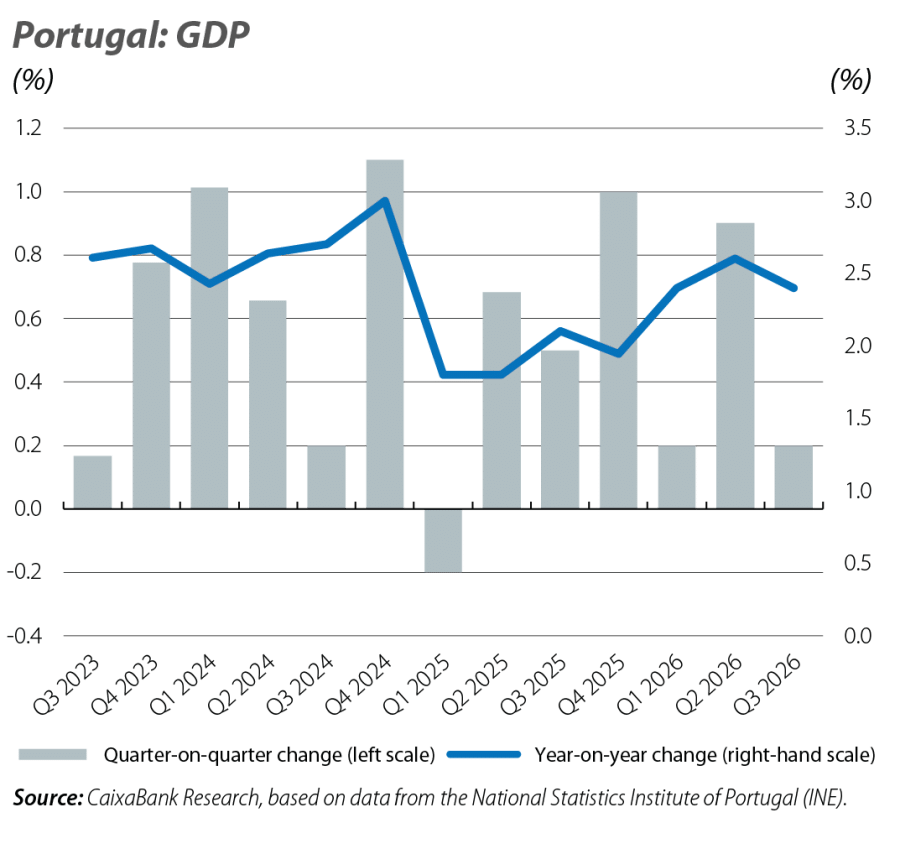
The economy remains buoyant, with GDP growing by 0.2% quarter on quarter and 2.4% year on year in Q3, reinforcing the growth outlook for 2026. Inflation nears 4% in October, while employment reaches record highs and the public finances remain balanced.
GDP grew by 0.2% quarter on quarter and 2.4% year on year in Q3, reinforcing expectations that the economy will expand by 2.3% in 2026
Growth continues to be supported by domestic demand. In particular, investment accelerated in the third quarter, as the pace of NGEU fund disbursement picked up. According to Portugal’s National Statistics Institute (INE), private consumption slowed amid a rising cost of living and higher interest rates. External demand continues to weigh on growth, owing to a severe energy shock and the high import content of investment. Indicators for Q4 point to a slowdown. The economic climate indicator fell to 2.3% in October (from 2.7% previously), driven by a sharp deterioration of sentiment in the services sector, which dropped from 10.5 points in September to 3.3 in October. By contrast, other sectors recorded a slight improvement. Households are also more pessimistic: the confidence indicator fell to –26.9 (from –22.3 in September), amid a more negative assessment of their financial position and the country’s economic outlook. Despite this deterioration, we expect growth to accelerate in Q4, supported by faster deployment of European funds and fiscal stimulus of around 800 million euros. The latter, which includes an extraordinary payment to pensioners and a retroactive cut in personal income tax, will help support household disposable income in the final weeks of the year. This scenario reinforces the forecast for 2.3% growth in 2026, 0.4 percentage points higher than in 2025.
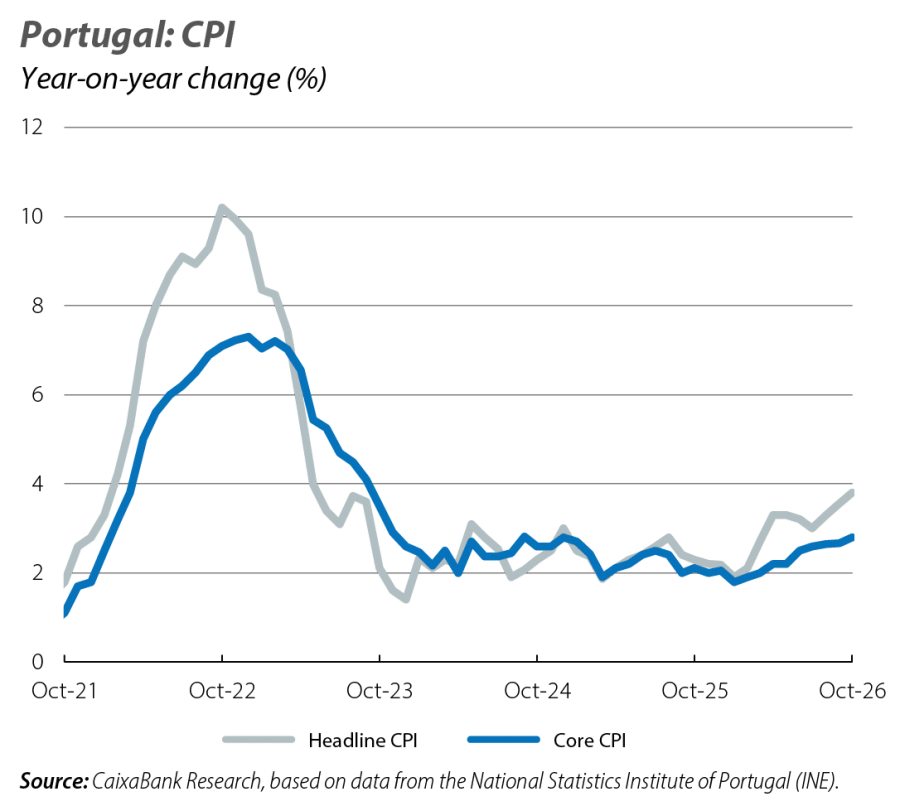
Inflation nears 4% in October
The headline CPI rose by 3.8% year on year (3.6% in September), while core inflation reached 2.8% (2.7% in September). Energy continued to drive up inflation, with prices accelerating once again and recording a 17.4% year-on-year rise (15.3% in September). Although energy prices are still feeding through only modestly to the rest of the consumer basket, this figure poses upside risks to inflation in 2026, which could exceed 3%. Industrial producer prices also continue to gather momentum and are likely to keep exerting upward pressure on inflation in the coming months.
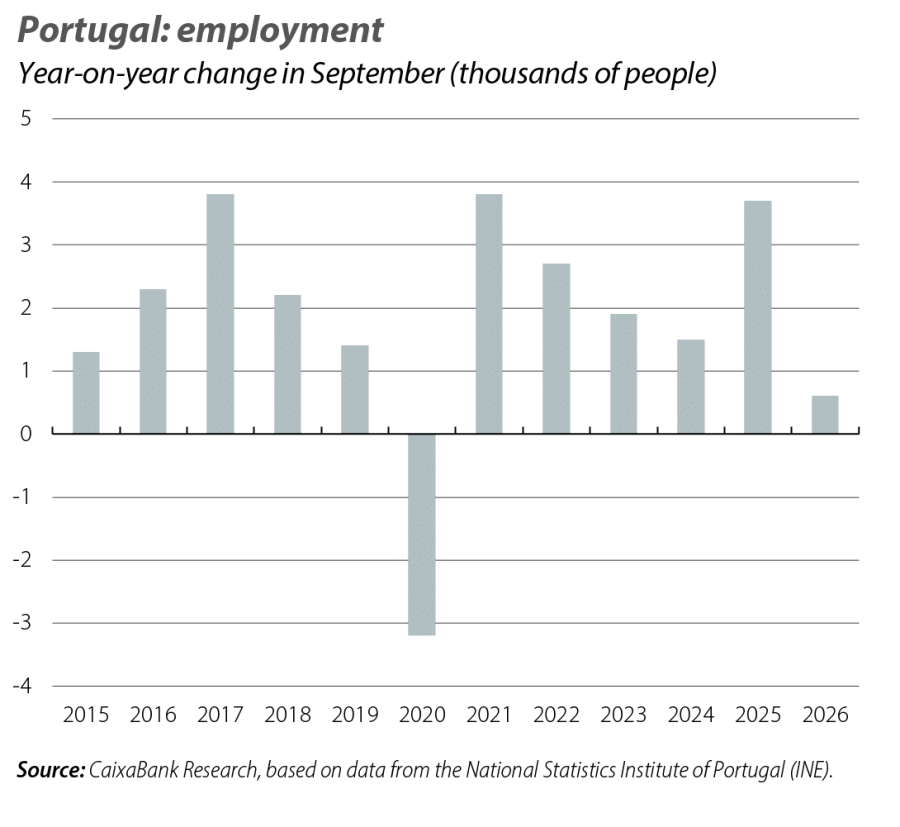
Employment will have reached record highs, while the public finances remain balanced
In September, employment rose by 0.6% year on year but fell by 0.1% from the previous month, its fourth consecutive monthly decline. Unemployment, meanwhile, continues to improve. Data from both the employment survey (compiled by the INE) and registrations of unemployed people at employment centres (according to the public employment service, IEFP) show that unemployment continues to fall. Compared with September 2025, the INE’s figures showed a 4.9% reduction, while the IEFP’s revealed a 10.1% drop. The unemployment rate also remained at 5.6%. On the fiscal front, the government forecasts a balanced budget in 2026 and a surplus of 0.1% of GDP in 2027. The completion of the RRP will ease spending pressures in 2027, although tax cuts and higher interest costs will constrain fiscal headroom. Public debt is expected to continue to decline, falling from 87.5% of GDP in 2026 to 84.5% in 2027.