The Spanish economy holds firm despite uncertainty and the energy shock
Spain’s economy continues to record strong growth, supported by domestic demand, albeit with some signs of moderation. The labour market continues to perform well and energy keeps inflation high, while the strength of the services balance contrasts with the deterioration in the trade balance. In the property sector, home sales are slowing, but the market remains tight.
The Spanish economy is facing today’s challenging environment of energy pressures and global geopolitical uncertainty from a position of strength. Growth remains robust and broad-based, driven particularly by private consumption, investment and services exports. The large stock of accumulated savings is allowing households to cushion the inflationary pressures and, for now, limit their impact on consumer spending (see the Focus «Household saving remains high despite the inflation shock» in this same report). The economy also continues to create jobs, although the exceptional regularisation of immigrants makes it difficult to assess the true strength of the labour market.
Spain’s economy continues to record strong growth, supported by domestic demand
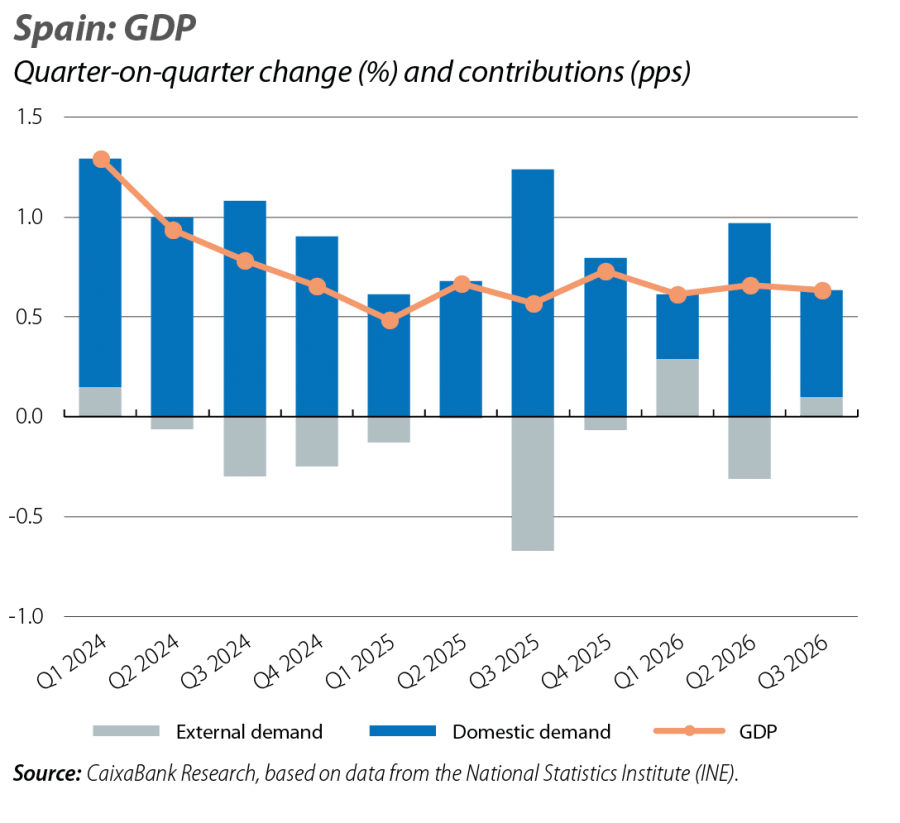
GDP grew by 0.6% quarter on quarter in Q3 2026, in line with CaixaBank Research forecasts and just 0.1 percentage points less than in the previous quarter. It thus continues to outpace the euro area as a whole, which grew by 0.2% excluding Ireland. In year on year terms, the rate accelerated by 0.1 pp to 2.7%. By component, quarter-on-quarter GDP growth was driven mainly by strong domestic demand, which contributed 0.5 pps. This was underpinned by private and public consumption, which rose by 0.6% and 0.9% respectively, as well as by business investment, which increased by 0.7%.
External demand contributed 0.1 pps to quarter-on-quarter GDP growth. This performance reflects stronger export growth of 1.3%, with both tourism and non-tourism services continuing to perform well, compared with a 1.1% rise in imports.
The economy remains buoyant, albeit with some signs of moderation
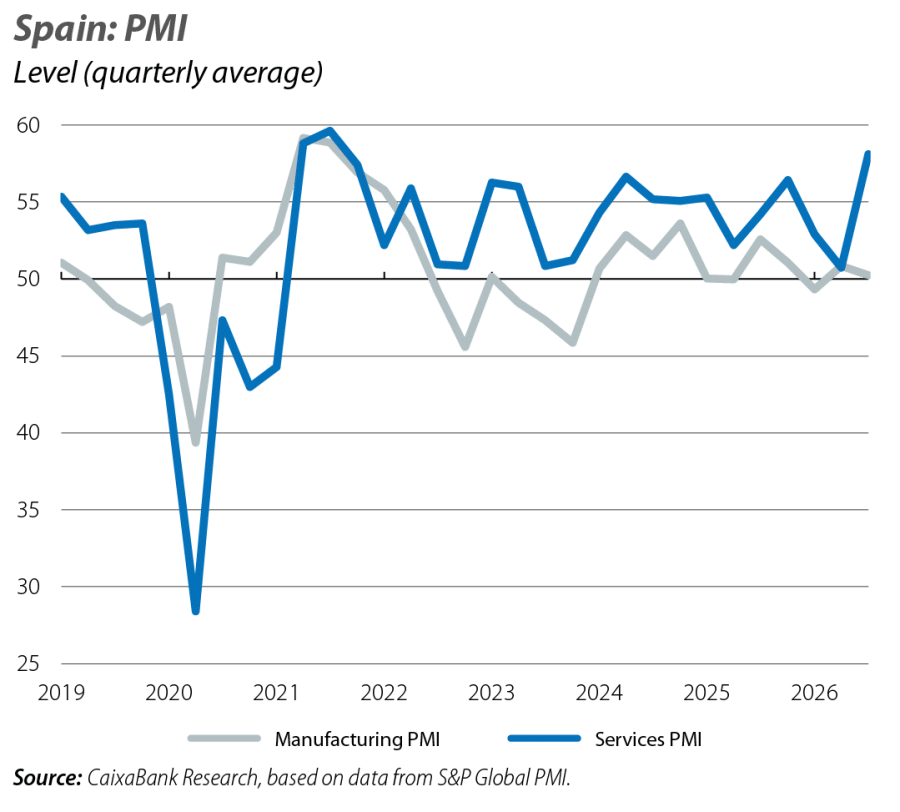
The data available for Q4 remain very limited, but are nevertheless consistent with a continuation of growth at a slightly slower pace. On the positive side, the manufacturing PMI rose to 52.2 in October, its highest reading since August last year. The services PMI, pending the publication of the October figure, is at its highest level since 2021. By contrast, retail sales volumes fell by 1.4% year on year in September, adding to the evidence that inflationary pressures are beginning to weigh on household spending decisions.
The labour market continues to perform well, but the extraordinary regularisation continues to cloud the picture
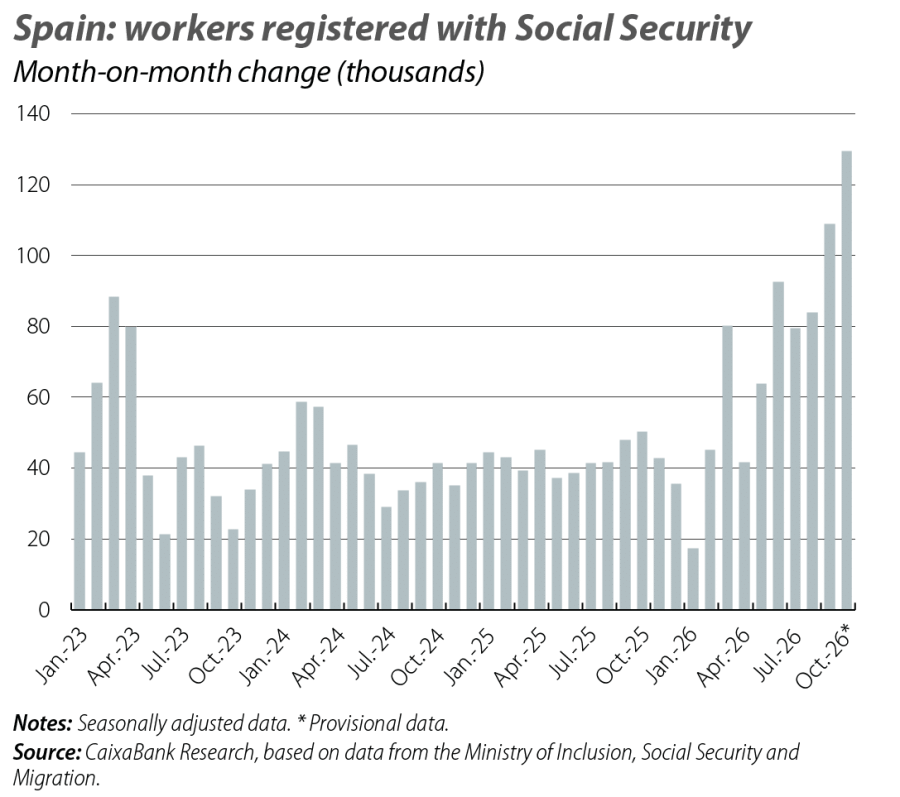
According to the Labour Force Survey (LFS), job creation slowed in Q3. Employment rose by 73,600 people, below the level usually recorded in this period (around 150,000 between 2023 and 2025). On a seasonally adjusted basis, growth was 0.3% quarter on quarter, down from 0.5% in the previous quarter. Meanwhile, growth in social security affiliation remains very strong, driven by the extraordinary regularisation of immigrant workers. By mid-October, seasonally adjusted registrations had risen by 129,481 people over the previous two fortnights, the largest increase since June 2021 and well above the monthly average in Q3 (90,748).
The effect on employment of the regularisation is difficult to quantify using the LFS, as it records individuals’ actual employment status regardless of whether their employment is officially registered. Even so, there are some signs of an increase in foreign workers, who accounted for 16.8% of total employment in Q3, 1 pp more than in Q1 before the process began. The impact is far more evident in the affiliation data. In the year to 30 September, the number of foreign workers registered with the Social Security system rose by 576,188, compared with 211,457 over the same period in 2025. Of this increase, 421,306 (73.1%) were reportedly linked to the regularisation process. At the same time, growth in the number of Spanish affiliates has slowed markedly, rising by just 108,103, compared with around 210,000 a year earlier. In any event, it remains unclear how much of the increase in foreign registered workers reflects genuine job creation and how much reflects previously undeclared employment relationships moving out of the informal economy.
Energy keeps inflation high
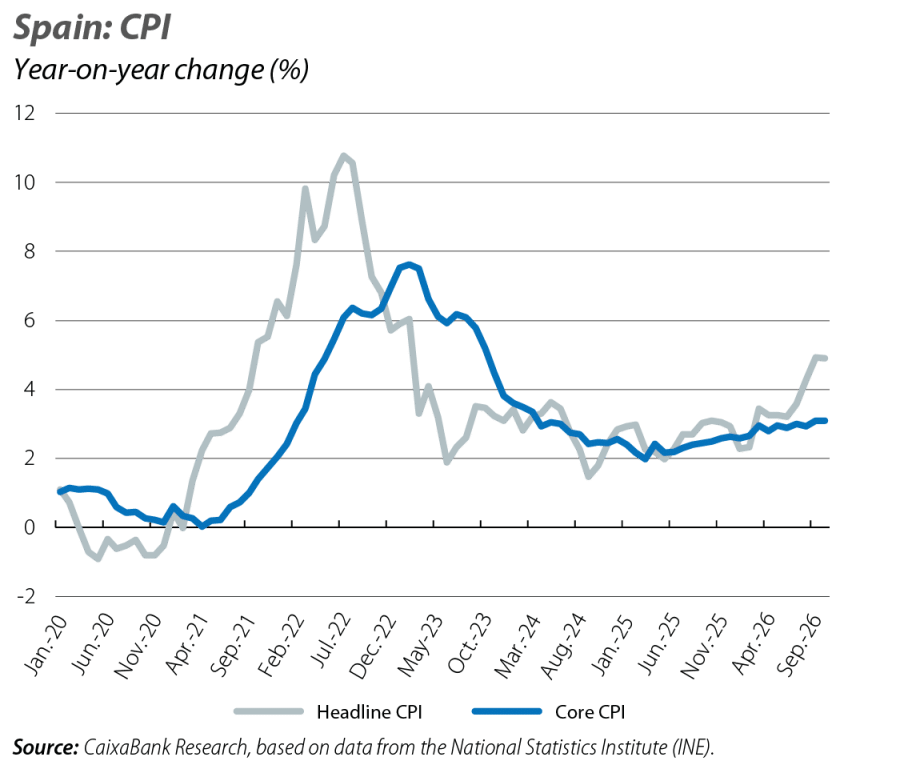
According to the CPI flash estimate, headline inflation stood at 4.9% in October, unchanged from the previous month. Core inflation, which excludes energy and unprocessed food, also held steady at 3.1%. With oil and gas prices still very high, subsidies that reduce fuel prices are offsetting the rise in services inflation driven by tourism. Nevertheless, the rise in energy prices in October was greater than we had anticipated, creating upside risks to our inflation forecasts.
The strength of the services balance contrasts with the deterioration in the trade balance
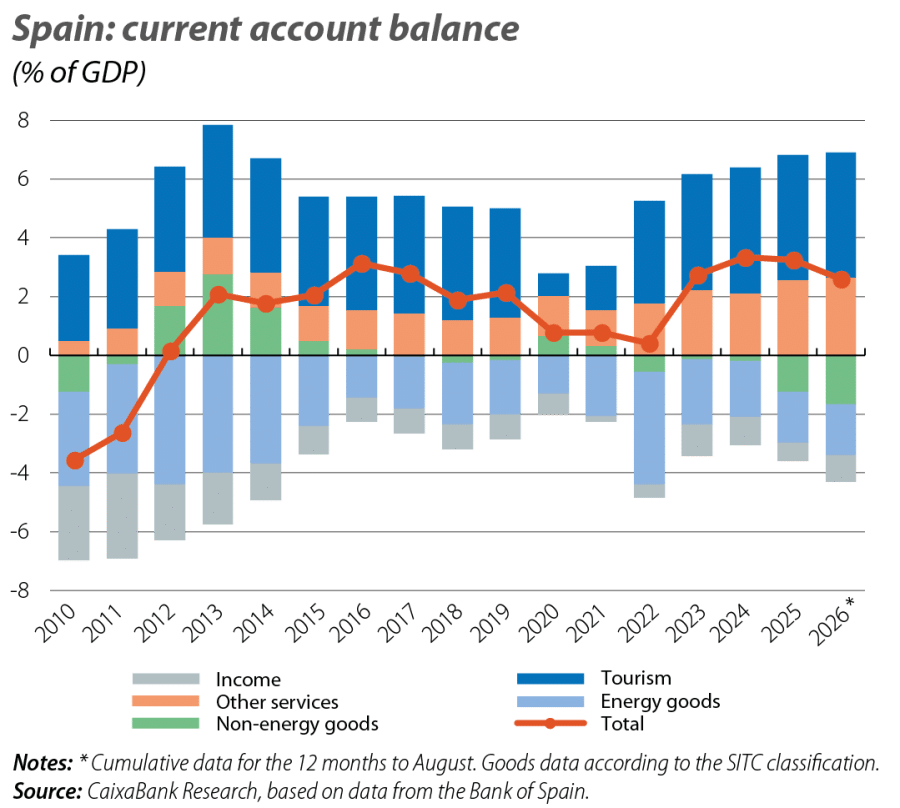
The current account balance recorded a surplus of 2.6% of GDP in the 12 months to August, 0.6 pps lower than in 2025 as a whole but still above the pre-pandemic level (2.1% in 2019). The trade deficit widened to 3.4% of GDP (–3.0% in 2025). This was despite the energy deficit stabilising at 1.7% of GDP, as the non-energy goods deficit deteriorated sharply (–1.7% vs. –1.2%), driven mainly by the motor vehicle and capital goods balances. By contrast, services continue to generate large surpluses. Non-tourism services are cementing their growing importance (2.6% of GDP, unchanged from last year), while tourism remains at a record 4.3% for the third consecutive year.
Home sales slow, but the market remains very tight
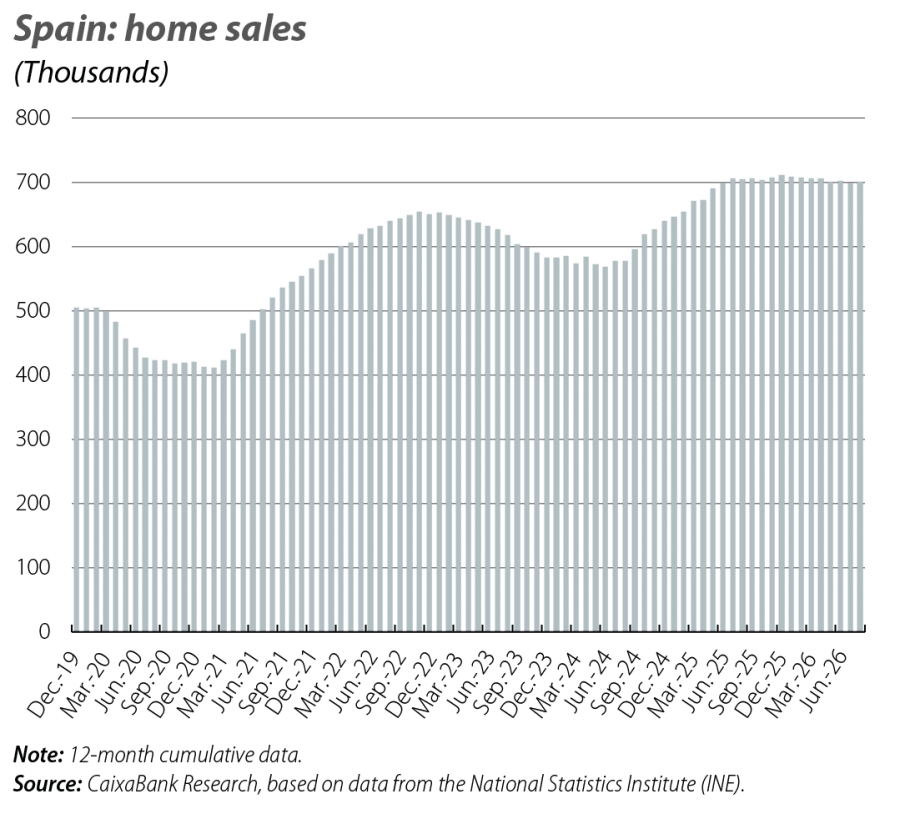
Sales were down 2.3% year on year between January and August. Deteriorating affordability, the base effect of an exceptional 2025 and the prospect of tighter financial conditions explain this normalisation. Activity nevertheless remains historically high, with around 700,000 transactions over the past 12 months. On the supply side, new-build permits have risen by 11% over the past 12 months, but this increase remains insufficient to close the gap with demand. Prices have risen more slowly in recent quarters, although the persistent imbalance between supply and demand will continue to push them higher.