
Household saving remains high despite the inflation shock
We examine recent trends in household income, consumption and saving, as well as the outlook for 2026 and 2027 as a whole in a context marked by the war in Iran, higher inflation and considerable global uncertainty.

The household saving rate remained high in the first half of 2026, although it continued to moderate. Strong employment boosted gross disposable income (GDI), which in turn helped sustain consumption despite the rise in inflation linked to the war in Iran. Households also drew on some of their savings buffer to sustain consumption levels. This trend is likely to continue in the second half of the year, although savings will remain well above their historical average. In this article we examine recent trends in household income, consumption and saving, as well as the outlook for 2026 and 2027 as a whole in a context marked by the war in Iran, higher inflation and considerable global uncertainty.
Mid-year review: income remains robust and savings stay high
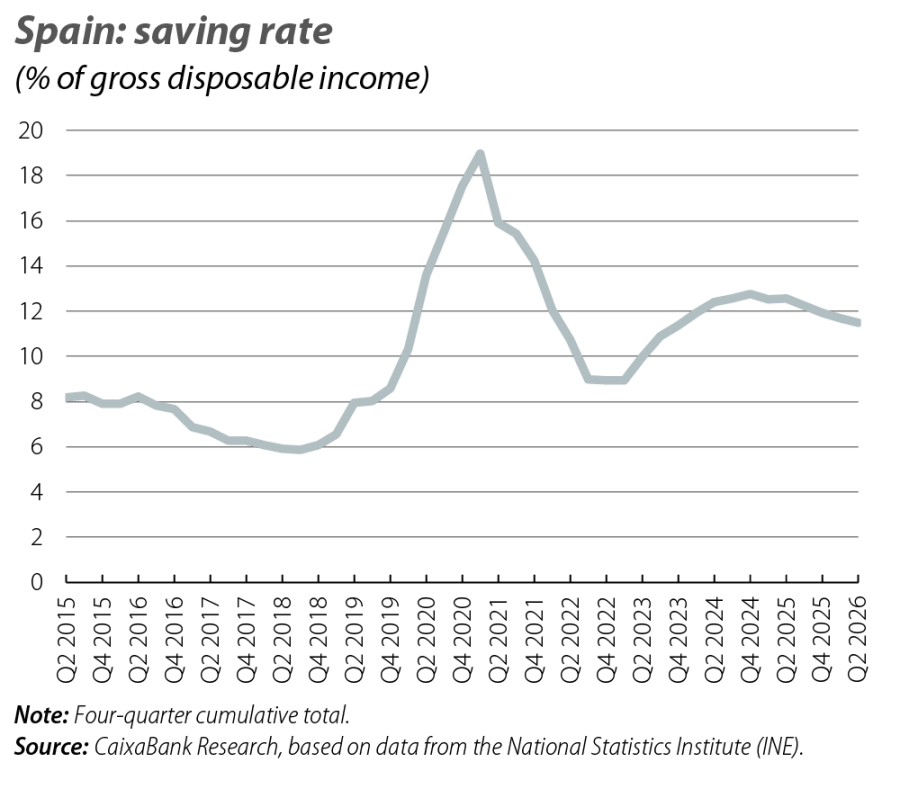
Household consumption was stronger than expected in Q2 2026, but an upside surprise in income prevented a sharper fall in the saving rate. In non-seasonally adjusted terms, gross saving reached almost 57 billion euros, equivalent to 18.7% of gross disposable income. Although this ratio was below the 19.9% recorded in Q2 2025, it remained above the 17.2% average for the second quarters of 2015-19. It is worth noting that Q2 tends to account for the largest volume of savings during the year, as it coincides with exceptional income such as summer bonuses and dividends.
To strip out this seasonality, it is more informative to look at the cumulative saving rate over the past four quarters. This measure fell slightly, from 11.7% in Q1 to 11.5% in Q2, broadly in line with our pre-release forecast of 11.6%.
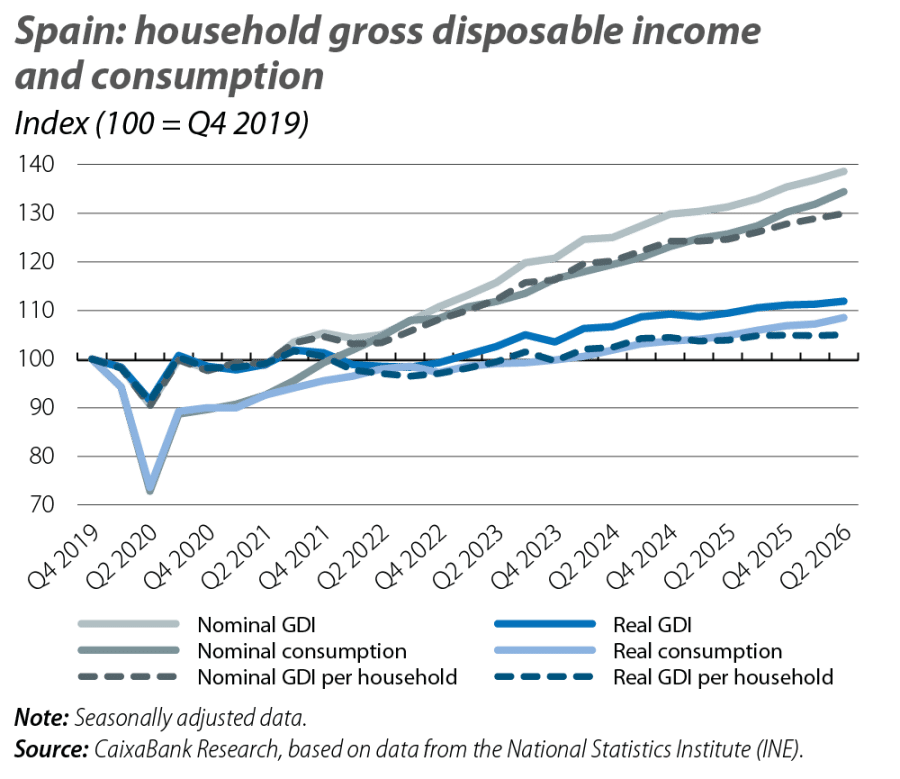
This moderation in saving reflected stronger spending growth. Nominal consumption grew by 6.9% year on year in Q2, up from 5.7% in the previous quarter, while real consumption growth accelerated from 3.0% to 3.5%. However, household income also surpassed expectations: nominal GDI rose by 5.5% year on year, above the 5.1% forecast. This trend was underpinned by a strong labour market, with wage-earner remuneration rising by 7.2%, reflecting a 2.9% increase in the number of employees and a 4.3% rise in the average compensation per employee.
In real terms, GDI rose by around 2.3% year on year. Strong growth in the number of households, at around 1.3%, tempered the improvement on a per-household basis: real GDI per household rose by 1.0%. Households’ purchasing power therefore continued to improve, though more modestly than the trend in aggregate income would suggest.
Household balance sheets continue to strengthen
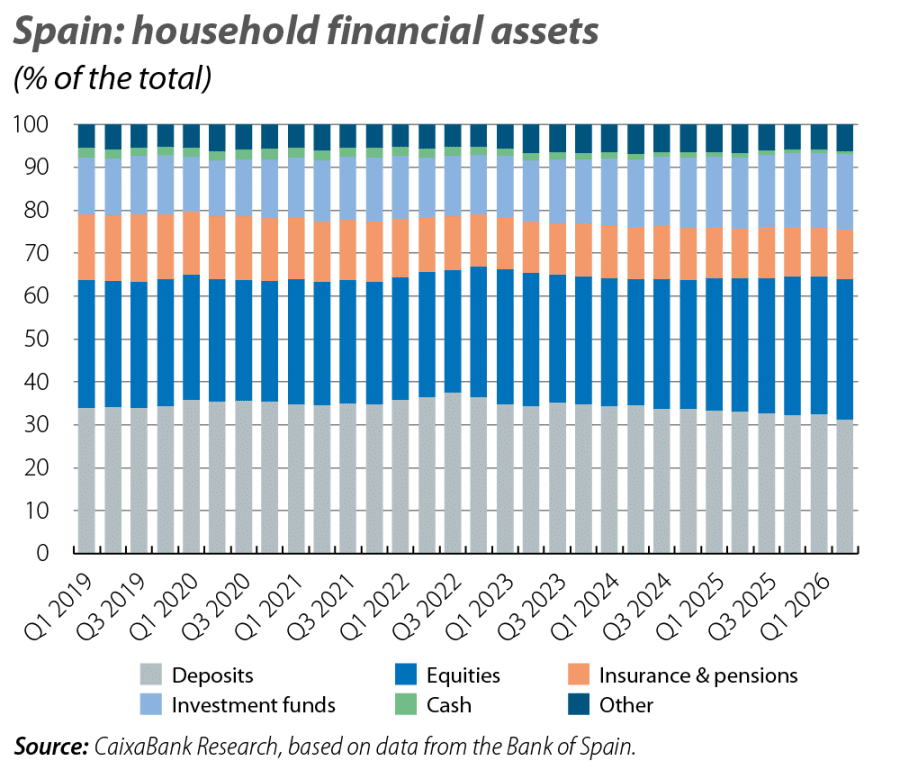
Households’ financial strength was also reflected in an increase in their stock of gross financial assets. In Q2 2026, they reached 3.65 trillion euros, equivalent to 209.8% of GDP and up from 202.2% in the previous quarter.
The stock of financial assets rose by 177.94 billion euros during the quarter. A distinction should be made between new asset purchases and valuation changes: 48.19 billion reflected net purchases, while 129.76 billion came from revaluations, mainly in equity holdings and investment funds.
Compared with Q2 2025, the total stock of financial assets rose by 10.5%. Growth was concentrated in equities and investment funds, the combined value of which rose by 17.2%, increasing their share of the financial portfolio from 47.4% to 50.3%. Deposits also rose, albeit more moderately, by 4.1% year on year. As a result, their share of the overall portfolio fell from 33.2% to 31.3%. Insurance and pension assets rose by 8.0%, with their share remaining broadly stable at around 11.5%.
At the same time, borrowing remained contained. Household debt fell by 755 million euros from the previous quarter to 728.82 billion, equivalent to 41.9% of GDP. This ratio fell by 0.6 percentage points (pps) compared to Q1 and by 1.9 pps year on year, reaching a level similar to that recorded in the second half of 1999. The combination of growing financial wealth and falling debt as a share of GDP strengthens households’ confidence and ability to cushion the impact of adverse shocks on their consumption.
Outlook: saving will continue to moderate, but remain above its historical average
Rising inflation and heightened uncertainty have opposing effects on saving. If households seek to maintain real consumption levels as prices rise, they must increase nominal spending and reduce the portion of income which they save. By contrast, greater uncertainty may prompt them to postpone spending decisions and increase precautionary saving.
So far, households have drawn on their savings to cushion the inflationary shock. Second-quarter data show a simultaneous acceleration in nominal and real consumption, suggesting that households are drawing on some of their savings buffer to sustain spending as prices rise. For the year as a whole, we estimate that a further decline in saving will offset just over half the impact of the rebound in inflation on real consumption1. This will bring the saving rate to 10.8% in 2026, compared with 11.9% in 2025 and the 11.5% forecast prior to the conflict with Iran.
In 2027, employment and wage growth, coupled with the pension update in line with 2026 inflation,2 will help support gross income. At the same time, the expected easing of inflation will likely reduce pressure on nominal spending. With gross disposable income and nominal consumption both growing by around 4.5%, we expect the saving rate to stand at 10.6%, just below its 2026 level.
Tensions in energy markets in recent weeks have cast doubt on the extent to which inflation will ease next year. Higher inflation could lead to a further drop in saving. As a sensitivity exercise, if inflation in 2027 were 1 pp above our baseline forecast and this increase fully fed through into higher nominal consumption, the savings rate could fall to around 9.8%.
In practice, the impact could be more limited. Higher inflation could be accompanied by greater uncertainty and boost precautionary saving. Higher-than-expected interest rates would also increase the incentive to save.
Ultimately, while there is uncertainty over the exact level of the saving rate in 2027, it is likely to remain well above the 8.6% average recorded between 2000 and 2019.
- 1
This estimate is derived by comparing the revision to the saving rate projected for 2026, from 11.5% before the conflict to 10.8% now, with the 1.3-pp upward revision to inflation. It assumes that, in the absence of a decline in saving, the additional increase in nominal spending caused by inflation would have translated into roughly equivalent lower real consumption growth.
- 2
Strictly speaking, the update will depend on average inflation between December 2025 and November 2026.