
Spain in 2027: a robust economy in a more challenging environment
We expect the Spanish economy to grow by 2.0% in 2027, a strong rate but lower than in 2026, mainly due to the lagged impact of this year’s energy shock. In this article we examine the drivers of GDP growth, the factors holding it back and the main risks to the outlook.

A positive result for 2026
The Spanish economy has weathered a 2026 marked by the conflict in the Middle East and resurgent inflation. We expect GDP to grow by 2.6%, compared with 1.0% in the euro area, supported by strong fundamentals: a robust labour market, a high household saving rate, low private-sector debt, limited direct trade exposure to the Middle East and the extensive roll-out of renewables, which has cushioned the rise in electricity prices. Population and employment growth have supported income and consumption, while investment has benefited from NGEU funds, business confidence and the 2025 interest rate cuts. Overall, 2026 will end with strong growth and no significant imbalances.
2027 outlook: tailwinds and headwinds
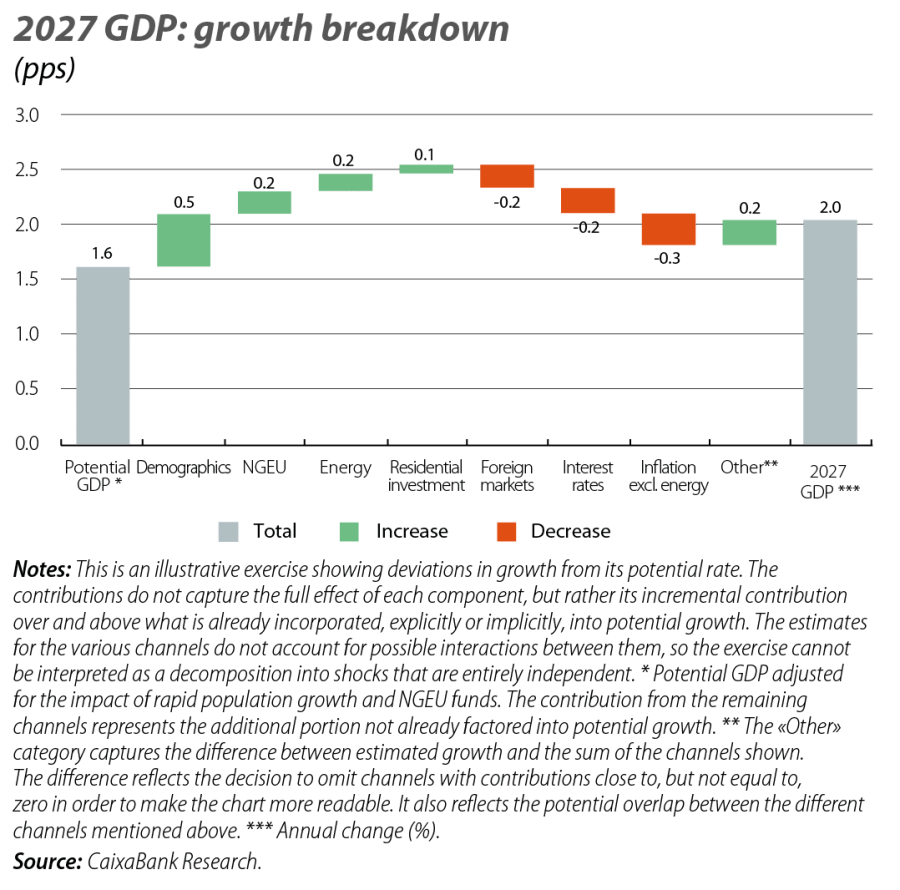
In 2027, we expect the economy to grow by 2.0% – a strong rate, albeit lower than in 2026. The slowdown in 2027 is mainly due to the lagged impact of the 2026 energy shock. Below, we outline the main drivers of GDP growth and its key constraints, as shown in the chart. Starting from potential growth of 1.6%, various tailwinds and headwinds would account for any deviation from this pace.1 On the positive side:
- Demographics: we expect the population to grow by just under 1% in 2027, which is well above the pre-pandemic rate, driven by migration flows. Taking this population’s entry into the labour market into account, we estimate that population growth could add 0.5 percentage points to GDP growth.2
- NGEU funds: despite the Recovery Plan formally ending in 2026, we do not expect a «cliff edge», as many projects and financial instruments will continue to be rolled out over several years. We estimate a contribution to growth of 0.2 pps, compared with 0.4 pps in 2026.
- Energy relief: the scenario assumes that average oil and gas prices will fall in 2027 compared to the previous year.3 This moderation would reduce costs for both businesses and households and could add 0.2 pps to growth. Nevertheless, the recent increase in tensions in energy markets poses downside risks. Later in this article, we examine the impact of alternative scenarios.
- Residential investment will continue to expand: strong demand and a gradual increase in supply will prolong the expansion in construction. We expect new-build permits to rise by around 10% again in 2027. Homes started in 2026 will continue to generate activity in 2027, as construction takes more than a year. This will be compounded by stronger demand for household durable goods. Residential investment could add a further 0.1 pps to growth.
- 1
Potential GDP is estimated using the production function approach. For further details, see the Focus «The medium-term potential growth of Spain’s GDP», in the MR04/2024. To strip out the effects of strong population growth in recent years and NGEU funds from the potential GDP calculation, we have assumed that the population has grown since 2022 at the 2017-19 average rate of 0.3% a year. We have also reduced annual investment by the estimated amount financed by NGEU funds. Potential growth is also consistent with interest rates and energy prices remaining at their 2026 average levels.
- 2
The main assumptions are that the employment rate (the employed population as a proportion of the total population) remains unchanged and that there is a productivity gap between the foreign-born and native populations, in line with the Bank of Spain’s estimate (see P. Cuadrado and A. Regil «An estimation of the contribution of the foreign population in Spain to GDP per capita growth in the period 2022-2024», Economic Bulletin 2025/Q2).
- 3
The scenario assumes an average oil price of 78.5 dollars a barrel in 2027 and an average gas price of 45 euros/MWh.
Not all factors are favourable to growth. We have also identified headwinds:
- Weak international conditions will continue to constrain exports. The US protectionist shift, the conflict in the Middle East and the impact of the inflation shock on our trading partners will, according to our forecasts, leave growth in the main export markets around 1 pp below the average annual rate recorded between 2014 and 2024.4 This channel is expected to shave 0.2 pps off GDP growth.
- Tighter financial conditions: in response to rising inflation, and following the two rate hikes already implemented, we expect the ECB to raise rates in December 2026 and once more in 2027. As a result, the Euribor would be around 90 basis points higher in 2027 than forecast before the crisis in Iran. As monetary policy operates with a time lag, the impact of the 2026 rate rises will be concentrated in 2027, shaving around 0.2 pps off growth.
- Indirect effects of the energy shock: higher energy prices not only increase households' energy bills, but also raise companies' production costs. As they pass these higher costs on through to the prices of other goods and services, inflation spreads across the consumer basket. This process is more gradual than the direct impact on energy, but it reduces households’ real incomes and constrains their spending capacity. We estimate that this channel will shave 0.3 pps off growth in 2027.
Finally, several other factors will also shape the Spanish economy in 2027:
- Savings as a buffer against unexpected shocks: after falling from 11.9% in 2025 to 10.8% in 2026, according to our forecasts, and helping to cushion the initial impact of the resurgence in inflation, we expect the saving rate to remain at similar levels in 2027. Households are likely to curb consumption slightly further in order to preserve some financial headroom against potential new shocks.
- The tourism sector will remain buoyant, although growth will slow. In 2026, the sector benefited from tourists switching destinations, as it was seen as being safer than the Middle East. In 2027, however, we expect growth to moderate as purchasing power weakens in the main source markets, converging towards its long-term trend rate.
- Public-sector contribution: based on the measures announced to date, we estimate that the fiscal stance, excluding NGEU funds, will be neutral. However, this will depend on the outcome of the 29 November general election and the policies implemented by the resulting government.
- 4
Export markets are calculated as the weighted average growth in imports across Spain's 15 largest export markets. See the Focus «How will the Spanish economy be affected by the performance of its main export markets?», in the MR11/2025, for further details about the calculation of the export markets variable.
Key risks: energy, inflation and interest rates
The main risks stem from a potential escalation of the conflict in the Middle East, which could push up energy prices, fuel inflation and prompt a more restrictive response from the ECB. Slower growth among Spain’s trading partners would also constrain the country’s exports.
To estimate this risk, we model an adverse scenario in which oil averages 105 dollars a barrel and gas 80 euros/MWh in 2027.5 Based on these assumptions, and taking into account the direct and indirect effects of energy prices, we estimate that inflation would be around 1.25 pps above our forecast.6 In this scenario, we expect that the ECB would raise its policy interest rates to 50 bps above our baseline scenario.
The impact on economic activity would depend largely on how households responded. Assuming households can absorb half the impact by reducing their saving rate, GDP growth in 2027 would be 0.3 pps lower than forecast.7 This is a relatively modest effect and is smaller than estimates based on historical sensitivities, but more consistent with the experience of recent years.8 Overall, even under this adverse scenario, the Spanish economy could maintain a relatively strong growth rate.
- 5
This scenario corresponds to the 75th percentile of the price distribution implied by the Brent crude oil and TTF gas futures derivatives markets. See the article «2027: monetary outlook and fiscal implications», in this same Dossier.
- 6
Our sensitivity analysis suggests that a 10% increase in oil prices raises inflation by 0.2 pps, while an equivalent increase in gas prices raises it by 0.04 pps. These energy price increases would also add 0.1 pps to inflation through indirect effects. The indirect effects take a year to emerge. Given that the shock occurred between September and October 2026, we assume that only half of its impact will materialise in 2027.
- 7
Absorbing half the impact on consumption would require a 0.5-0.6-pp reduction in the saving rate. Households have scope to make this adjustment, as the saving rate remains high.
- 8
This calculation should be regarded as a partial exercise. It does not factor in slower growth among our trading partners or a possible rise in uncertainty, nor does it account for the potential adoption of new fiscal measures to cushion the impact on households and businesses.