
Global economic outlook: how much more resilience in 2027?
Next year will once again test the resilience of the global economy. Economic policy will have less room to respond, while structural forces such as population ageing and climate change will continue to take effect.

In recent years, the global economy has fared better than expected amid a succession of shocks, from Russia’s invasion of Ukraine and the US tariff shift to disruptions to energy flows through the Strait of Hormuz. This resilience has been underpinned by the initial strength of private-sector balance sheets and employment, financial stability and the ability of businesses, supply chains and energy markets to adapt.1 It will be tested again next year, however, at a time when economic policy will have less room to respond, while structural forces such as population ageing and climate change will continue to take effect.
In a fragmented and uncertain geopolitical environment, we expect the global economy will continue to be shaped by two opposing forces: the drag from the energy shock and the boost from the technology cycle. The course of the conflict in the Middle East and artificial intelligence’s ability to generate corporate returns, broaden its adoption and boost productivity will determine the balance between the two, with differing effects on growth, inflation and monetary policy. This backdrop is compounded by different imbalances across the major economies: buoyant domestic demand and large fiscal and external deficits in the US, savings that are not being channelled sufficiently into investment in the EU and overinvestment amid weak consumption in China.2
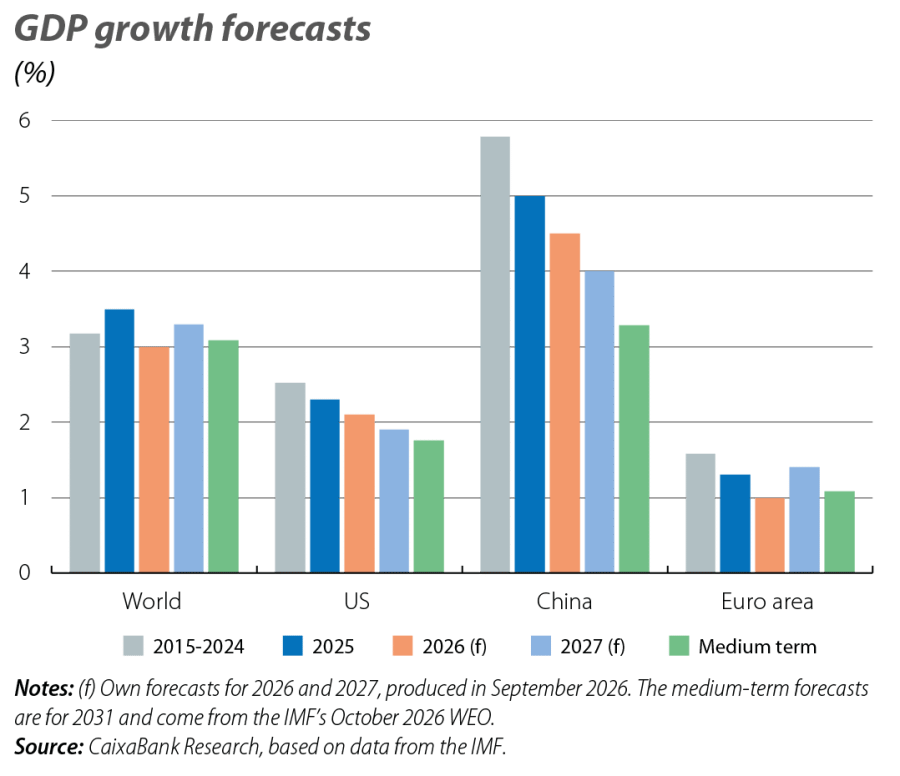
Under our baseline scenario, the gradual easing of the energy shock – despite upside risks to prices given recent futures prices – and continued technological momentum will allow global growth to rise from 3.0% in 2026 to 3.3% in 2027. This pace would be close to the growth recorded over the past decade and that projected over the medium term (see first chart). Growth will vary across regions: the US will slow slightly, expanding by 1.9% in 2027 compared to 2.1% in 2026; the euro area will regain some momentum, accelerating from 1.0% to 1.4%; and China will continue to slow, moderating from 4.5% to 4.0%. Stronger growth in other emerging economies will partly offset the gradual loss of momentum in these three major blocs.
With limited fiscal headroom, the composition of the stimulus will be crucial
Persistent inflation, especially if the energy shock continues, limits the scope for monetary easing, while diminishing fiscal space also constrains the capacity to respond.3 The dilemma will be less about whether to stimulate or consolidate than where to focus scarce resources without exacerbating inflationary pressures. In the event of further shocks, any support measures should be temporary, protecting vulnerable households without blunting price signals or eroding the remaining policy headroom.4
The US continues to run large fiscal and external deficits alongside strong domestic demand. However, they also push up long-term interest rates and heighten concerns about the sustainability of public debt. According to the IMF, the fiscal stance will be somewhat restrictive in 2027, as the gradual improvement in the structural primary balance that began in 2026 continues, though this will not amount to substantial consolidation (see second chart). The One Big Beautiful Bill Act (OBBBA), passed in 2025, will continue to support economic activity, while the public finances will remain firmly in deficit.5 The new Democratic majority in both chambers may seek to reverse some spending cuts or block the extension of temporary tax measures, together worth around 0.5%-0.7% of annual GDP.6,7 However, the presidential veto and lack of supermajorities render the prospect of any substantial change in the fiscal path unlikely without bipartisan agreement.
- 3
For further details, see the article «2027: monetary outlook and fiscal implications», in this same Dossier.
- 4
IMF (2026). «Fiscal Monitor: Taxing Better to Boost Growth».
- 5
IMF (2026). «United States: 2026 Article IV Consultation».
- 6
See the Brief Note «Contundente victoria demócrata en las midterms, bloqueo a la vista» (content available in Spanish) and the Focus «Are the midterms important for Trump? And for the US?», in the MR10/2026.
- 7
Estimate based on Congressional Budget Office (2025). «Estimated Budgetary Effects of Public Law 119-21 [OBBBA]».
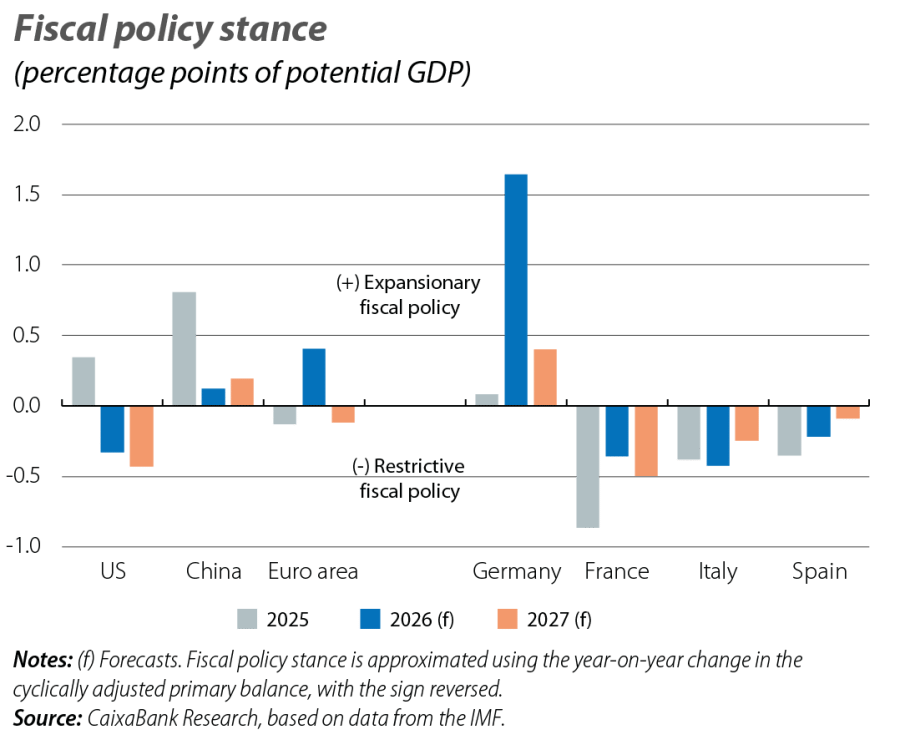
In the EU, the end of the roll-out of NGEU funds coincides with growing funding needs to close strategic gaps. The aggregate fiscal stance is expected to be broadly neutral in 2027, although Germany has more scope for fiscal expansion, while Italy and especially France face tighter constraints. There is also growing pressure to redirect spending towards strategic areas such as defence and infrastructure.8 Implementing the competitiveness agenda will depend on the political cycle and negotiations over the EU’s 2028-34 budget, which will need to reconcile these new priorities with the position of the frugal countries and the preservation of cohesion policies.9
China can stimulate its economy again, but another expansion in infrastructure and manufacturing investment would exacerbate local government problems and excess capacity, while indiscriminately reviving the property sector would delay its adjustment. Any fiscal support should strengthen social protection, support the completion and delivery of unfinished homes sold off-plan and reduce household uncertainty in order to boost consumption and lessen reliance on exports.10
- 8
European Commission (2026). «An Assessment of the Euro Area Fiscal Stance in 2026 and 2027 amid an Energy Supply Shock».
- 9
See the Focus «The upcoming budget takes over from NGEU in the European Semester», in the MR07/2026.
- 10
D. García-Macía, S. Jain-Chandra, S. Kothari and Y. Xu (2026). «How China’s Economy Can Pivot to Consumption-led Growth».
AI’s moment of truth
The surge in digital capital investment has supported the economic cycle, particularly in the US, with AI recently emerging as one of its main drivers (see third chart). In 2027, however, AI will need to demonstrate that its impact can extend beyond technology infrastructure, lead to broader adoption across the productive economy and generate corporate returns that sustain the investment drive. The capacity to make this leap will vary widely. The US has an advantage in computing, models, semiconductors, financing and intangible assets. China has industrial scale and rapid adoption, but faces constraints accessing advanced technology. The EU continues to lag in investment, scale and the commercialisation of innovation.11
- 11
See the Dossier «The present and futures of the new AIconomy», in the MR05/2026.
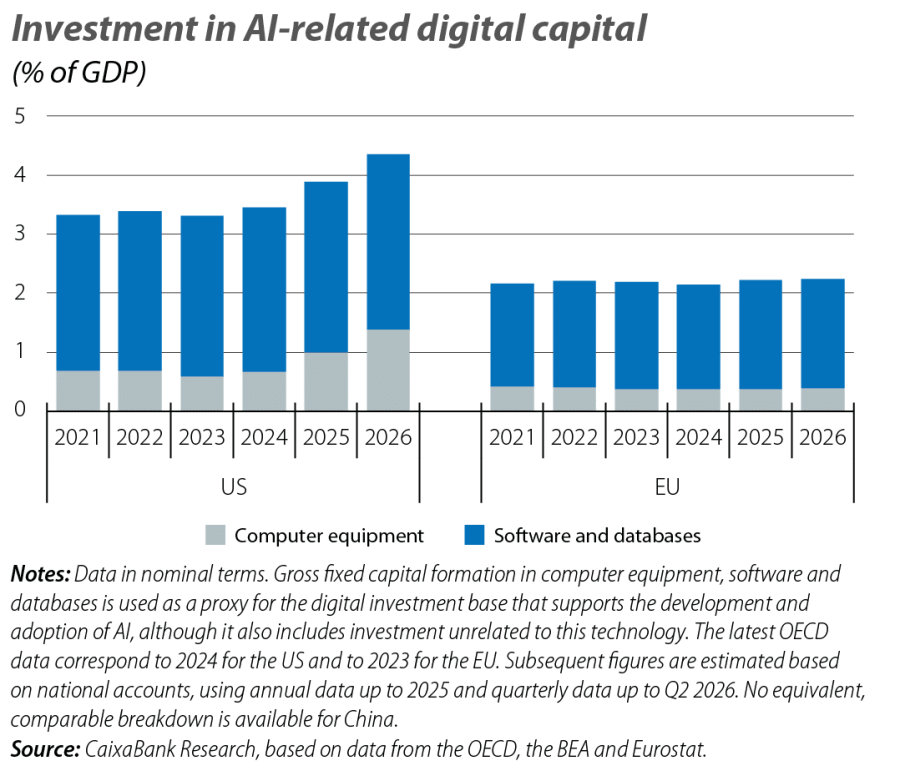
In our baseline scenario, the AI boom will continue to support growth over the coming years, particularly in the US, although its strength will increasingly depend on investment delivering tangible productivity gains. Its widespread adoption will require diffusion across sectors, as well as extensive human capital, data and business reorganisation. Faster transmission to the wider economy would boost potential growth. By contrast, weaker-than-expected results could curb investment and trigger a correction in market valuations, with knock-on effects for financial conditions and aggregate demand.12
- 12
K. Barhoumi et al. (2026), «Global Economic and Financial Implications of Artificial Intelligence: Lessons from a Scenario-Planning Exercise» and IMF (2026), «Global Financial Stability Report: Resilience, Risk, and Transformation».
Imbalances constraining growth
The three major blocs face different initial imbalances. The US combines robust domestic demand, large fiscal and external deficits and slower labour supply growth due to immigration restrictions.13 The EU generates ample savings but fails to channel enough of these resources into investment, innovation and companies with sufficient scale.14 China maintains very high levels of investment and productive capacity, but consumption remains weak and capital continues to flow into sectors with diminishing returns or excess capacity, while the property crisis and weak confidence are weighing on demand.15
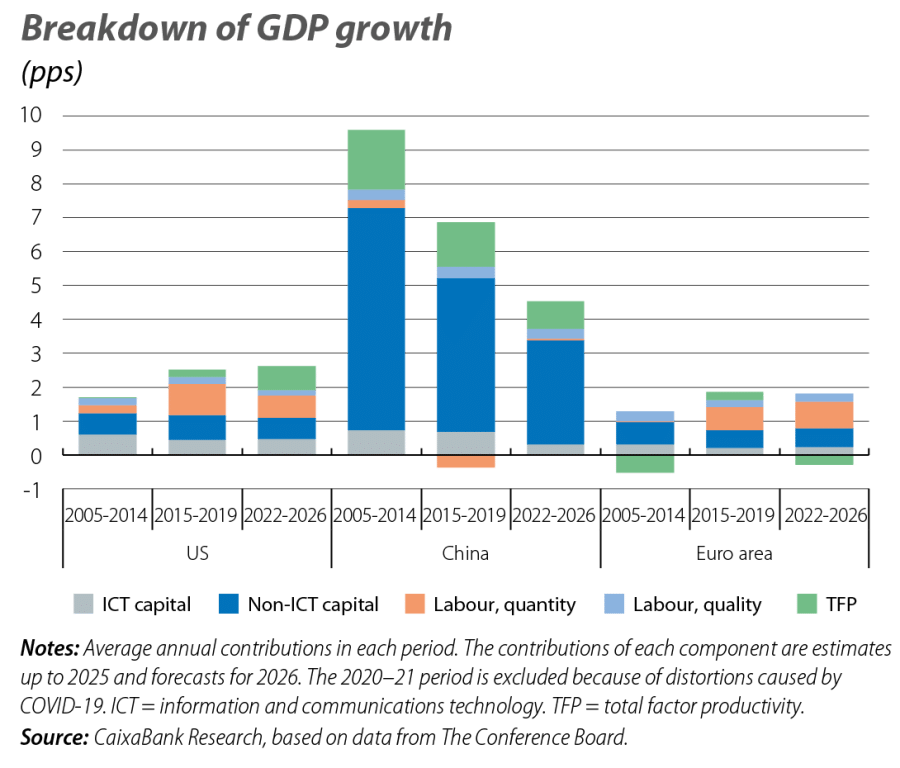
Against this backdrop, the contributions to growth of labour, capital and productivity differ markedly across blocs (see fourth chart). Recently, the US has seen a more favourable and balanced growth mix, with a recovery in total factor productivity (TFP) and a greater contribution from technology capital than in the pre-pandemic years. China remains heavily reliant on capital accumulation, although the contributions of both capital and total factor productivity continue to decline. In the euro area, by contrast, modest growth reflects a contribution from TFP that has remained very low or even negative in recent years. Looking ahead, population ageing and low participation among some groups will constrain the labour supply,16 while capital will need to be directed towards more productive uses. Further sustained productivity gains will depend above all on AI adoption spreading throughout the productive economy, being accompanied by organisational change and enabling a more efficient allocation of resources.
- 13
See the Focus «Trump 2.0 immigration policies: the end of the American Dream?», in the MR10/2026.
- 14
See the Focus «How far has the EU progressed on the Competitiveness Compass?», in the MR04/2026.
- 15
OECD (2026). «OECD Economic Outlook: Under Pressure».
- 16
See the article «The effects of ageing on growth and policy tools to mitigate them», in the Dossier of the MR09/2025 and the Focus «What can we expect from labour force participation rates in the US and EU?», in this same Monthly Report.
From resilience to better growth
Resilience will remain necessary, but it will no longer be enough to sustain growth. If the energy shock subsides, the global economy could gain momentum in 2027, but this will not necessarily signal stronger underlying growth. The key will be to turn this rebound into more robust growth without exhausting the available buffers or recreating the previous imbalances. Achieving this will require higher labour force participation, harnessing immigration to counter population ageing, channelling savings into productive investments and ensuring that the technology cycle delivers productivity gains. These transformations, together with adaptation to climate change, which is already affecting productive capacity,17 will compete with other strategic priorities for limited resources.
The political, financial and geopolitical environment poses additional risks. Unmet expectations over AI’s performance, rising sovereign bond yields or vulnerabilities in non-bank financial intermediation could tighten financial conditions. This is compounded by the prospect of deadlock between the Trump administration and a Democratic-controlled Congress over the next two years, as well as Europe’s political and budgetary cycle, marked by tensions in France. Internationally, the fragile truce between the US and China does not eliminate the risks surrounding Taiwan, while the war in Ukraine and Russia’s hybrid threats continue to exert pressure on Europe. Fragmentation can reduce strategic dependencies, but it can also raise costs, duplicate capacity and slow the spread of technology.18
Ultimately, in 2027 the global economy will need to show that it remains as resilient as it has been in recent years, while also beginning to deliver better growth on more balanced and sustainable foundations.
Geopolitics
We analyse the major geopolitical trends and thier effects on the financial markets and the economy.

Digitalisation & Technology
The keys to understanding how digitalisation and new technologies are substantially transforming the economy and how society works.

Macrofinance
What factors will determine the evolution of interest rates, investment sentiment and macro-financial conditions in general?