Are the midterms important for Trump? And for the US?
On 3 November, Americans will return to the polls to renew the entire House of Representatives and one-third of the Senate, the two chambers in which the Republican Party secured a majority in 2024. Although Donald Trump will not appear on the ballot, these elections represent the first major national test of his second term.

Opinion polls and election results since his return to the White House currently point to a political environment favourable to the Democrats. At the same time, the regions and social groups that contributed most to the Republican swing in 2024 do not yet appear to have reaped the economic benefits they were promised. The outcome will thus test the confidence that the electoral base which returned Trump to the presidency continues to place in him. More importantly, however, it will determine the institutional checks on his power and influence the debate within the Republican Party surrounding the continuation of his agenda ahead of the 2028 presidential elections.
What is being decided on 3 November?
In the midterm elections, all 435 members of the House of Representatives and 35 of the 100 senators will be up for election (see the first two charts).1 The Democrats need to increase their number of representatives from 214 to 218 to regain the House, while they require four additional seats to achieve a majority of 51 senators, as the vice presidency – and therefore the tie-breaking vote – will remain in Republican hands.
- 1
Of the 35 Senate seats up for grabs, 33 are up for regular renewal and 2 are special elections to decide who will complete the terms of J.D. Vance and Marco Rubio, who were provisionally replaced after taking up their positions as Vice President and Secretary of State, respectively.
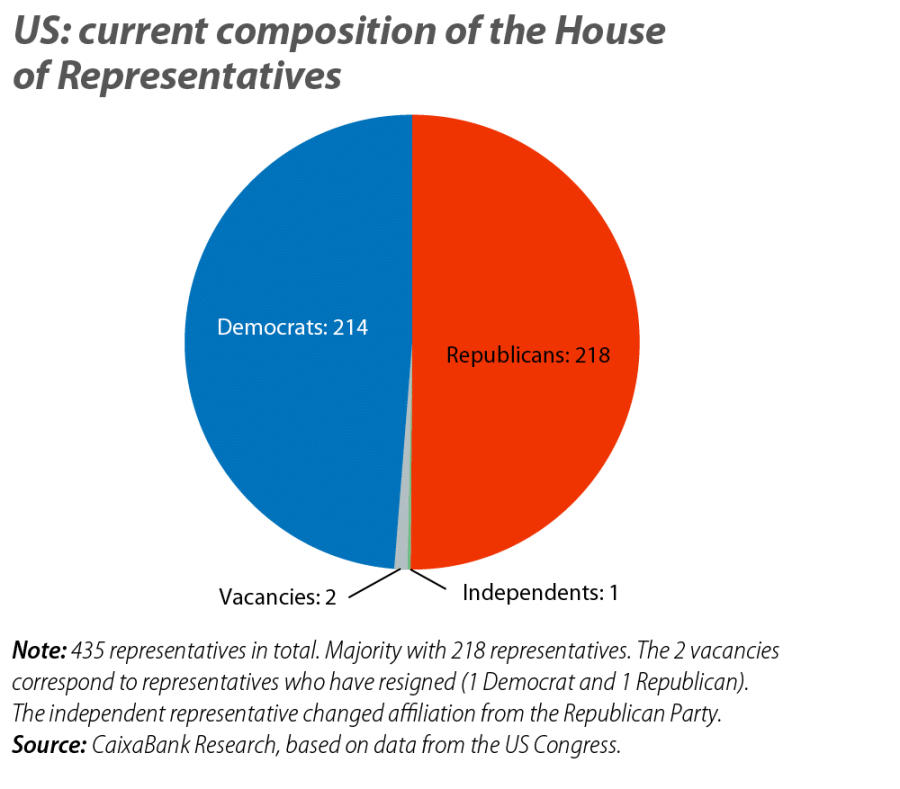
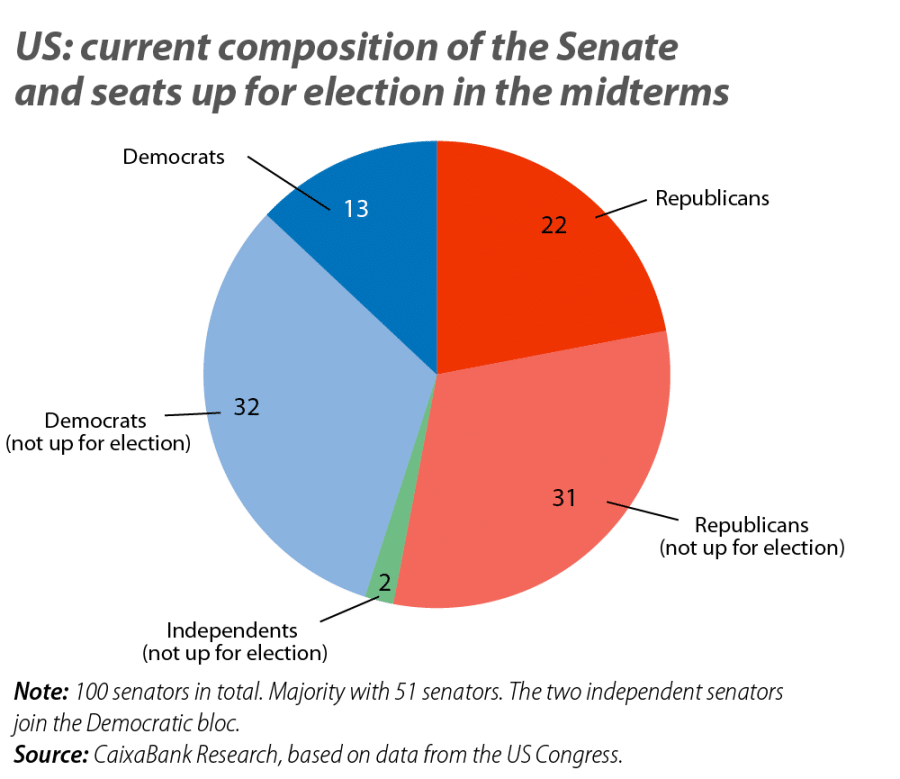
The extent of a Democratic victory will depend on which chamber is won. Control of the Senate would allow them to block appointments of federal judges, senior administration officials, or members of the Federal Reserve. Control of the House would grant them greater powers to conduct investigations into the Executive, demand documents and examine potential conflicts of interest or abuses of power – a strategy which Democratic leaders seem to prefer over immediately initiating a new impeachment process. A Democratic majority in either chamber could block new Republican legislation, while control of both would allow an alternative agenda to be advanced, although Trump would retain veto power. In the fiscal sphere, the new political balance could modify some of the planned spending cuts in the One Big Beautiful Bill Act (OBBBA) or make it difficult to extend its temporary provisions, although it would be unlikely to alter substantially the projected path of the national deficit and debt in the absence of bipartisan agreements. The political confrontation could also extend to funding bills, complicating the approval of federal spending and increasing the risk of partial government shutdowns, with the associated economic costs.2
Losing control of Congress would not prevent Trump from continuing to act through executive orders and powers delegated by previous laws, especially on matters related to migration, trade and foreign policy. He would have considerable room for manoeuvre, though not unlimited: he would need funding to implement some measures and his decisions would remain subject to existing laws and court oversight. The Supreme Court’s setbacks to the tariffs imposed under the IEEPA and the attempt to restrict birthright citizenship illustrate these limits.3
- 2
Congressional Research Service (2026), «Past Government Shutdowns: Key Resources» and Congressional Budget Office (2025), «A Quantitative Analysis of the Effects of the Government Shutdown on the Economy Under Three Scenarios».
- 3
See the Focus «The new US tariff landscape (2026 back-to-school edition)», in the MR09/2026, and the Focus «Trump 2.0 immigration policies: the end of the American Dream?», in this same Monthly Report.
Opinion polls favour the Democrats
The Democrats have history on their side: the president’s party has lost seats in the House in 20 of the 22 midterm elections held since 1938.4 This consistency does not determine the outcome, but it reinforces the interpretation of the opinion polls, which already place the Republicans in a vulnerable position.
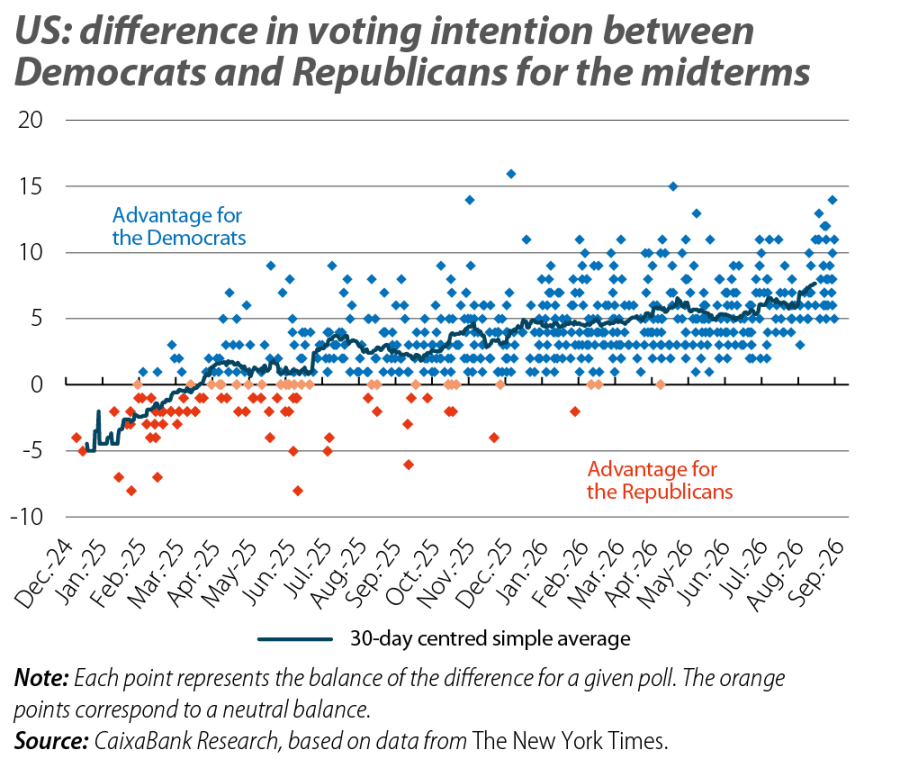
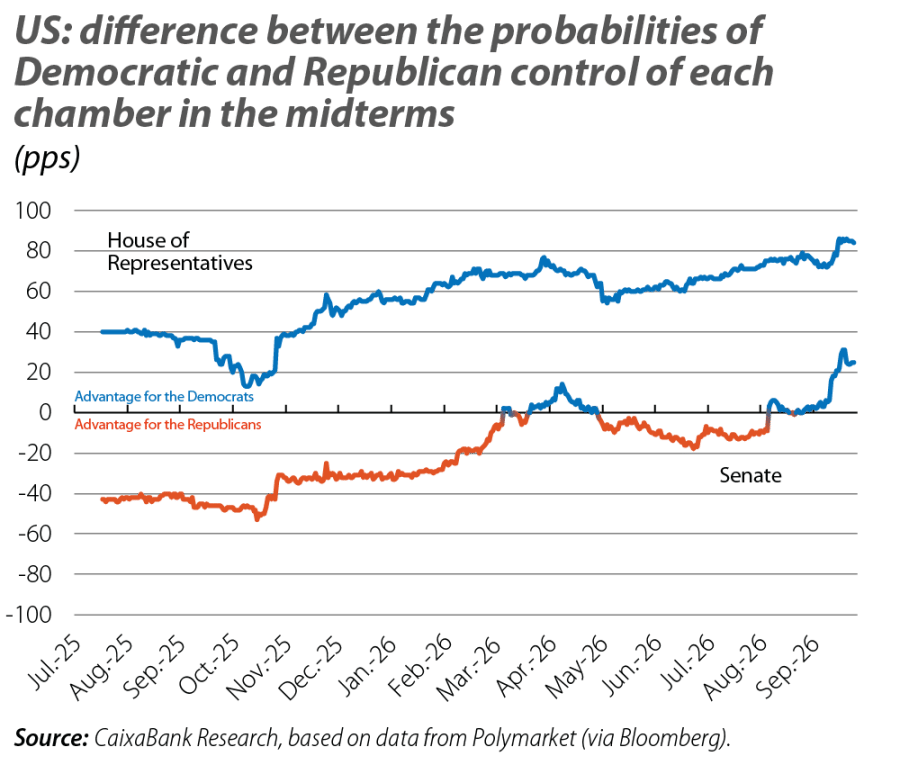
At the end of September, the average of the polls on congressional voting intentions placed the Democrats some 7-8 points ahead of the Republicans (see third chart). This advantage does not automatically translate into seats, given the district boundaries and the geographical distribution of votes, but it is consistent with a significant risk to the narrow Republican majority in the House. The prediction market platform Polymarket assigned, at the end of September, a 90% probability to a Democratic House and just under a 40% probability to the Republicans retaining the Senate (see fourth chart). The difference is due to the characteristics of the electoral map. To regain control of the Senate, the Democrats need to emerge with a net gain of four seats. Their main opportunities lie in states currently represented by Republicans, such as North Carolina, Maine, Alaska and Ohio, while Iowa and Texas present more challenging options. At the same time, they must retain Georgia and Michigan, two states won by Trump in the 2024 presidential elections.5
Elections results have offered similar signals. In 2025, the Democrats took control of the government in Virginia, retained power in New Jersey, and maintained the progressive majority in the Wisconsin Supreme Court (whose members are elected at the polls) in a state where Trump had won in 2024. More revealing still is the pattern of elections held since his inauguration: in an analysis published in April on 229 federal and state elections with candidates from both parties (mainly special elections for Congress and state legislatures), Democrats exceeded the vote share obtained by Kamala Harris in 2024 in 193 of them, with an average improvement of 5 points.6 In the New York mayoral elections, Zohran Mamdani’s victory, with a campaign focused on housing and the cost of living, provided further evidence that an alternative economic agenda could gain support even in neighbourhoods where the Republican vote had made significant gains in the last presidential elections.
- 6
POLITICO (2026), «Democrats Have Made Up Ground in Nearly Every Election Since Trump Took Office». In any case, this signal should be interpreted with caution, due to the typically lower turnout in special elections and because Harris had performed worse than other Democratic candidates in some areas.
Have the areas that shifted towards the Republicans received the promised economic dividend?
Trump’s victory in 2024 was supported by greater mobilisation among Republican voters, the abstention of former Democratic voters, and concerns about inflation and immigration. His gains were widespread across the country: his vote share increased compared to 2020 in 9 out of 10 counties and gained ground most notably in large urban areas, regions with a high immigrant population, southern Florida, the Texas border region, and the industrial states of the Midwest.7 The question now is whether those areas have experienced the changes they were hoping for and whether their voters feel their situation has improved.
The available data do not allow us to identify any distinct economic dividend in the areas that led the swing towards the Republicans. The US economy has maintained positive growth, but in August 2026 only eight states recorded a statistically significant year-on-year increase in non-farm employment, while 10 showed notable rises in their unemployment rates compared to a year earlier.8 These statistics indicate that the improvement in employment is far from widespread, although they do not allow a causal link with Trump’s policies to be established. It is also worth noting that voters’ perceptions are influenced by party identification.9
Tariffs provide protection against foreign competition for producers of steel and other goods, but they also increase costs for companies that use imported metals and components. This tension is particularly relevant for the industrial belt of Michigan, Pennsylvania, Wisconsin and Ohio. The available evidence suggests that tariffs have increased the cost of imported goods without yet producing a noticeable improvement in overall employment, with modest and uneven labour effects across sectors and regions.10 Moreover, the energy shock triggered by the conflict in the Middle East has added new inflationary pressures, directly affecting fuel costs, which are one of the most visible prices for American households. It has also driven up interest rates, complicating the main economic expectation placed on Trump: bringing down the cost of living.11
Migration policy presents a similar tension. Some preliminary analyses link the intensification of operations and detentions carried out by the Immigration and Customs Enforcement (ICE) agency with declines in local labour supply, consumption and employment, including that of US-born workers.12 Their impact could also be electoral. Trump significantly increased his support among Latino voters in 2024, largely driven by economic discontent, but the 2025 elections in Virginia and New Jersey reversed some of that progress. Polls indicate that his support is weakening amid high prices and these communities’ exposure to ICE operations, although it is still unclear how much is due to changes in voting and how much to increased mobilisation among Democrats.13
- 7
Economic Innovation Group (2024), «The Economic Geography of the 2024 Elections».
- 8
Bureau of Labor Statistics (2026), «State Employment and Unemployment, August 2026».
- 9
C. Sahm (2026), «Consumer Sentiment Isn’t Politics, but Politics Is Reshaping It».
- 10
M. Azzimonti and J. Titcomb (2026), «U.S. Import Tariffs in 2025: Realized Tariff Rates, Import Prices, and Local Labor-Market Effects», and J. Matschke and M. Dzholos (2025), «Higher Tariffs Might Have Created Headwinds to Employment Growth in 2025».
- 11
Federal Reserve Bank of Chicago (2026), «The Aftermath of the 2026 Oil Shock: Some Alternative Macroeconomic Scenarios».
- 12
E. Cox and C.N. East (2026), «Labor Market Impacts of ICE Activity in Trump 2.0», and E. Hernández (2026), «ICE-ing the Economy: Immigration Enforcement Under Trump 2.0 and Local Economic Activity».
- 13
Pew Research Center (2025), «Voting Patterns in the 2024 Election»; Pew Research Center (2026), «Trump’s approval rating hits second-term low among his Latino voters, though many still approve»; and CBS News (2025), «Latino Voters Swing Toward Democrats in 2025 After Trump’s 2024 Historic Gains».
The greatest challenge between now and 2028 will be for the economy
A Republican defeat would not leave Trump powerless, but it would alter his incentives. Without the possibility to seek re-election and with reduced legislative power, he could shift his focus towards areas with greater presidential autonomy, such as trade, migration and foreign policies, increasing regulatory and geopolitical uncertainty. The midterms will thus determine how much of his agenda Trump can fund, safeguard and turn into a lasting legacy. For the Republican Party, a defeat would also pose the dilemma of maintaining an agenda that energises its base but could jeopardise its chances in the 2028 presidential elections. For the US, the issue at stake is balancing the ability to act with institutional checks: an opposing Congress could limit the most disruptive decisions and reduce legislative surprises, but it could also lead to a period of deadlock, legal challenges and less predictable budgeting. Ultimately, whatever political balance emerges from the ballot box, it will not be neutral for the US economy and will influence the level of uncertainty in the coming years.