
The ageing of the workforce: a challenge for Spain and Europe
The ageing of the workforce is emerging as a structural challenge that will increasingly constrain the labour market and economic growth. While this trend is shared across the major European economies, Spain has one of the fastest-ageing workforces, behind only Italy, while the change has been somewhat more moderate in Germany and France.

Spain’s labour market is enjoying a period of strength, with year-on-year employment growth above 2% and record employment levels: 22.85 million people in work, according to the Q3 Labour Force Survey. However, this positive trend masks a structural challenge that will increasingly constrain economic growth: the ageing of the workforce. In this article we analyse changes in the age profile of the workforce, identifying which segments are growing or shrinking as a share of the total labour market and comparing Spain with Europe as a whole.1
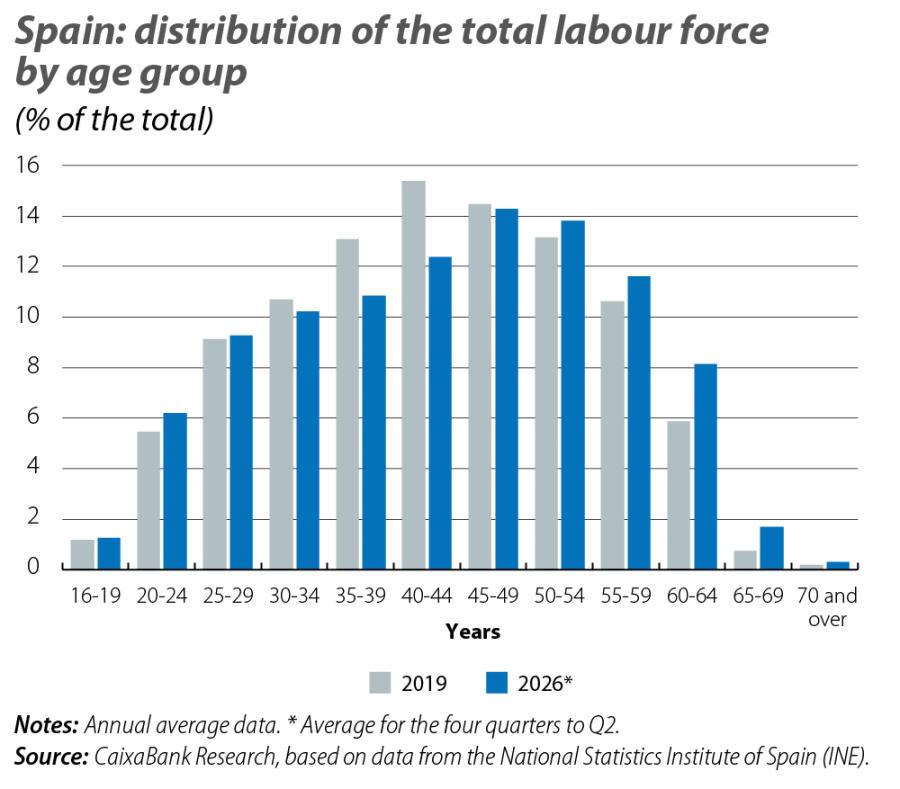
The labour force has grown since 2019 by 8.8% (just over 2 million people), but its age profile has changed significantly. As the first chart shows, the distribution has shifted markedly to the right. Thus, while the labour force aged 25 to 54 – the age group with the highest labour force participation rates – has grown by 276,000 people, a meagre 1.6%, the number aged over 55 has risen by more than 1.4 million, or 35.3%.
- 1
For a complementary perspective focusing on the factors behind changes in labour force participation rates in the US and the four largest EU economies, see the Focus «What can we expect from labour force participation rates in the US and EU?» in this same report.
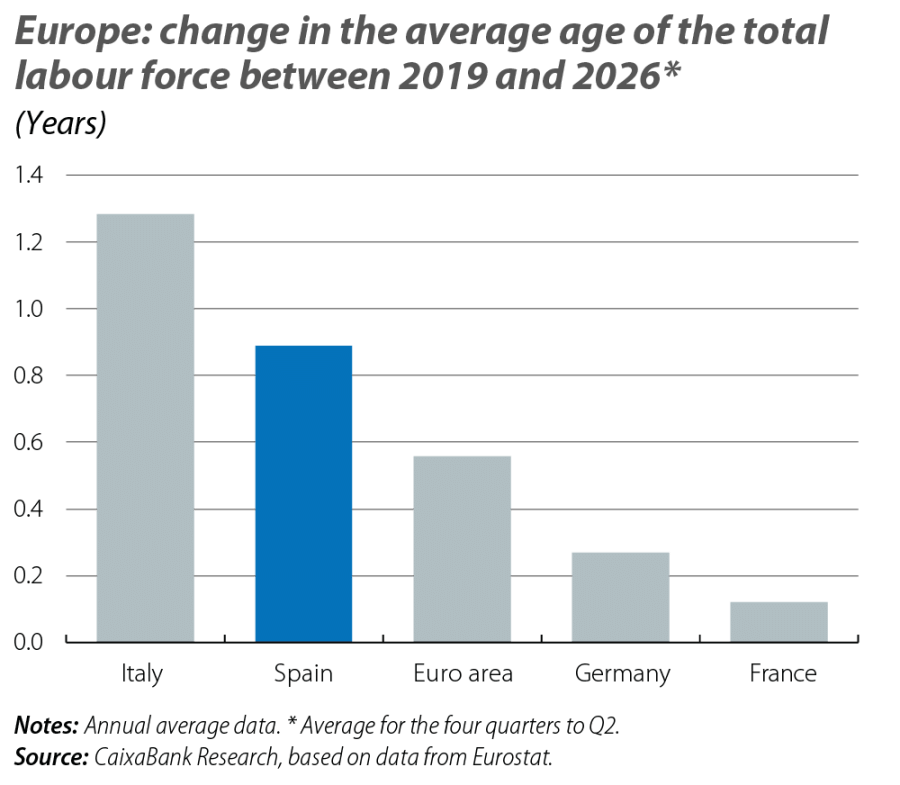
Another way to look at this is to calculate the average age of the labour force,2 which has risen from 42.6 years in 2019 to 43.5 in 2026. While this trend is shared across the major European economies (see second chart), Spain has one of the fastest-ageing workforces, behind only Italy, while the change has been somewhat more moderate in Germany and France.
- 2
The LFS provides data by age group in five-year bands, so we assign the same age – the midpoint of the band – to all labour force participants in each band, i.e. 22 for everyone aged 20-24, 27 for those aged 25-29 and so on.
A breakdown by nationality shows that the vast majority of new labour market participants are foreign nationals, numbering more than 1.2 million, an increase of 41.3%. By contrast, Spanish participants increased by just 149,000, or 0.8%. The remainder are dual nationals. In any case, ageing affects both groups: the average age among Spaniards has risen from 43 to 43.9 years. Foreign nationals, while still younger on average, have also aged: their average age rose from 39.4 in 2019 to 40.8 in 2026.
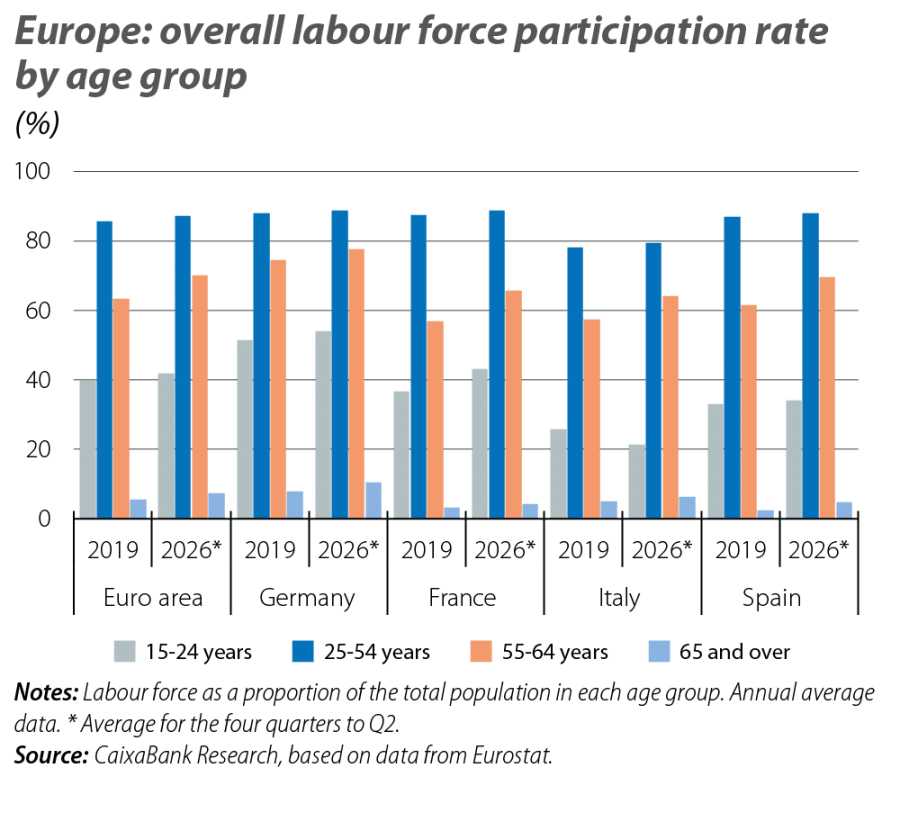
Given that economic growth depends, among other factors, on what happens in the labour force, the retirement of increasingly large cohorts may constrain labour force growth and, consequently, economic growth. There are two main ways to mitigate this effect: increase the working-age population – immigration could help achieve this – and raise the labour force participation rate. However, there is limited scope for this second approach. Among prime-age workers aged 25 to 54, the participation rate is already close to 90% in both Spain and neighbouring countries (see third chart). There is greater scope for gains among young people and older workers, although they are unlikely to match prime-age participation rates.3
- 3
Several factors constrain growth in labour force participation among the youngest and oldest age groups. For younger people, these include staying in education longer and difficulty finding work due to a lack of experience; for older people, retirement and early exit from the labour market, employability issues and adapting to new technology.
Population projections produced by Spain’s National Statistics Institute (INE) illustrate these constraints. Between 2026 and 2030, 3.4 million people are expected to turn 65, while the population aged 25 to 54 will increase by just 290,000, and even this increase is driven by the migration flows projected by the INE.4 The population aged 15-24 will increase by 268,000, while the number of 55-64 year-olds will rise by 606,000. If age-specific participation rates remained constant, the labour force would increase by around 892,000 people by 2030. That equates to an average annual growth of 0.7%, compared with the 1.6% recorded between 2022 and 2025. By contrast, if labour force participation rates rose to the considerably higher levels found in Germany, the increase would be around 1.1 million people and annual growth would reach 0.8%.5 Higher labour force participation can therefore cushion the impact of ageing, but it is unlikely to offset it. Changes in the working-age population will thus remain the main constraint on labour supply.