Investing to compete: the new cycle of modernisation in the Spanish food industry
The food industry is not only the leading manufacturing sector in the country in terms of activity, employment and international reach; it has also established itself as one of the major drivers of investment in Spain’s industrial sector. In an environment characterised by rising costs, regulatory pressure, international competition and increasingly sophisticated consumer demands, the sector has continued to allocate resources to boost efficiency, enhance traceability and improve sustainability and food safety. This investment capacity reflects a distinctive feature: unlike more cyclical manufacturing sectors, the food industry combines relatively stable demand with a constant need for renewal. In the coming years, the challenge will lie in combining the traditional importance of physical capital with greater investment in intangible assets – innovation, digitalisation, data, traceability, branding and human capital – which are crucial for boosting productivity and competing in higher value-added segments.

A leading sector within the manufacturing industry
The significance of the food industry3 is not solely due to its size – it is the country’s leading manufacturing sector, with a turnover of nearly 185 billion euros, accounting for 21.3% of manufacturing GVA and providing around half a million jobs – but also due to its contribution to national cohesion, value creation in the agrifood chain, and the trade balance. In 2025, food and beverage exports reached almost 52.6 billion euros, positioning the sector as the second largest manufacturing exporter, behind only the automotive industry. Moreover, it recorded a trade surplus exceeding 14.8 billion euros, equivalent to 0.9% of GDP.4
- 3
Food and beverage sectors (sections 10 and 11 of the National Classification of Economic Activities, or CNAE), with 2024 data for turnover and GVA, and 2025 data for employment (Social Security affiliates), based on data from the National Statistics Institute (INE, Structural Business Statistics [EEE]) and the Ministry of Inclusion, Social Security and Migration.
- 4
Data from DataComex.
Within Europe, Spain is among the leading food powers, ranking fourth in the EU in terms of turnover, behind Germany, France and Italy.
However, the Spanish economy is more specialised in this sector: the share of food in manufacturing GVA is 21.3%, compared to 7.6% in Germany, 18.0% in France, and 11.1% in Italy.
In terms of investment, the Spanish sector shows an intensity (as a proportion of GVA) similar to that of France and Germany, but below Italy (see the charts above): in 2023, the Spanish sector invested 0.8% of GVA in intangible assets, slightly above the EU average and Germany, but below Italy’s 2.2%. This gap suggests there is room for improvement in technological and intangible assets, especially when compared to the Italian model.
The sector also leads investment within manufacturing
The food industry is the manufacturing sector that invests the most in Spain: almost 6.9 billion euros in 2024, accounting for 21.7% of the total. Since 2019, it has accumulated a growth of 32.9%, in line with the manufacturing sector as a whole (32.4%).5 These figures reveal that not only is it a vast sector in terms of size, but also one with sustained levels of investment, even in the face of recent price shocks, uncertainty and a tightening of financial conditions.
In terms of investment intensity (investment over value added), the food industry ranks at a medium-high level within manufacturing. It clearly surpasses traditional sectors such as textiles, furniture or light metallurgy, but lies below highly capital-intensive sectors like the chemicals or automotive industries.
The food industry has a different investment profile to sectors such as the automotive, chemicals, or capital goods industries. While these activities are often more exposed to the business cycle and large-scale projects, the food sector shows a more distributed, continuous pattern of investment linked to recurring operational needs: plant modernisation, automation, food safety, energy efficiency, traceability and adaptation to increasingly demanding regulatory standards. This stability in investment also entails constant demand: as a mature and highly competitive sector, investment must not only maintain the installed capacity but must also increase efficiency, improve quality, reduce costs and enable greater product differentiation.
- 5
For a detailed analysis of investment trends in recent years, by sector and asset type, see «Cross-section of business investment in Spain: more intangibles and an increasingly mixed pattern», in the Sectoral Observatory S1 2026.
The composition of investment confirms the sector’s industrial and operational nature. Tangible assets account for the majority of investment efforts (see the charts below), particularly in machinery, transport equipment, technical installations and constructions. This structure is consistent with an industry in which production scale, automation, logistics, quality and food safety are decisive factors. In this regard, there is a growing trend towards investments linked to sustainability (energy, water, circular economy or emission reductions), particularly in the dairy, meat, beverage and fruit and vegetable industries. In this context, sustainability should not only be seen in terms of regulatory compliance, but also as a lever for reducing costs, securing supplies and meeting new requirements demanded by consumers, distributors and regulators.
In contrast, although investment in intangible assets6 has been highly dynamic in recent years, with a 44.7% increase between 2019 and 2024 compared to 32.9% for total investment, their role remains relatively minor: they account for just 4.5% of the total. That is three times lower than the average across manufacturing as a whole and well below the most knowledge and technology-intensive activities such as machinery, pharmaceuticals, the automotive industry and transport equipment (around 25.0%) and, above all, computer products (44.6%).
This gap does not diminish the sector’s investment effort, but it does indicate the direction that the next phase of modernisation should take. The food industry will continue to require physical capital – factories, machinery, facilities and logistics – but the performance of these assets will increasingly depend on their integration with intangible technologies and skills: sensors and advanced automation, data analytics, artificial intelligence applied to industrial processes, digital traceability, innovation in formats and products, advanced supply chain management, design, branding and highly-qualified human capital. In a sector where competition is not solely based on price, these assets will become increasingly important for capturing more value.
- 6
Expenditure on R&D, software applications, industrial property, administrative concessions, patents, licences, trademarks, designs, copyrights, etc.
Investment and productivity in the food industry go hand in hand
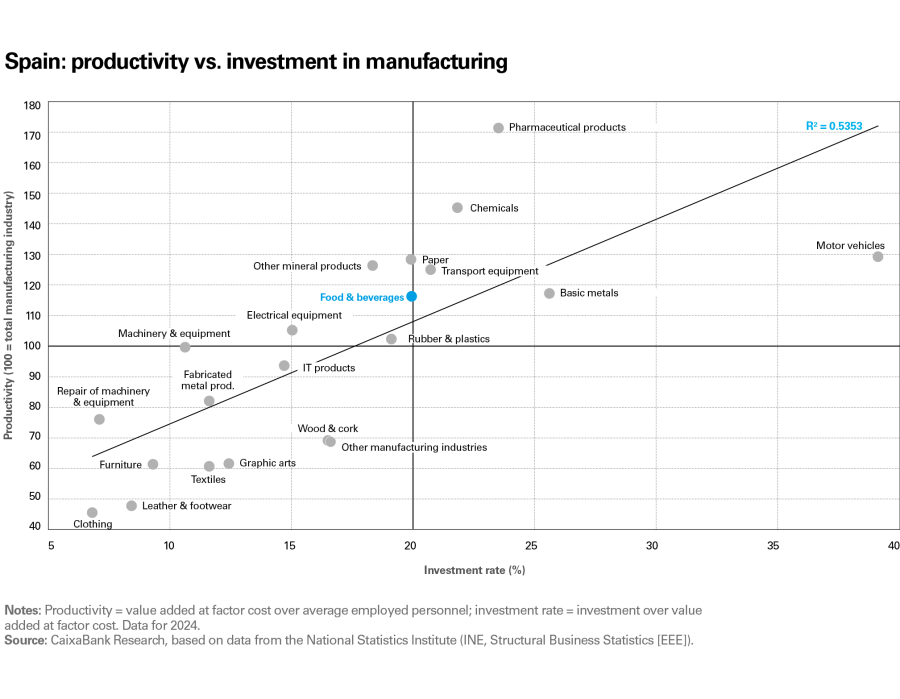
As shown in the following chart, within the manufacturing industry there is a positive relationship – albeit with significant variation across activities – between investment effort and labour productivity. This is consistent with the role that the accumulation of capital plays in driving productive efficiency.
The food industry occupies a mid-tier position within manufacturing, slightly above the trend line, suggesting it achieves an efficient return on its investment efforts. It does not reach the productivity frontier of more R&D-intensive sectors, such as pharmaceuticals or chemicals, but it holds a stronger position than several traditional manufacturing industries. Moreover, relatively speaking it seems to achieve more productivity per unit of investment than much more capital-intensive sectors, such as the automotive industry.
In mature sectors, productivity improvements do not solely rely on increasing physical capital, but on combining it with technology, organisation, data, innovation and human capital.
The food industry occupies a mid-tier position within manufacturing, suggesting it achieves an efficient return on its investment efforts
A highly diverse investment by activity
A detailed analysis reveals that there is no common investment pattern across the food industry. The meat industry (processing, production and preservation) accounts for over 20.0% of investment, driven by the need for specialised facilities, traceability and health-related compliance; however, its contribution in terms of GVA is below average (see the charts below). The activities that invest the most in volume terms are fruit and vegetable processing, wine production (investments linked to quality, brand and positioning) and bakery products. In terms of investment intensity, prepared meals, potato processing and pasta stand out.
In the breakdown by asset type, there is a clear predominance of tangible assets, mainly machinery and technical installations, which in many cases exceed 50.0% of the total investment, in line with standardised and automated industrial processes. Transport equipment also accounts for a high proportion of total investment, although the pattern is uneven across different activities, with particularly high levels in activities where logistics and distribution are central to the business model, such as in beverage manufacturing. Intangible assets, on the other hand, play a more important role in certain sectors, such as cocoa and chocolate, wine and dairy products, where innovation, branding, perceived quality and differentiation play a more prominent role.
It should be recalled that the food industry contains a mix of large-scale, capital-intensive activities and others where value is more reliant on branding, innovation, quality, design or specialisation. Therefore, the levers of modernisation will not be identical across all sectors: in some, the focus will be on automation and operational efficiency; in others, on differentiation, commercial digitalisation, sustainability, product innovation or international positioning.
Intangible assets play a more important role in certain sectors, such as cacao and chocolate, wine and diary products
A distinct territorial dimension
Investment in the food industry is concentrated in regions specialised in this activity. More than 53.0% of the total investment in tangible assets (the EEE does not break down investment in intangibles) is made in four regions: The Valencian Community, Castile and León, Andalusia and Catalonia. This distribution reflects the productive base of each region: fruit and vegetable processing in the Valencian Community, meat and dairy in Castile and León, and olive oil and fruit and vegetables in Andalusia.
Catalonia holds a particularly significant position, contributing almost a quarter of the total investment on its own and possessing the most diversified food industry in the country, although the meat industry – primarily pork – stands out. Furthermore, it has significantly increased its proportion of the total in recent years and is the only region among the top four to have done so (see the chart below).
As a percentage of the sector’s GVA, the highest investment effort is found in Aragon, Murcia and Catalonia (all above 25.0%), and especially in Navarre, at 43.1%, which is 12 points higher than in 2019. Besides Navarre, only Galicia and the Basque Country have increased their investment intensity (very slightly in both cases).
Navarre stands out for both its dynamism and its investment intensity: between 2019 and 2024, investment in the region doubled. This pattern indicates an exceptional investment cycle, possibly linked to a larger business base, greater export orientation, and major projects in the meat industry and in plant processing.
Conclusions
Spain’s food industry is notable for its investment capacity, lower exposure to the business cycle and strong regional roots. These characteristics make it a key element for modernising the productive base and enhancing the international competitiveness of the agrifood sector.
The challenge, however, will increasingly be qualitative. Investing in plants, machinery and facilities will remain essential, but productivity gains will increasingly depend on the incorporation of technology, data, innovation, brand and human capital. Ultimately, the sector already invests heavily; the key will lie in investing better.
Investing in plants, machinery and facilities will remain essential. The key will lie in investing better