The Spanish agrifood sector consolidates its recovery amid ongoing challenges
The agrifood sector is facing 2026 from a stronger position than that of recent years, supported by the gradual normalisation of agricultural activity, the moderation of food inflation and the resilience of the food industry. However, the environment remains challenging. Despite improved water conditions, extreme weather events are on the rise, increasing uncertainty around harvests. At the same time, the war in Iran has introduced new pressures on energy and fertiliser costs, in an international context still marked by trade tensions and sluggish exports.

The agricultural sector continues its recovery in 2026 following recent shocks
In the wake of the 2022 crisis, characterised by drought and a sharp rise in costs, Spain’s agricultural sector experienced a significant recovery, particularly in 2024 (15%) and 2025 (11.9%). The 2026 data suggest that the sector continues to enjoy rapid growth following the exceptional figures of previous years (5.6% year-on-year in the first half of the year, versus 2.6% for the economy as a whole). The labour market is also showing a gradual improvement, consolidating this positive trend in activity: the number of registered workers in the primary sector rose by 1.6% year-on-year between January and August compared to the same period in 2025, leaving behind the job losses observed between 2022 and 2024.
Normalisation of activity and recovery of employment
Agricultural income grew rapidly in 2025 (8.9% in nominal terms), driven by an increase in production (+7.5% nominal and +6.7% real) which outpaced costs (+4.8% nominal and +1.7% real). This progress reflects the gradual normalisation of production conditions following the adverse weather of previous years. The crop sector led the growth (+7.7% nominal and +9.5% real), particularly in cereals, fruits and vegetables, while olive oil was the main exception due to the sharp price adjustment following the recovery of the harvest. Livestock also showed favourable growth (+6.9% nominal and +2.6% real), particularly the egg and cattle segments.
On the cost side, intermediate consumption rose by 4.8% (+1.7% in real terms), which was below production growth, thus improving margins. Although feed prices continued to rise, the stability of fertiliser prices and the fall in energy costs contrasted with the severe pressures recorded in 2022 and 2023.ostes energéticos contrastaron con las fuertes tensiones registradas en 2022 y 2023.
Gradual normalisation of production conditions following the adverse weather of previous years
Main macroeconomic indicators of agricultural income*
The outlook for 2026 remains positive, although there will be significant differences between crops
The ESYRCE survey by the Ministry of Agriculture, Fisheries and Food (MAPA) indicates better performance among the main Mediterranean woody crops, while herbaceous crops show a more mixed pattern, with some performing worse than in 2025.1
Among rainfed crops, olive groves and vineyards stand out. The yields of the former are around 40% higher than in 2025 and nearly 60% above the average of the last five years, while vineyards have recorded increases of around 20% year-on-year, placing yields well above the historical average. All this points to a very positive campaign for two of the main Mediterranean crops. In contrast, winter cereals, legumes, and almond trees in particular are experiencing declines in yield compared to 2025. However, cereals and legumes remain close to their usual levels when compared to the average of the last five years. Irrigated farming continues to play a stabilising role, with smaller fluctuations and yields close to historical levels.
- 1
At the closing date of this publication, data from the ESYRCE survey for the first half of 2026 is available.
Yield of the main crops in the Spanish agricultural sector for 2026
Overall, the agricultural sector will continue to benefit from more favourable conditions than those observed in 2022-2023, albeit with mixed trends between products and pockets of weakness in some field and horticultural crops. Weather conditions, production costs and the international context will continue to be decisive. Additionally, there are increasing regulatory and environmental demands in areas such as the use of inputs, water management, animal welfare, traceability and emissions. While these measures enhance the sector’s sustainability, they could also increase adaptation costs.
Water conditions improve, but exposure to extreme events increases
The National Drought Observatory of the Ministry for the Ecological Transition and the Demographic Challenge (MITECO) reports that no region is currently experiencing prolonged drought or temporary water scarcity, except for in the Júcar river basin district and the upper Guadiana area.2 However, the impact of climate change is no longer limited to drought: the sector is facing more frequent and intense extreme weather events, such as storms, hail, torrential rainfall and heatwaves, which affect production and increase uncertainty about yields. According to Agroseguro, up until the end of July 2026, these adversities had affected nearly 1.2 million hectares and resulted in 374 million euros in compensation, one of the highest amounts recorded for this period of any year.
Moreover, the effects of climate change extend beyond the direct loss of crops. High temperatures disrupt agricultural schedules and key processes for crop development, while livestock farming faces cost increases and declining pasture availability. All this indicates that climate change is becoming a structural challenge for the Spanish agrifood sector, reinforcing the need for further progress in terms of adaptation, efficient water use, and insurance coverage.
- 2
MITECO distinguishes between prolonged drought, which is a natural phenomenon linked to a deficit of rainfall and water flows, and temporary scarcity, associated with short-term issues in meeting water demands (supply, irrigation, etc.), which is assessed based on scenarios of normality, pre-alert, alert and emergency status. The latest available data at the close of this report is for May 2026.
Farmland is increasingly exposed to extreme weather events
Geopolitical tensions reignite risks to energy and fertiliser costs
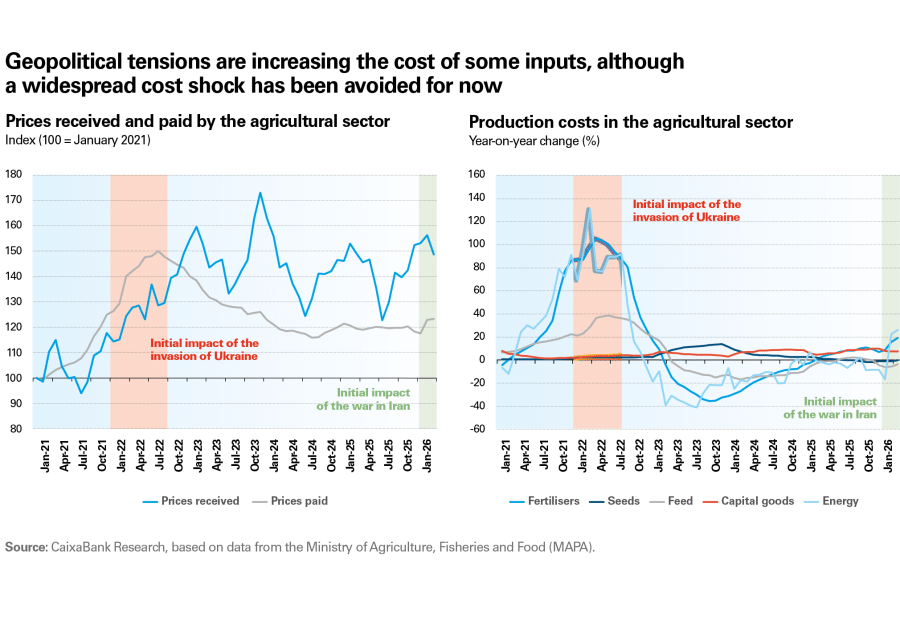
The latest available data from MAPA, corresponding to April, already showed significant price increases for items that are key to Spanish farmers, such as energy (+27% year-on-year) and fertilisers (+19.5%). For now, although significant, the price increase is less than that which followed the outbreak of the war in Ukraine (see the following chart). In any case, what happens over the coming months will largely depend on the war in Iran and the situation in the Strait of Hormuz.
Foreign trade loses momentum in a highly adverse context
Spanish agrifood exports fell in the first half of 2026 (–1.4% year-on-year), while imports increased (2.3%), reducing the trade surplus to just over 10.3 billion euros, 11% less than a year earlier.
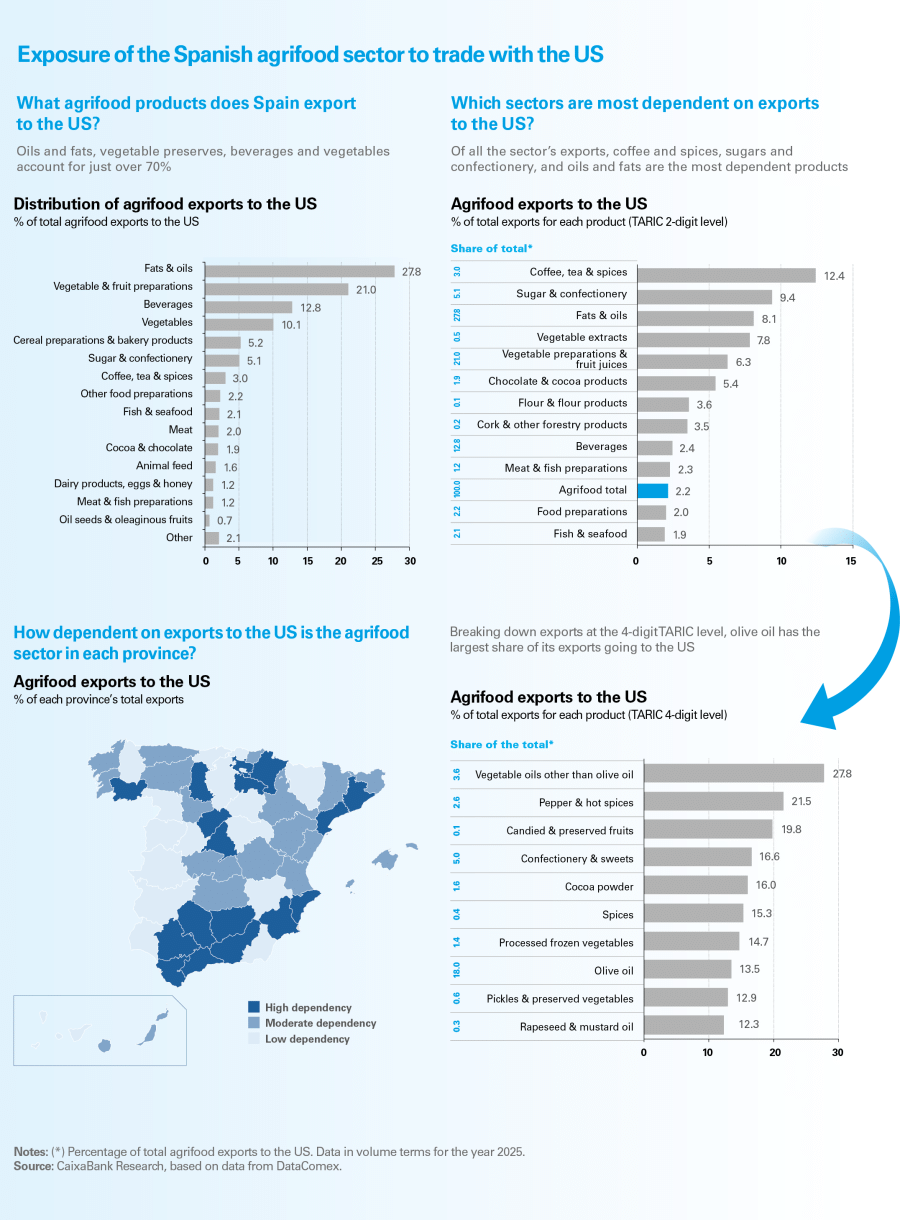
By product and destination, export growth is concentrated in fruits and vegetables, and in markets in central and northern Europe, especially Germany. This partially offsets the decline in meat sales and the reduced contribution from China and the US. Pork exports continue to be affected by lower Chinese demand, due to the recovery of its livestock and increased self-sufficiency following the African swine fever (ASF) crisis. This is compounded by trade restrictions due to recent ASF outbreaks in Catalonia. The following infographic shows which products (especially olive oil) and regions (provinces in Andalusia and eastern Spain, among others) are most exposed to the US tariff hike.
On the import side, the provisional application of the EU-Mercosur agreement introduces a new competitive element for sensitive products such as beef, poultry, sugar and rice. Although it is still too early to assess the impact on imported volumes, prices and the income of Spanish producers, the sector has been expressing concern about the differences in production standards and costs, as well as the ability of the existing control and safeguard mechanisms to respond quickly to potential market disruptions.
Performance of Spanish agrifood exports
Food and beverages: contrasting fortunes in the food industry
The performance of the agrifood industry is uneven. The food sector continues to perform better than manufacturing as a whole, with increases in production and employment, as it is supported by the essential nature of its products and the fact that demand is less sensitive to the economic cycle. In contrast, beverage manufacturing shows less dynamism due to its greater exposure to the hospitality sector, exports and changes in consumer habits. Food remains the main driver of activity, whereas the beverages sector relies more heavily on price trends to maintain its turnover.
The agrifood industry is progressing unevenly
Upside risks to food inflation persist
Food inflation has eased in the second half of 2026, settling at around 2% year-on-year. This slowdown has been particularly intense in non-alcoholic beverages and unprocessed foods, which are precisely the categories that recorded the largest price increases during 2025 (although prices of the latter also surged in August). Processed foods have followed a more stable trend, while alcoholic beverages maintain low growth rates. Overall, the traffic light chart for food inflation shows a more restrained pattern than in 2025, but it remains uneven among its components. Although 60% of food items experienced year-on-year price growth of less than 2% in August, the increase in costs observed since April and the recent rise in unprocessed food prices warrant continued caution, given the possibility of renewed upward pressures in the coming months.
Food inflation has moderated in the first half of 2026, but tensions persist
While in 2025 many items recorded double-digit price increases, from January to August 2026 lower growth rates prevailed, with some products even registering declines. The correction is particularly noticeable in vegetable oils, sugar and tropical fruits, while basic categories such as cereals, pasta and potatoes show greater stability. All this indicates a gradual normalisation of supply conditions and production costs, placing food inflation in a much more contained and consistent environment than that observed in the years following the 2022 inflationary shock.
How has inflation affected food items?
Over the coming months, prolonged geopolitical tensions could gradually affect food prices through the costs of energy, transport and certain inputs. However, the intensity and speed of this transmission will depend on how long this episode lasts, how energy prices evolve, and the capacity of margins to absorb cost increases throughout the chain.
The moderation of inflation and new consumption habits reshape demand
After several years of high inflation, retail food sales grew by 1.5% year-on-year in real terms between January and July. Furthermore, data from the Food Consumption Panel of the Ministry of Agriculture, Fisheries and Food (MAPA) indicates a stabilisation in household purchases following the significant fluctuations seen in the post-pandemic years.
By distribution channel, the sales growth is particularly strong among small retailers and local supermarkets. Although they follow different business models, both are benefiting from a preference for local shopping and the moderation in inflation: the former due to their specialisation and closer links with consumers, and the latter due to their ability to contain prices and the growing importance of the distributor’s brand.
Regarding the composition of people’s shopping baskets, products perceived as healthy, nutritious and affordable, such as eggs, are gaining prominence, while there is a decline in the consumption of relatively more expensive categories such as fish, fresh fruits and vegetables and dairy products. There is also a notable increase in the consumption of oil (thanks to price reductions) and ready meals, in line with the growing demand for products that save time and effort in the preparation, purchase or consumption of food (the so-called demand for convenience). Overall, consumption patterns reflect a combination of adaptation to the accumulated increase in food prices and structural changes in household habits.