Investment and private consumption continue to support Portuguese activity
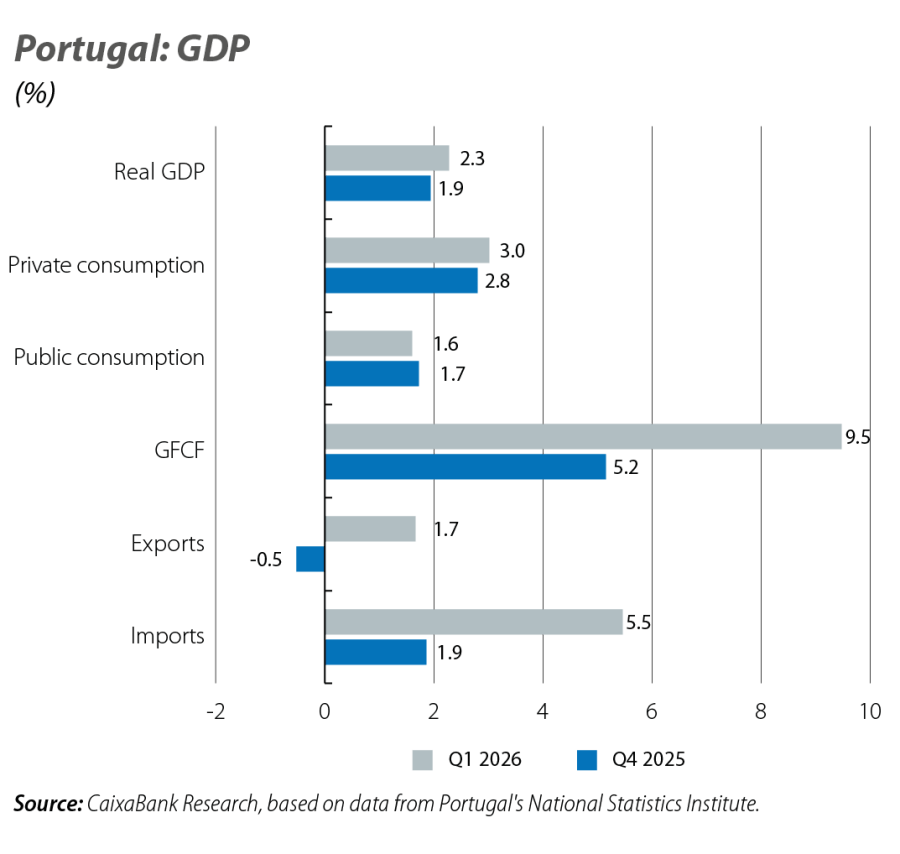
GDP stagnated in Q1 2026 in quarter-on-quarter terms, while it recorded a 2.3% growth rate year-on-year. This performance is due to the improvement in the contribution from domestic demand and a more negative contribution from external demand.
Stagnation of GDP in Q1
GDP stagnated in Q1 2026 in quarter-on-quarter terms, while it recorded a 2.3% growth rate year-on-year. This performance is due to the improvement in the contribution from domestic demand and a more negative contribution from external demand. Specifically, domestic demand contributed +4.1 pps to year-on-year growth (vs. +3.1 pps in Q4), supported by the acceleration in gross fixed capital formation (+9.5% year-on-year in Q1). On the external demand side (+5.5% year-on-year vs. 1.9% in the previous quarter), linked to the high import content of investment. Available indicators suggest that economic activity in Q2 will remain moderate but in expansion. The European Commission’s economic confidence indicator stood at 101 points in April and May (vs. 103.7 points in Q1), above its historical average of 100 points. In this context, we have revised our growth forecast for 2026 downwards, from 2.1% to 1.8%. Despite the adverse international environment, domestic factors will limit the negative impact of the conflict in the Middle East. Although external demand will remain weak due to the weak growth performance of the country’s major trading partners, domestic demand will support growth through both investment and consumption. These are backed by public investment, which should remain strong in this final year of the Recovery and Resilience Plan, and by a dynamic labour market.
Inflation remains entrenched above 3% in May
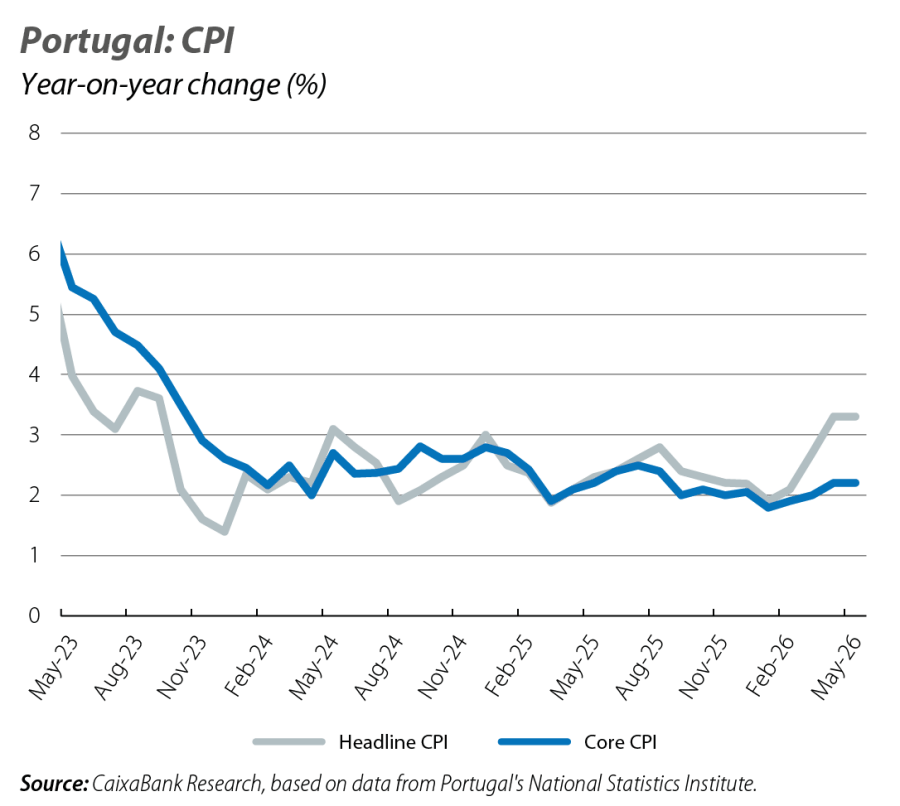
The National Statistics Institute’s flash estimate indicates that inflation remained unchanged in May relative to April (headline rate: 3.3% and core rate: 2.2%), driven by rising energy costs (+13.2% year-on-year) and unprocessed food prices (+5.7%). Given the persistence of the conflict in the Middle East, high uncertainty, and the sustained high levels of oil and natural gas prices, we have revised our inflation forecast for 2026 upwards to 2.9%, 0.8 pps higher than the previous forecast.
Employment and tourism continue to grow at notable rates
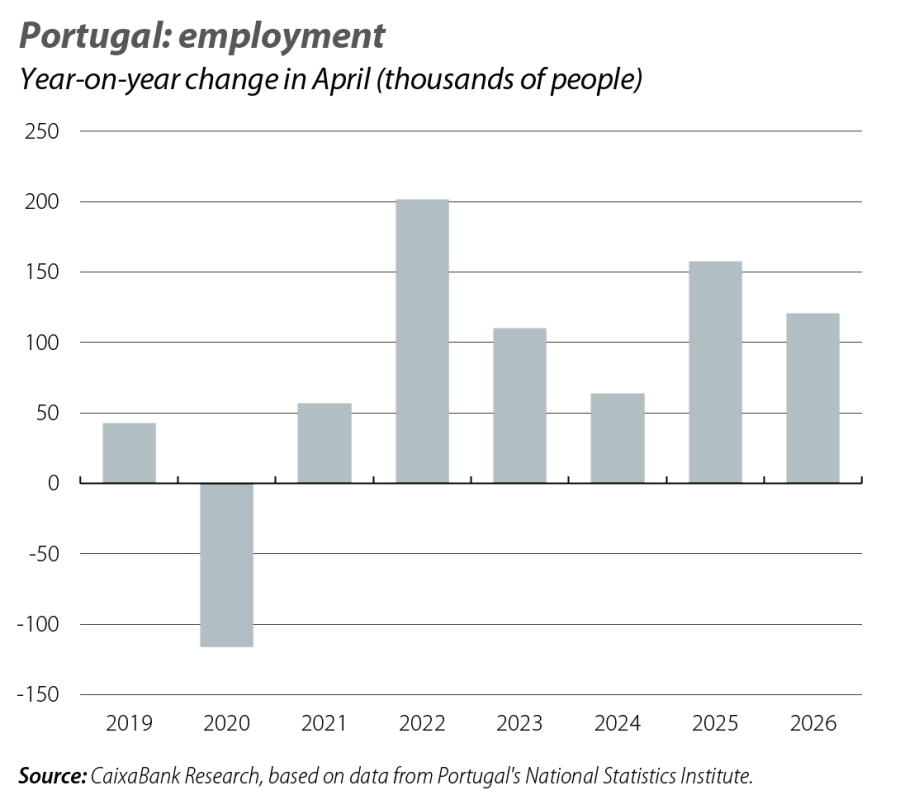
Employment in April remained strong, with a year-on-year growth rate of 2.3% and reaching a new all-time high of 5,344,700 people in employment. At the same time, the unemployment rate fell to 5.7% (–0.5 pps compared to the same month the previous year). The current account balance recorded a deficit of 616 million euros up to March, 809 million less than the same period the previous year. This is explained by the deterioration in the balance of trade in goods by 779 million euros, linked to the growth in imports of non-energy goods. The services balance also decreased (–202 million euros, –3.0% year-on-year) due to the reduction in the surplus of the non-tourism services balance. The tourism balance saw its surplus increase by 140 million euros (+3.5% year-on-year), and this growth is expected to continue in the coming months, given the steady increase in total overnight stays and tourism revenues.