Stormy start to the year for the Portuguese economy
In 2025, the Portuguese economy grew by 1.9%
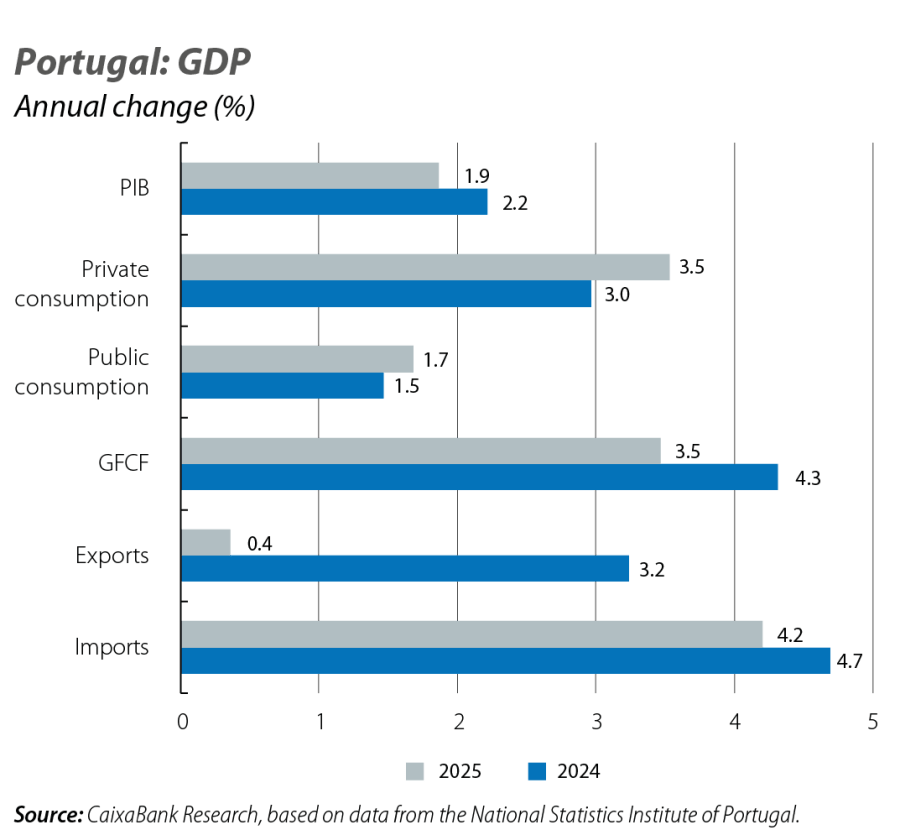
In 2025, the Portuguese economy grew by 1.9%, driven by domestic demand, which contributed 3.7 pps, largely due to the growth of private consumption. The contribution from foreign demand was negative (–1.8 pps), resulting from a sharp slowdown in exports (0.4% vs. 3.2% in 2024), while imports continued to grow at a steady pace, driven by dynamic consumption and investment. In Q4, quarter-on-quarter growth stood at 0.9% (revised +0.1 pps), which places the carry-over effect for 2026 at 1.2% (i.e. the annual growth if a quarter-on-quarter growth of 0% were recorded in all four quarters). In this context, we have revised upwards the expected growth for this year to 2.1% (vs. 2.0% previously).
The forecast for 2026 incorporates the impacts that adverse weather conditions could have on economic growth
Although the magnitude of the effect of these events is still uncertain, we can expect to see a negative impact in Q1 and a boost to activity in the following quarters, driven by the recovery of activity and the reconstruction efforts in the affected areas, which could almost entirely offset the losses recorded at the beginning of the year (not yet fully accounted for). The sentiment indicators for February – which already include the period of these storms – reveal a positive trend. The European Commission’s Economic Sentiment Indicator (ESI) improved compared to January (104.3 points vs. 103.4 previously), while the National Statistics Institute’s economic climate indicator also rose, with improvements in services and industry. In contrast, sentiment in the construction and trade sectors deteriorated, as did consumer sentiment.
The CPI rises again in February
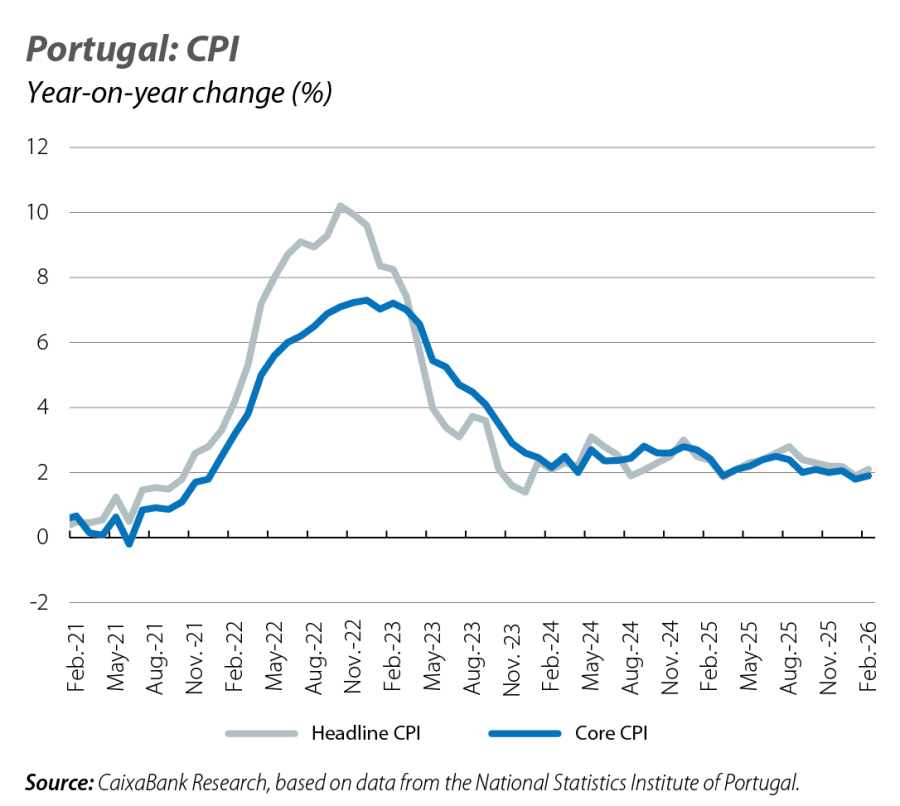
Headline inflation stood at 2.1%, compared to 1.9% in January, driven by the sharp month-on-month rise in unprocessed food prices (+0.5%) and energy prices (+0.9%). The impact of the storms may have exerted additional pressure on unprocessed food prices, and this effect could persist throughout the year, in a category that already recorded high inflation last year. The core index remained contained below 2%, standing at 1.9% (vs. 1.8% previously).
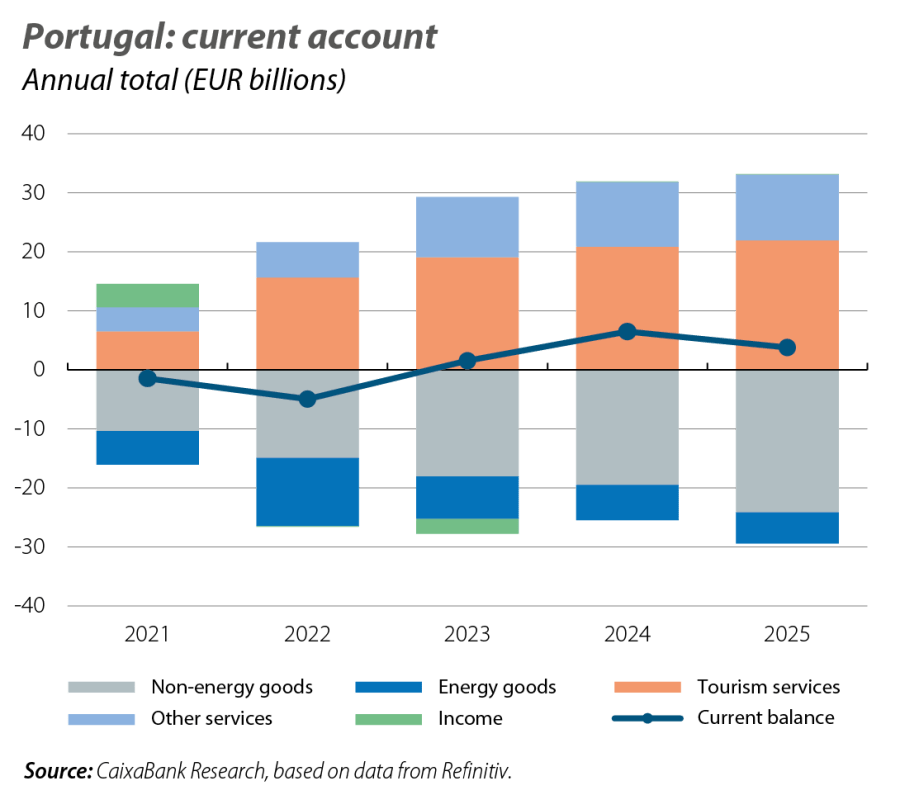
The current account balance decreased in 2025
In the year as a whole, it recorded a surplus of 1.2% of GDP (3.8 billion euros), representing a 1.0-pp reduction versus the 2024 figure. This pattern is justified by an increase in the deficit of the balance of trade in goods (+3.95 billion euros compared to 2024), as a result of the increase in imports (+2.71 billion euros) and the decrease in exports (–1.24 billion euros). On the other hand, the surplus of the services balance increased (+1.26 billion euros compared to 2024), mainly due to the rise in tourism exports. The available data show that the tourism sector remained buoyant in Q1. In January, the number of guests was up 3.8% year-on-year, with overnight stays by residents showing a trend of higher growth. We maintain a stable growth outlook, amid global dynamism in the sector.