Entrepreneurial drive in Spain: evolution, sectors and challenges
Spain has experienced a sustained increase in business entrepreneurship in recent years, reaching its highest level since 2012. However, business creation remains below the European average and significant structural challenges persist: a high early failure rate among new businesses, a strong geographical concentration of entrepreneurship and a limited focus on high value-added sectors. Despite these weaknesses, encouraging signs are emerging in sectors linked to digitalisation and the Economy 4.0. The major challenge lies in harnessing this dynamism to ensure that more projects survive, consolidate, and are directed towards higher-productivity sectors, so that all this can translate into more solid, balanced, and lasting economic growth.
Recent trends in entrepreneurship in Spain: from the 2008 crisis to the post-COVID boom
The trajectory of entrepreneurship in Spain over the last decade and a half has been strongly influenced by the business cycle and the socio-economic changes the country has experienced.
After the financial crisis of 2008-2013, Spain experienced a boom in «necessity-driven» entrepreneurship: many people started their own businesses due to the lack of jobs. The Total Early-stage Entrepreneurial Activity (TEA) rate –16 the percentage of adults aged between 18 and 64 involved in nascent or new business initiatives – reached a peak of 5.7% in 2012. As the economy recovered and employment in paid work increased, that initial momentum subsided slightly, placing the TEA rate at around 5.2% in 2016. Subsequently, with a more favourable environment, there was a shift towards «opportunity-driven» entrepreneurship: between 2017 and 2019, entrepreneurial activity picked up again (TEA rate around 6%-6.5%), indicating that more entrepreneurs were identifying market niches and vocational projects, supported by an emerging start-up culture in the major cities.
The outbreak of the pandemic in 2020 triggered a sudden pause that reduced the number of new initiatives. However, the response was swift: many businesses adapted (through digitalisation, model changes, etc.) and support measures (such as ICO guarantees) prevented a wider business collapse.
By 2021 entrepreneurial activity was already back on track, and since then company creation has shown sustained growth. In 2023, the business birth rate (newly created companies as a percentage of the total number of existing enterprises) stood at 9.1%. This is similar to the level of more recent years, but still below the peaks reached during the post-financial crisis recovery (2014-2018), when it exceeded 10%.
- 16
GEM Spain Report 2024-2025.
Territorial concentration: a few autonomous communities drive entrepreneurship
The map of entrepreneurship in Spain reveals significant geographical disparities. The most populous autonomous community regions, with dynamic economies, exhibit greater entrepreneurial dynamism, while regions with more traditional or less diversified productive structures are lagging behind.
In 2023, the Balearic Islands, the Valencian Community, and the Canary Islands led business creation, with rates around 10%-11%, almost double those recorded in less active regions. These regions are strongly geared towards consumer services and tourism, sectors with low barriers to entry where a large number of small businesses proliferate during favourable periods.
Also above the national average are Andalusia, Madrid, Murcia and Catalonia, which combine larger economies with more diversified and innovative business ecosystems. At the opposite end of the spectrum, regions such as La Rioja, Navarre, Castile and León, and Galicia have lower business birth rates (around 6%-7%), associated with more stable productive bases and a greater reliance on traditional sectors.
These gaps mean that some regions create new businesses at a rate almost twice that of others, resulting in a highly concentrated entrepreneurial panorama across the country. In the Balearic and Canary Islands, the 2022-2023 tourism boom resulted in a wave of new businesses in hospitality, trade and transport, while the inland areas of mainland Spain, with lower demand and population, barely generated new businesses.
The Balearic Islands, Valencian Community and Canary Islands stand out for their high rate of entrepreneurship
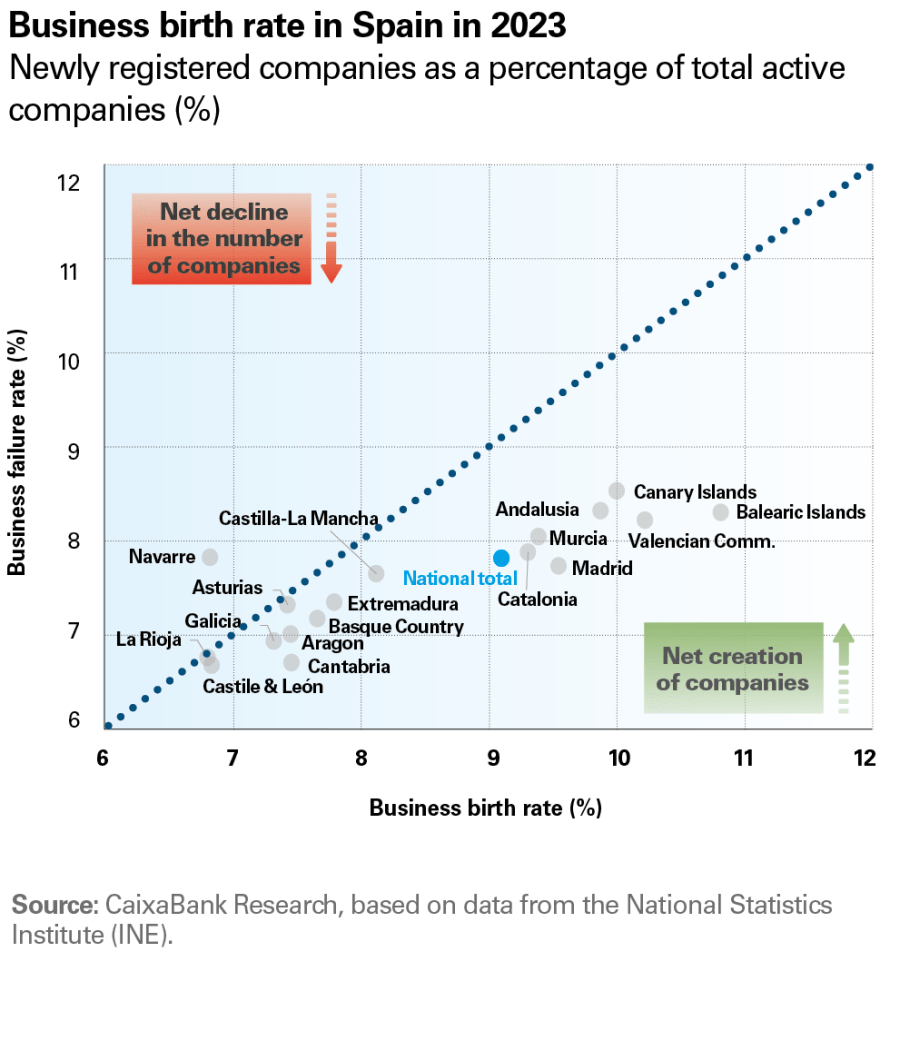
Another important observation is that the more entrepreneurial regions tend to register relatively contained business failure rates (i.e. they lie further from the bisector of the chart on the previous page) and achieve greater net growth of the business base. This is the case for the Balearic Islands, the Valencian Community, Madrid, Andalusia, the Canary Islands and Catalonia. In contrast, the rest of the regions cluster around the bisector and reflect patterns of lower net expansion and greater business stability.
The more entrepreneurial regions tend to register relatively contained business failure rates and achieve greater net growth of the business base
The geographical concentration of entrepreneurship poses the challenge of balancing business development across regions. Expanding opportunities for entrepreneurship in lagging regions could foster more even growth and prevent excessive concentration in traditional hubs like Madrid or Barcelona. To achieve this, each area should promote forms of entrepreneurship that align with their local competitive advantages: for example, encouraging innovation related to agrifood and the green economy in rural areas, boosting sustainable tourism in mature coastal regions or supporting industrial start-ups in areas with a manufacturing tradition. Similarly, leveraging the reach of public-private support networks at the regional level (accelerators, business incubators, regional programmes, etc.) can help to boost entrepreneurship beyond the major urban centres.
In which sectors is Spanish entrepreneurship concentrated? The winners of the Economy 4.0 vs. sectors lagging behind
The sectoral profile of entrepreneurship in Spain reflects the national economic structure, clearly dominated by services. Within this broad domain of services, the entrepreneurial drive is not uniform. Emerging sectors linked to digitalisation and the Economy 4.0 stand out. Specifically, sectors such as information and communications, technological activities, or research and development show high business creation rates, which also exceed their failure rates, indicating a net expansion of the business base in these fields.
Particularly noteworthy is the growth in transport and logistics, closely linked to the success of e-commerce. This sector has become one of the main drivers of new entrepreneurship in Spain. The business birth rate in transport and storage reached 11.8% in 2023, more than 5 pps above its level a decade ago, reflecting structural changes such as the rise of e-commerce and the reorganisation of supply chains. This dynamism contrasts with the stagnation – even decline – of traditional sectors such as wholesale and retail trade, which has seen its share of new business creation decrease, indicating a shift in entrepreneurial effort away from traditional commercial distribution in favour of more innovative logistical activities.
Particularly noteworthy is the growth in transport and logistics, closely linked to the success of e-commerce
Special mention should be made of activities related to hospitality and leisure, which combine very high business creation with equally high failure rates. In these sectors with low entry costs and fierce competition, the business base is constantly being renewed: many companies emerge, but many others also disappear. Thus, the net growth is modest despite the observed dynamism, creating an intense and structural «business turnover».17 This pattern suggests that the challenge in tourism and consumption does not lie in attracting new entrepreneurs (who already exist in large numbers), but rather in ensuring that a greater proportion of these projects manage to consolidate and scale up, thus generating sustained value over time.
- 17
For a detailed analysis of business turnover in the catering sector, refer to the publication «Business turnover, a structural challenge for Spain’s catering sector» in the Monthly Report of February 2026.
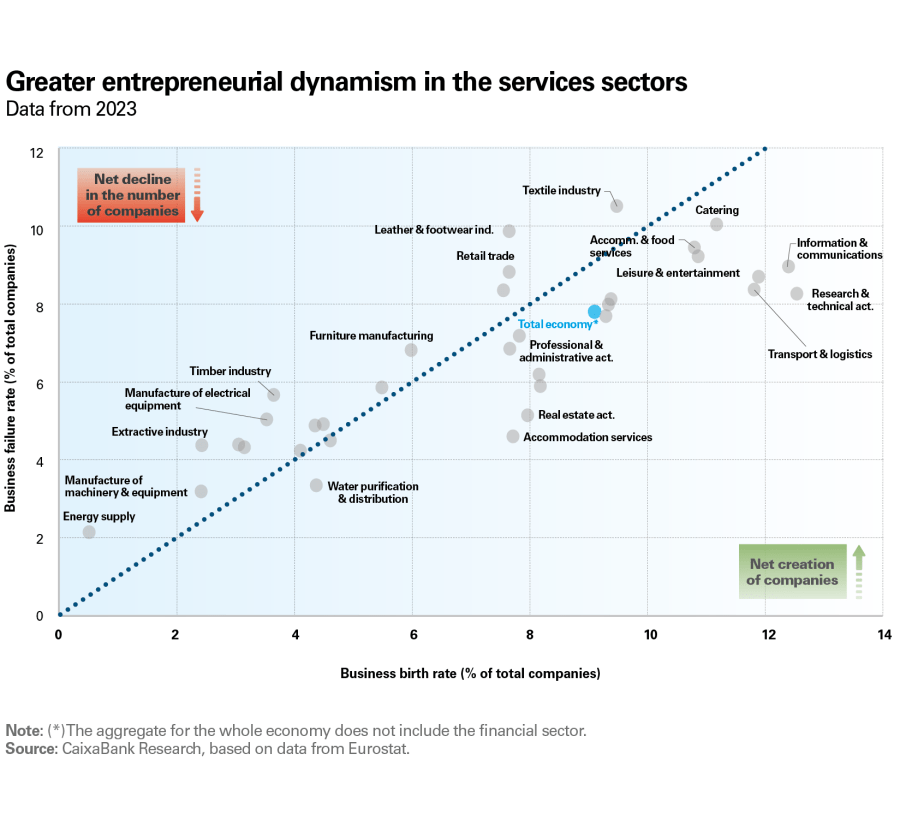
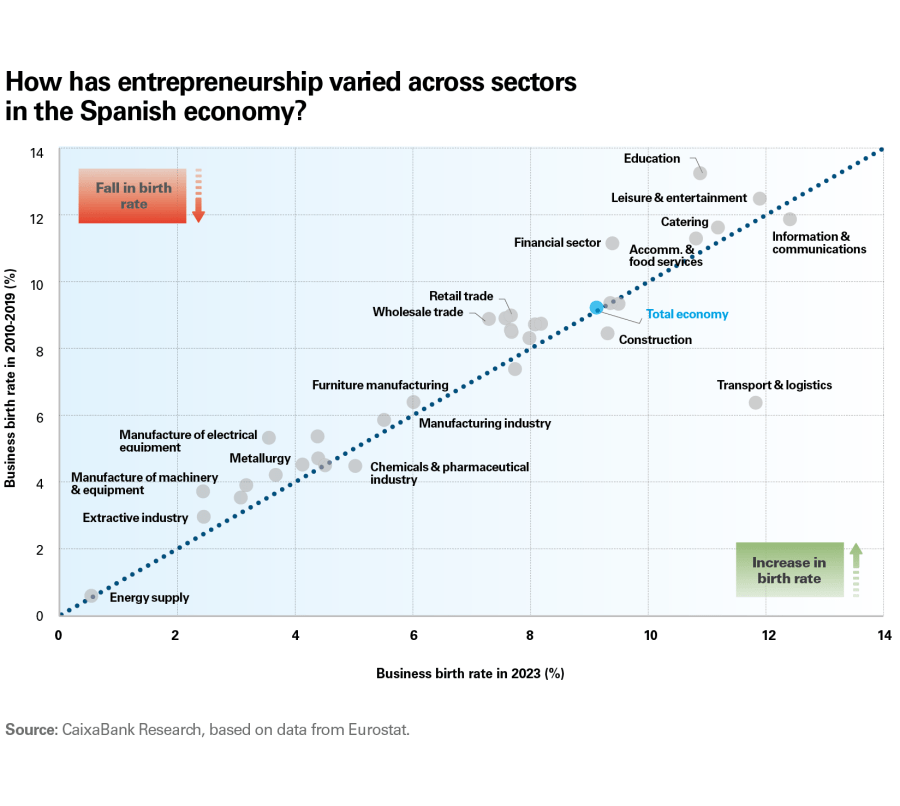
The manufacturing sectors, meanwhile, show modest business birth rates and in many cases a failure rate exceeding that of new entries. This implies a net contraction of the sector: i.e. more firms are closing down than are being created. This occurs especially in industries undergoing profound transformations (globalisation, technological change, new consumption habits, etc.) where the level of entrepreneurship is not sufficient to offset the departure of existing companies.
Spain in the European mirror: what position does Spanish entrepreneurship hold in Europe as a whole?
In comparison with Europe, Spain has lost some of its relative dynamism since the end of the last decade. While in the mid-2010s business birth rates were similar to – and occasionally even higher than – those of the EU, since 2019 the gap has once again become unfavourable. In 2023, the European rate (10.5%) exceeded that of Spain by more than 1 pp. However, entrepreneurship in Spain remains at levels comparable to those of other major European economies and above countries such as Germany or Italy.
The business birth rate remains below the EU average
The following chart provides a comparison of the business birth rate in Spain with that of the EU by economic sector. Most sectors lie to the left of the bisector, indicating that the lower entrepreneurial dynamism of the Spanish economy is widespread.
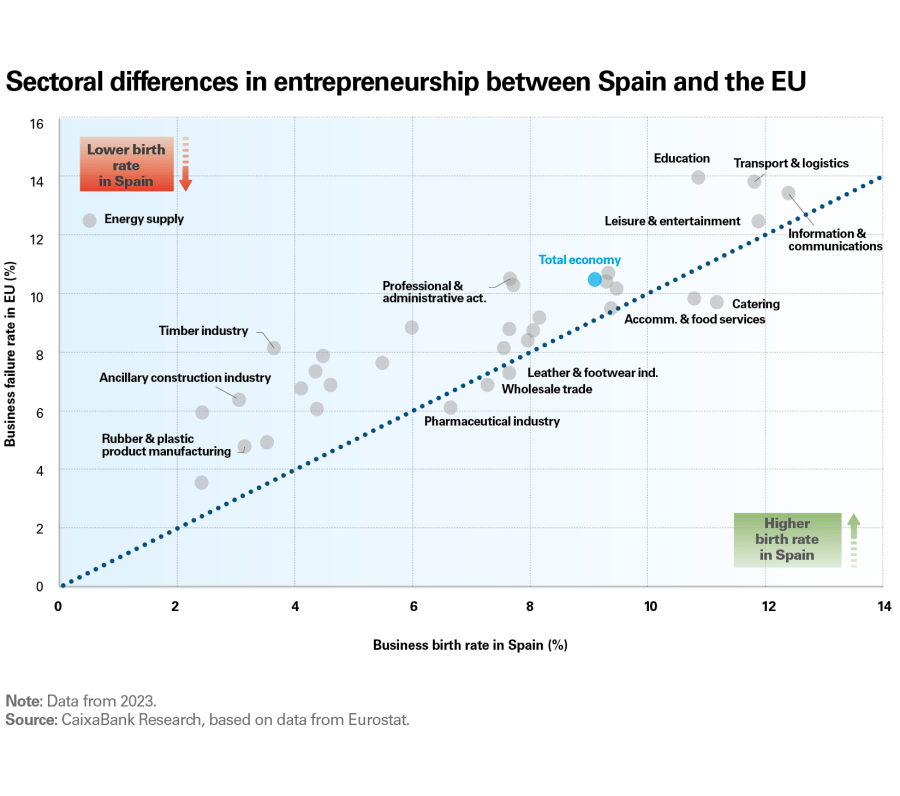
This gap is particularly pronounced in industrial sectors – such as manufacturing, chemicals, metallurgy, and the automotive sector – and in advanced services, such as professional and administrative activities. Also, sectors with high barriers to entry or that are highly regulated (such as energy, education, healthcare or the financial sector) show a very limited level of entrepreneurship in Spain compared to other countries, suggesting that the obstacles are more structural than circumstantial.18
On the contrary, Spain only outperforms the EU average in activities linked to consumption and tourism: for example, the catering and hospitality sectors show business creation rates above the European average, indicating particularly strong entrepreneurial momentum in these spheres. However, as already noted, this relative strength is accompanied by high business turnover: these are sectors in which many businesses are created but many also disappear. The underlying challenge, therefore, lies in transforming dynamism into consolidation and growth.
There are also some industrial niches where Spain shows greater entrepreneurial initiative than our neighbours (in cases such as the pharmaceutical industry or the textile and leather industry), as well as in wholesale trade.
- 18
The «energy supply» sector includes only companies whose main activity is the production or final sale of electricity, gas or heat. In several European countries, the energy transition has been accompanied by greater business fragmentation in the sector – with numerous small producers and marketers – while in Spain much of the entrepreneurial dynamism linked to energy is channelled through industrial and service activities, outside this category. Regarding the «education» sector, in Spain the provision of educational relies more heavily on the public sector and on well-established partly or fully private networks, with lower turnover and less creation of new companies. In several European countries, however, market education is structured through a greater number of small private entities.
The challenge of entrepreneurship: not only to create, but to survive and grow
The challenge of entrepreneurship does not end with business creation: that is where it begins. What is truly decisive is when projects survive, consolidate and grow. In this area, Spain faces a significant structural problem. According to the harmonised business demography statistics published by the National Statistics Institute (INE), only 78.5% of companies survive their first year, meaning that almost 1 in 5 closes within the first 12 months. At a five-year horizon, the survival rate falls below 44%.
This evidence underscores the need to redirect public policies: it is not enough merely to promote entrepreneurship in quantitative terms; rather, the key is improving survival in the early stages. The cumulative impact would be significant: more companies reaching maturity means more stable employment, greater innovative capacity and a more robust productive base.
Entrepreneurship is a strategic lever for Spain’s economic transformation. In a context marked by the digital transition, climate challenges and the urgency to boost productivity, having a robust, inclusive and resilient entrepreneurial ecosystem is more necessary than ever. Spain has talent, creativity, and a growing network of institutional and financial support, but these assets will only translate into sustainable growth if the structural barriers hindering projects’ consolidation are overcome.
Reducing administrative and regulatory obstacles is a key first step. Simplifying procedures, designing a tax system that does not penalise the growth of SMEs and more agile regulatory frameworks, especially in highly regulated sectors, would contribute to building a more favourable environment. In parallel, it is essential to strengthen the support available during the initial phases: advisory, management training, access to financing and connection with mentor and investor networks. Professionalising management from the outset and linking entrepreneurs with the business, academic, and technological ecosystem significantly increases the chances of survival and scaling up.
It is also essential to direct entrepreneurial dynamism towards sectors with higher value added, which are knowledge- and capital-intensive, such as technology, renewable energy, biotechnology and advanced services. Aligning entrepreneurship with major structural changes – digitalisation, sustainability and smart re-industrialisation – would multiply its long-term impact.
Ultimately, supporting entrepreneurship means supporting a more dynamic, innovative economy that generates high-quality employment. Spain has made progress, but consolidating a true entrepreneurial engine requires perseverance in reforms and support for business survival and growth.