From the weekday set menu to Saturday night: weekly consumption patterns in Spanish restaurants
Dining out in Spain shows a clear pattern of concentration towards the end of the week, with a higher average spend, suggesting an increasing trend towards more social and discretionary consumption, with seasonal variations.
Following the post-pandemic boom, Spain’s catering industry is entering a phase of more sustainable growth. Spending remains dynamic, driven by the tourism sector, albeit more moderate than in recent years. Beyond this pattern, in this article we focus on the sector’s marked seasonality. Specifically, leveraging the highly detailed card spending data recorded on CaixaBank POS terminals,1 we analyse the intra-weekly seasonality of catering spending, that is, how demand is distributed across the days of the week.
- 1
According to our internal data, 40.5% of the total turnover of the average Spanish restaurant is concentrated in just four months of the year (the high season from June to September), as we analysed in the article «The catering sector in Spain in 2024: what the data from millions of card payment transactions reveal» in the Tourism Sector Report S1 2025.
Most catering spending occurs between Friday and Sunday
Catering activity is concentrated in the last days of the week. In fact, this has been a fairly stable pattern in recent years (see first chart), although between 2021 and 2022 there was a slight increase in the relative weight from Friday to Sunday. This was probably linked to remote working and changes in office habits, which partially reduced consumption from Monday to Thursday. In any case, the effect was limited and has been gradually corrected since then. In 2025, just over 57% of weekly spending occurred between Friday and Sunday (just 0.7 pps more than in 2019), compared to just under 43% from Monday to Thursday.
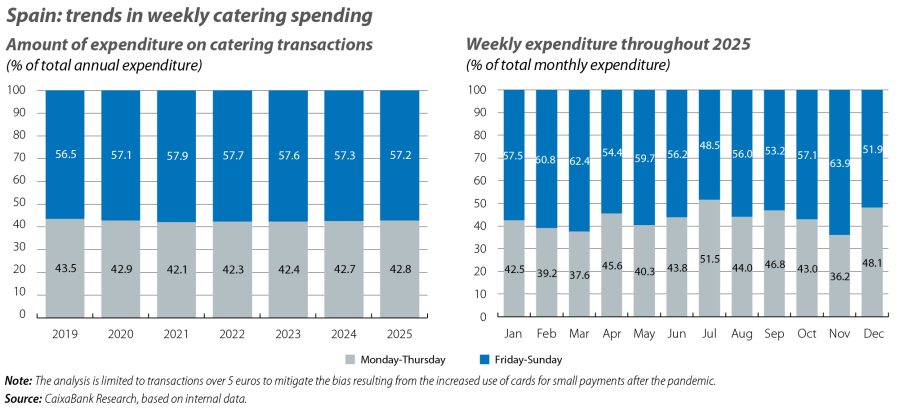
The relative importance of Friday to Sunday highlights a structural feature of the sector: catering spending is closely linked to leisure time. Indeed, this trend received a boost in the years immediately following the pandemic. The higher concentration of spending on Fridays and at weekends is largely due to a higher amount per transaction, although the greater number of transactions is also a contributing factor. Around 53% of transactions occur between Friday and Sunday, which is 4 points less than when we looked at the percentage of spending.
The key lies in the average transaction value: whereas from Monday to Thursday it is around 16.5 euros per transaction, in the last three days of the week it stands at around 23 euros, some 37% more.2 One possible interpretation of this gap is the different pricing structures and consumption formats during the working week versus Friday-Sunday: on weekdays, options such as the set menu of the day are more common, whereas they are less prevalent from Friday to Sunday.
It is worth asking whether this pattern is consistently reproduced throughout the year or if there is some seasonal variation. Broadly speaking (see second chart), it is observed that the proportion of spending from Monday to Thursday is relatively higher in months with more leisure activities and holidays, such as July, December, or April (Easter), which tends to smooth the difference between Monday-Thursday and Friday-Sunday.
- 2
These average transaction figures pertain to the year 2025, but this gap has remained very stable in recent years and the figures do not differ significantly from those of 2019.
In recent years, dinner has seen its share of total spending grow relative to lunch
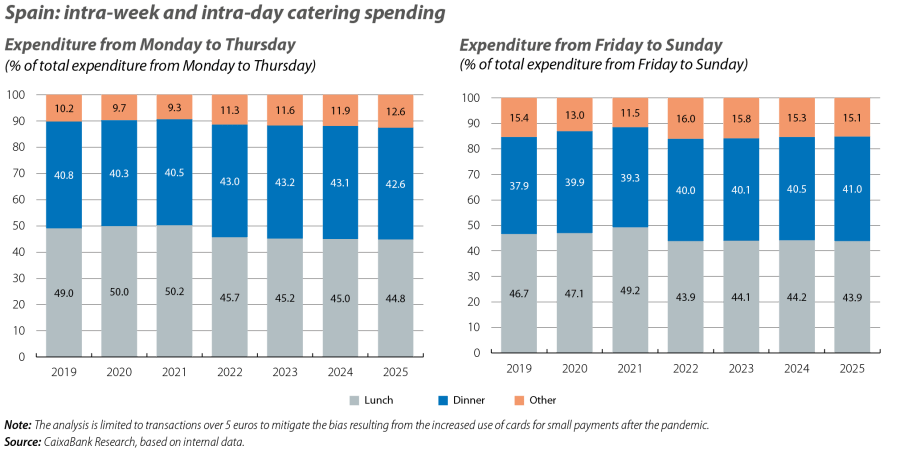
The trend in catering spending indicates a very gradual shift in daily consumption patterns: although lunch remains the main meal, dinner has been gaining relative importance over time, both from Monday to Thursday and, especially, from Friday to Sunday.
Between Monday and Thursday, dinner has gone from representing 40.8% of spending in 2019 to 42.6% in 2025, while lunch has decreased from 49.0% to 44.8%. A similar trend is observed from Friday to Sunday, where dinner has increased its share from 37.9% to 41.0%. The pandemic temporarily altered this pattern: in 2021, there was an increase in spending on lunch from Friday to Sunday (49.2% of expenditure, compared to 46.7% in 2019), probably linked to a recovery in consumption that was still affected by restrictions and was more concentrated during daytime hours. However, in the following years, the distribution of expenditure gradually shifts back towards dinner.
This trend indicates a shift in spending patterns in favour of leisure and social activities, particularly towards the end of the week. Although lunch still accounts for the majority of spending, the relative growth of dinner supports the idea that dining from Friday to Sunday increasingly relies on more discretionary consumption experiences with higher average spending.
Consumption patterns vary between provinces
Across all Spanish provinces, the percentage of spending on dining from Friday to Sunday exceeds that of the rest of the week. However, when analysing the distribution of this variable and comparing the pattern between Monday to Thursday and Friday to Sunday, notable differences emerge, as shown in the maps of the last chart.
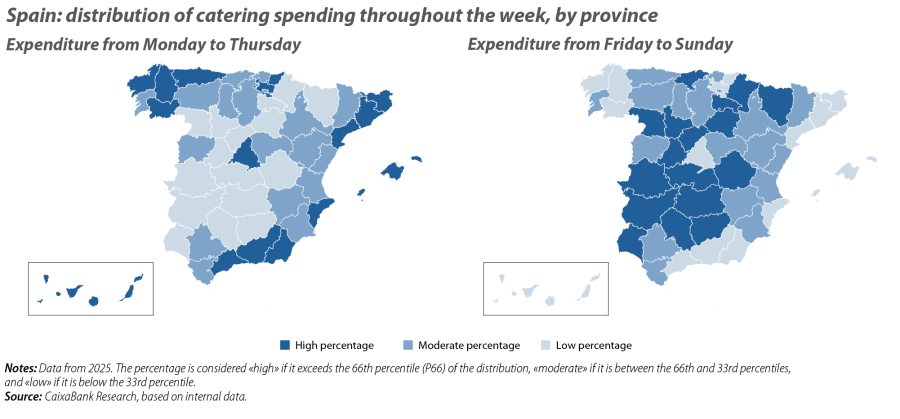
Spending during the working week tends to be relatively higher in provinces with greater economic and urban density, where the catering sector benefits from work-related activity and recurring consumption associated with daily life. In contrast, in much of Spain’s interior and in some western and southern provinces, spending from Friday to Sunday represents a relatively higher proportion of the total, reflecting a pattern more closely associated with leisure and socialising. Overall, this contrast indicates the coexistence of two geographical demand profiles: one that is more structural and sustained throughout the week, and another more concentrated and dependent on consumption towards the end of the week.
The Mediterranean arc and some tourist provinces deserve special mention, as they exhibit a more mixed pattern. Specifically, they combine a relatively high level of weekday spending with a significant presence of consumption from Friday to Sunday, which is consistent with a more diversified demand associated with foreign consumers.
The analysis of catering spending in Spain highlights the significant persistence of a pattern that is clearly concentrated from Friday to Sunday, when more than half of expenditure occurs, driven by a higher average transaction value and linked to leisure activities. However, this pattern shows some seasonality – with a higher relative weight of weekday consumption during festive periods or times of increased leisure activity – and geographical differences that reflect the coexistence of demand profiles that are more linked to daily economic activity versus those more oriented towards leisure. Additionally, there is a gradual shift in daily habits, with dinner gaining prominence slightly relative to lunch, particularly towards the end of the week, suggesting a growing trend towards more social and discretionary consumption experiences.
Real-Time Economics
Follow the evolution of the Spanish economy with our real-time indicators and our published articles.