Spain’s middle class in numbers: rising incomes, waning sense of progress
We take a snapshot of the incomes of what is considered to be the middle class in Spain in recent years, and we look at why we have the feeling that it is in retreat.
The middle class continues to expand as a share of Spain’s total population, according to the latest data from the National Statistics Institute’s Living Conditions Survey (LCS). In 2023, 61.5% of households belonged tothe middle class (+0.4 pps vs. 2022), 8.1% to the upper class (−0.7 pps) and 30.4% to the working class (+0.3 pps). In the same year, incomes increased for all economic classes, and for the middle and working classes in particular: the income of a middle-class household increased by 3.7% in real terms, that of a working-class household by 3.3% and that of an upper-class household by 1.3%. These findings challenge the common perception that the middle class is in retreat, so this article aims to offer a practical guide to interpreting the results: what do we mean by middle class? How many euros do households belonging to it earn? What differences do we observe according to the family structure?
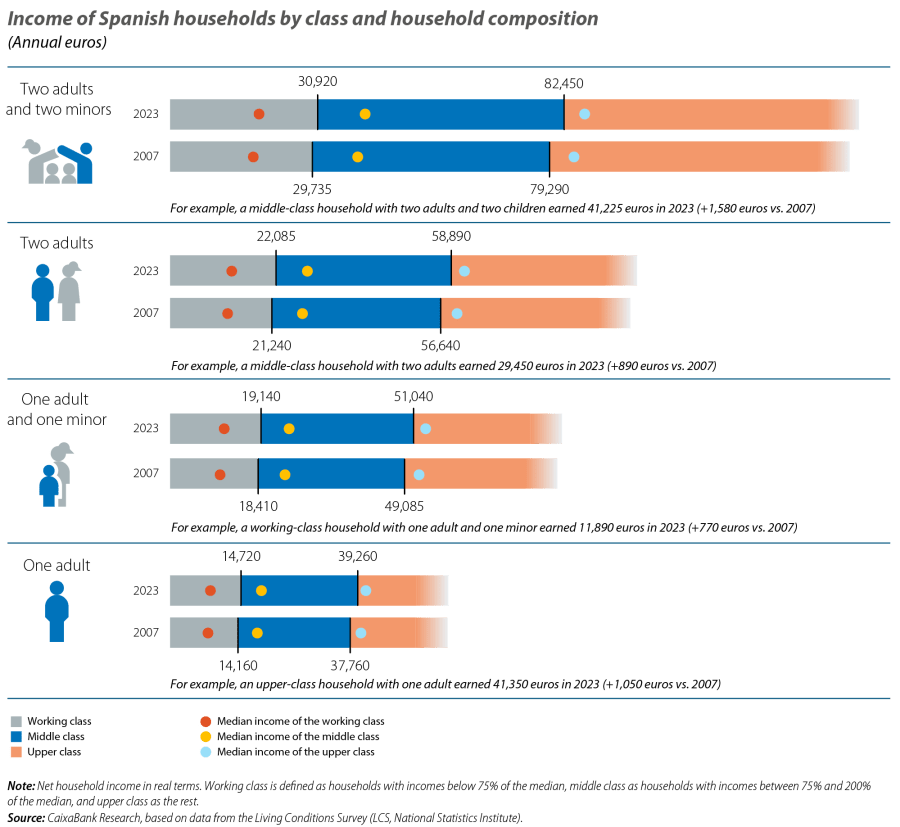
To analyse the middle class in Spain, we use the data from the LCS, which gathers economic and social information from households and their members, and we adopt the OECD definition, which considers middle-class households to be those with an income between 75% and 200% of the median income of the population.1 In order to compare households of different sizes and compositions, we adjust household incomes using the OECD equivalence scale, which allows us to calculate income per unit of consumption. This scale assigns a value of 1 to the first adult (over 14 years of age), 0.5 to additional adults and 0.3 to those under the age of 14. For example, a household with two adults and two minors is equivalent to 2.1 consumption units, while a household with one adult and one minor is equivalent to 1.3 units. Using the adjusted incomes per unit of consumption, the thresholds for each class are established (households with incomes below 75% of the median are considered to be working class, and those above 200% to be upper class) and households with different compositions can be compared.
The accompanying infographic allows us to identify which economic class each type of household belongs to according to its income and composition.2 For instance, according to the established thresholds, a household consisting of two adults and two minors would be classified as middle class if its income lies between 30,920 euros and 82,450 euros in 2023. On average, households in this class earned 41,225 euros, which is 1,480 euros more than in 2022 and 1,700 more than in 2019, but only 1,579 euros more than in 2007. This result shows how improvements in incomes in real terms are concentrated in these latter years, since between 2014 and 2019 households only managed to recover the sharp fall in incomes that was triggered by the financial crisis between 2008 and 2013.3 Thus, the cumulative progress over a period of more than 15 years is limited, having been affected by multiple crises (the financial crisis, the pandemic, inflation), which helps explain why the general sentiment does not reflect a perceived improvement in income levels. For example, the average annual improvement in real terms between 2007 and 2023 for a household of two adults and two children is less than 100 euros per year, which represents a very small improvement in living standards. On the upside, all households saw an improvement in their situation in 2023, which shows that the middle class is recovering economic capacity after years marked by multiple crises. If this pattern is consolidated, as the data for 2024 suggest, then we may be entering a period of more sustained progress – one that Spanish households might finally begin to feel.
- 1
See the article «How has the middle class evolved in Spain?» in the MR12/2024 for further details.
- 2
Net household income in real terms (2018 euros).
- 3
The income of a household with two adults and two minors decreased by 5,557.1 euros between 2007 and 2013, and recovered by 5,284.7 euros between 2013 and 2019.
Demographics
How does demographics affect economic growth, the reallocation of the model of production, the labour market and productivity?