Portugal maintains the economic momentum thanks to employment and investment
The Portuguese economy is showing remarkable resilience in 2025, driven mainly by a buoyant labour market and increasingly strong investment.
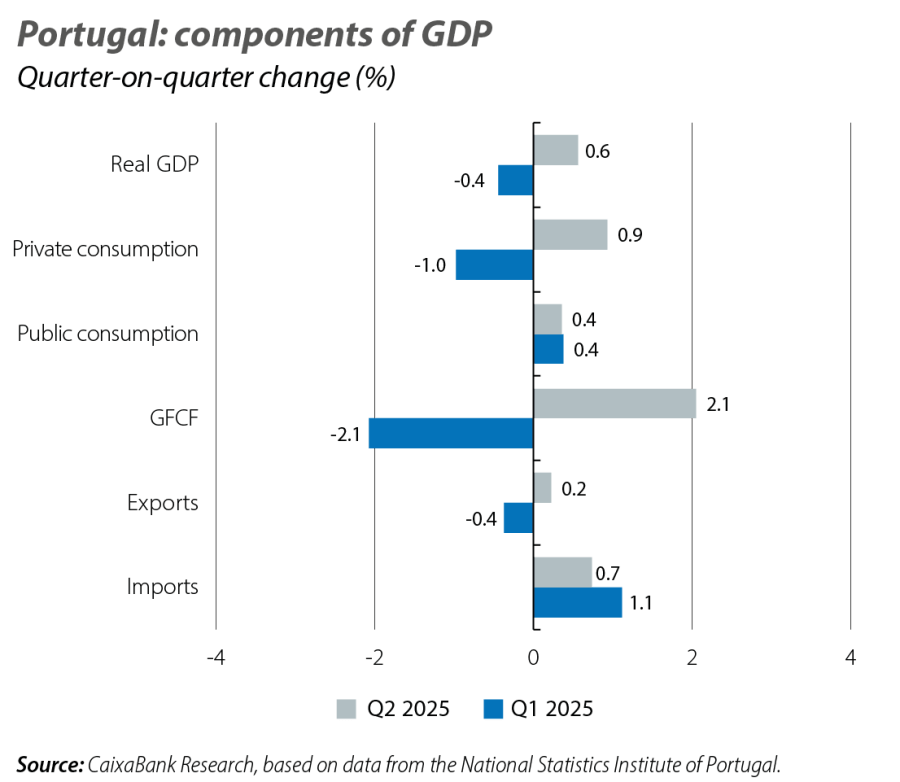
In Q2, GDP grew by 0.6% over the previous quarter, offsetting the 0.4% fall recorded in Q1 and recovering quarterly growth rates consistent with the average observed in recent years. Domestic demand was the main driver of this growth and contributed 0.8 pps to the quarter-on-quarter increase in GDP, with a particularly strong performance from investment, up 2.1% quarter-on-quarter. In contrast, foreign demand subtracted 0.2 pps, due to import growth (0.7% quarter-on-quarter) exceeding that of exports (0.2% quarter-on-quarter).
Q3 is expected to bring robust results, driven by private consumption
Q3 is expected to bring robust results, driven by private consumption and favoured by lower income tax rates, retroactive payments and exceptional payments to pensioners. These measures represent a 900-million-euro increase in household income, equivalent to 0.3% of nominal GDP. However, we could see a correction in Q4, similar to that recorded between Q4 2024 and Q1 2025, when household income normalises.
Inflation picked up again in August and stood at 2.8%
Inflation picked up again in August and stood at 2.8%, 0.2 pps above the previous month. Core inflation remained stable at 2.5%. However, unprocessed foods rebounded 0.9 pps to 7.0%, due to rising prices in products such as coffee and beef, as well as due to wage increases in the agricultural sector. In addition, persistent inflation in services, above 4%, is contributing to the rigidity of the core index.

The labour market continues to exceed expectations
In Q2, employment reached a new peak since 2011, with a year-on-year growth rate of 2.9%, the highest of any Q2 since 2017 (excluding during the pandemic). Manufacturing, consulting, scientific and technical activities, as well as accommodation and catering were responsible for more than 65% of the increase. The unemployment rate fell to 5.9%, the lowest on record (except for during the pandemic).

House prices continue to rise
The residential price index closed the first half with a year-on-year increase of 14.9%, while bank valuations reached 1,945 euros/m² in July, 18.7% more than the previous year. Sales remain high, although it is expected that they will stabilise and that price growth will moderate.
The current account balance to June has accumulated a surplus of 577 million euros
The current account balance to June has accumulated a surplus of 577 million euros, albeit with a sharp fall of 80% compared to the same period in 2024, due to the deterioration in the balance of trade in goods. However, the increased surplus in the balance of trade in services (+5.8%), especially in tourism, partially offsets the deterioration in the balance of goods.